The Bijagós Islands are an archipelago off the coast of Guinea-Bissau, in West Africa. On September 19 and 20, 2026, we visited two of them, Caravela and Carache, and watched a high-octane dance performance in a village courtyard. The people may not have much materially. They are warm, open, and proud of their culture, and for two days they let us see it up close.
We arrived by boat from the ship to white-sand beaches, pristine turquoise water, and a forest that runs right to the shore. We walked inland through the trees to reach the villages. On the other side awaited one of the most authentic village experiences we have had across 150+ countries.
How do you reach the Bijagós villages?
We cleared immigration for Guinea-Bissau early in the morning at Maio Island. It was overcast and raining. From the ship’s balcony, I felt a breeze that wasn’t cold like the polar regions or hot like the days before. It was just right. The ocean looked choppy to me, but the crew called it calm. I guess it’s all relative.
The night before, heard a talk from Sonia. She and her husband, a Portuguese couple, adopted Bijagós through an induction ceremony. They run a lodge and lead island tours in English and Portuguese.
After lunch, we took Zodiacs to Caravela’s white-sand beaches. It had rained all morning, and the forest looked freshly washed. The temperature had dropped to a pleasant 75F.
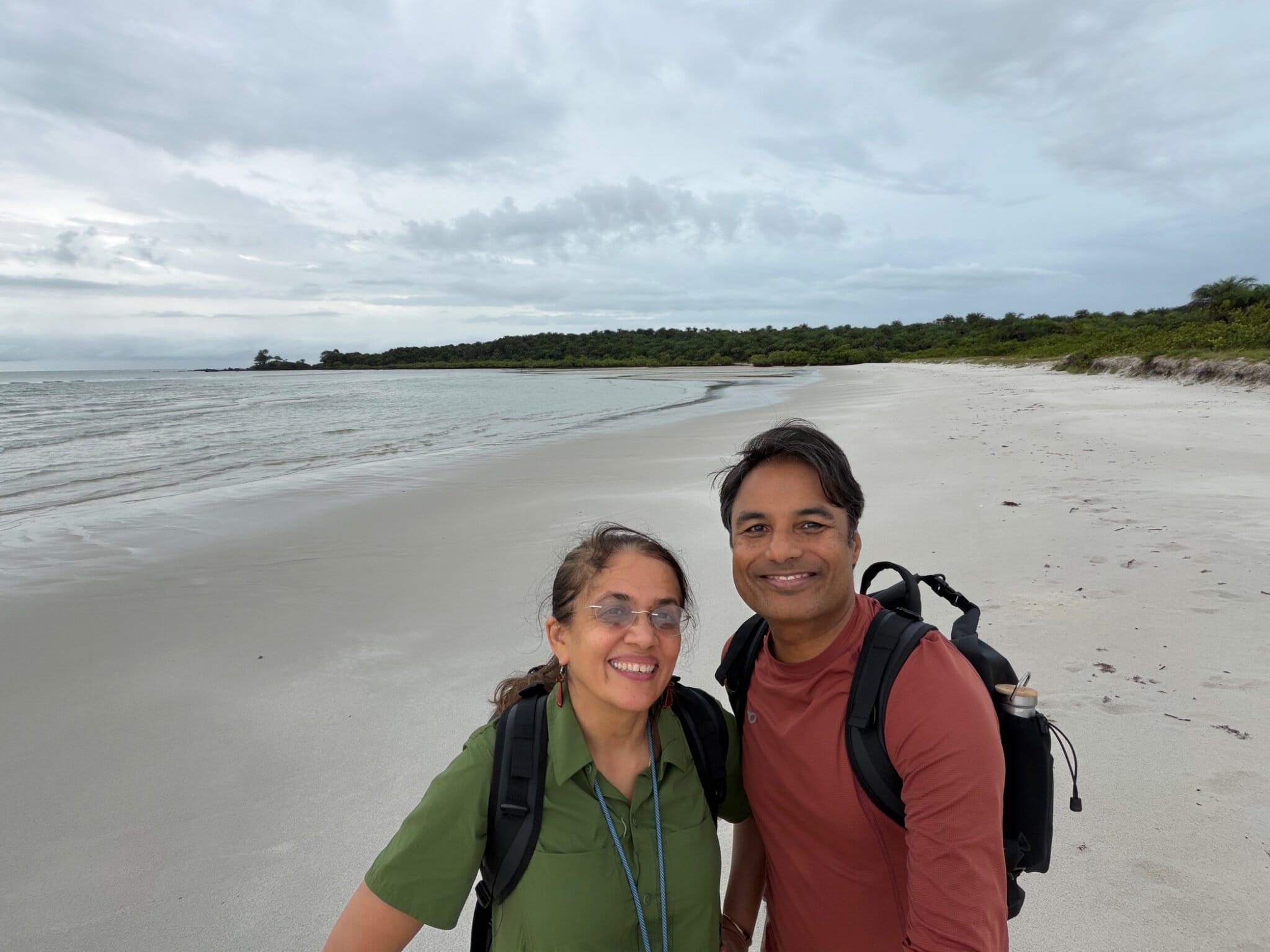
We opened our umbrellas against the drizzle and walked in single file on a narrow trail. The wet sand under the trees made for soft footing.
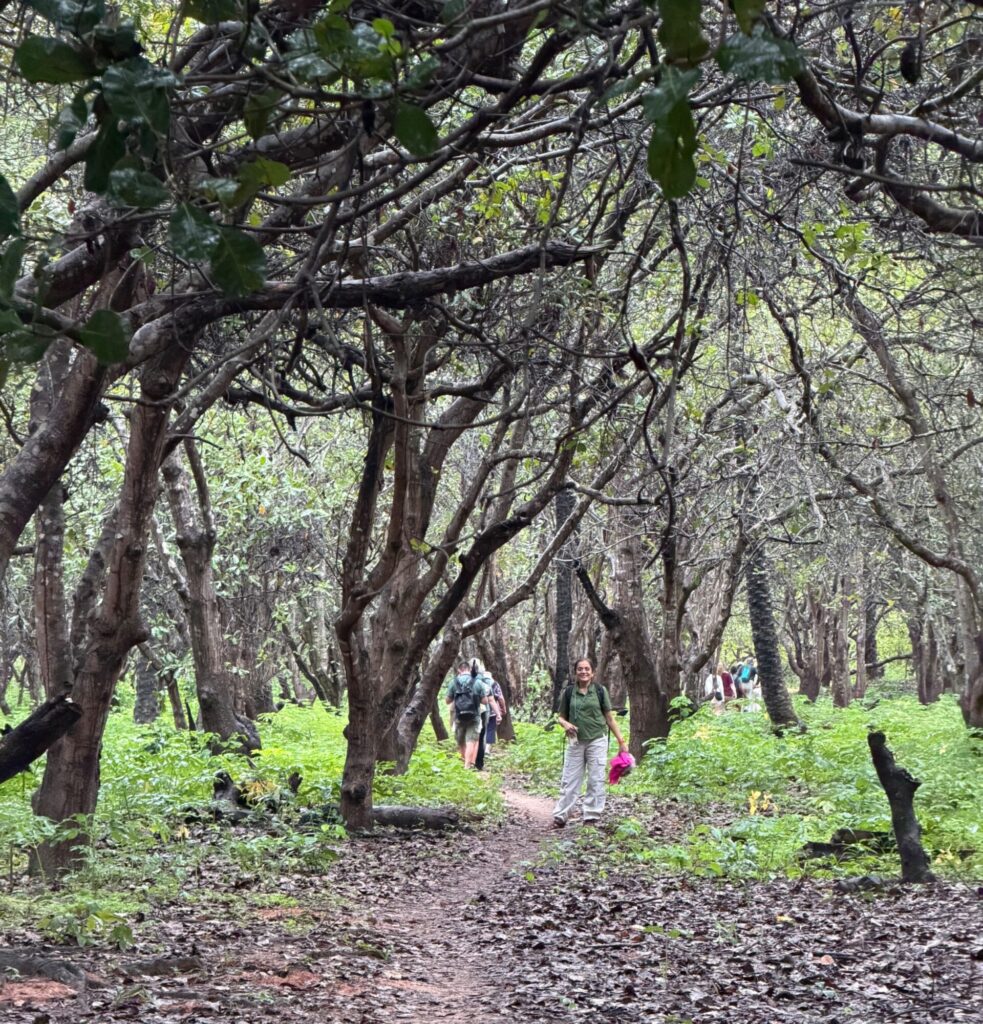
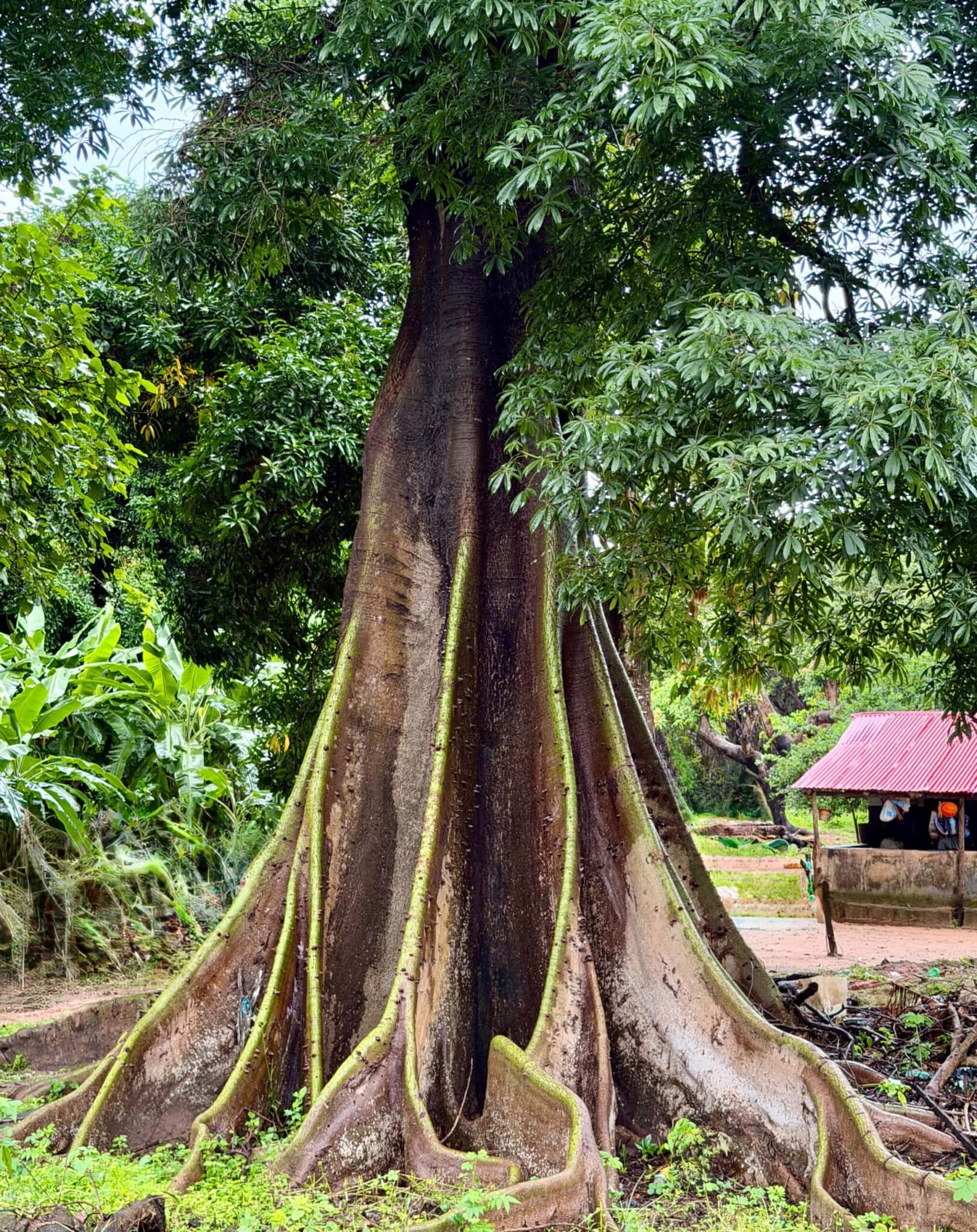
Tall trees, cashew farms and ferns as tall as trees lined the trail. Some of the trees were enormous and ancient. Every layer of the forest was crowded with plants.
What does a Bijagós village look like?
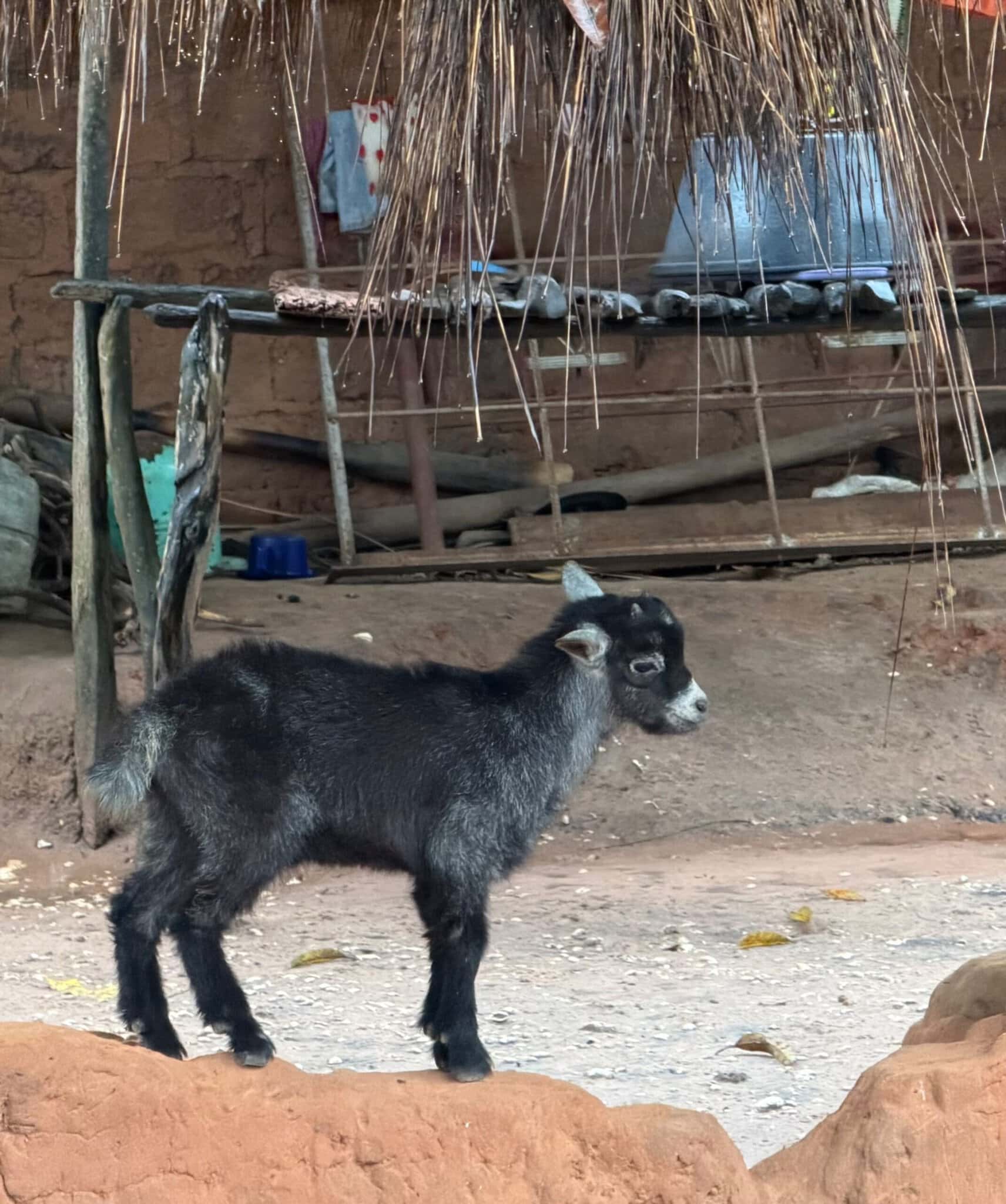
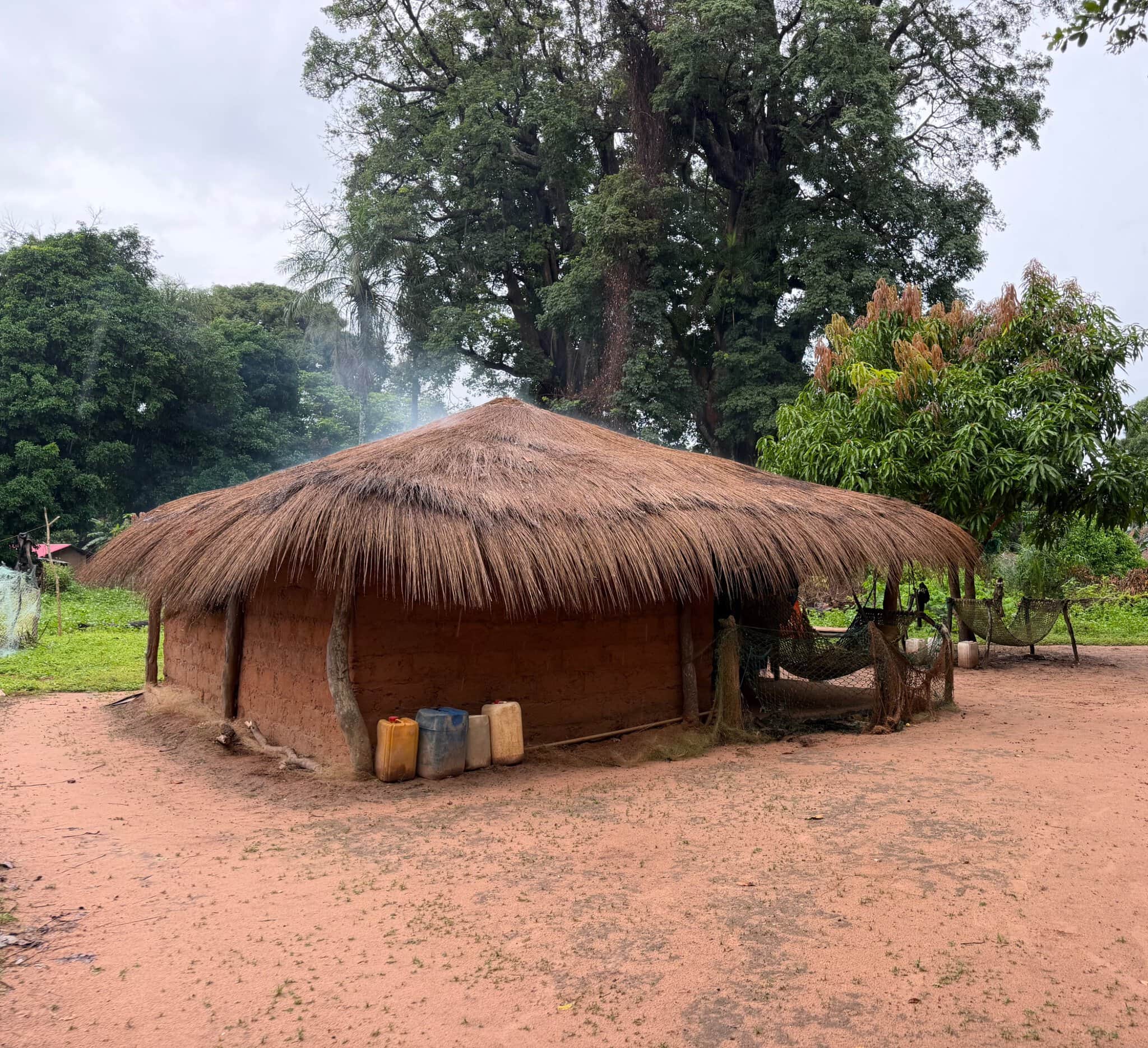
After about 2 km of flat walking, we saw a cluster of thatched huts. Baby goats greeted us first, followed by excited children. We heard the rhythmic drums of the Bijagós that grew louder as we approached.
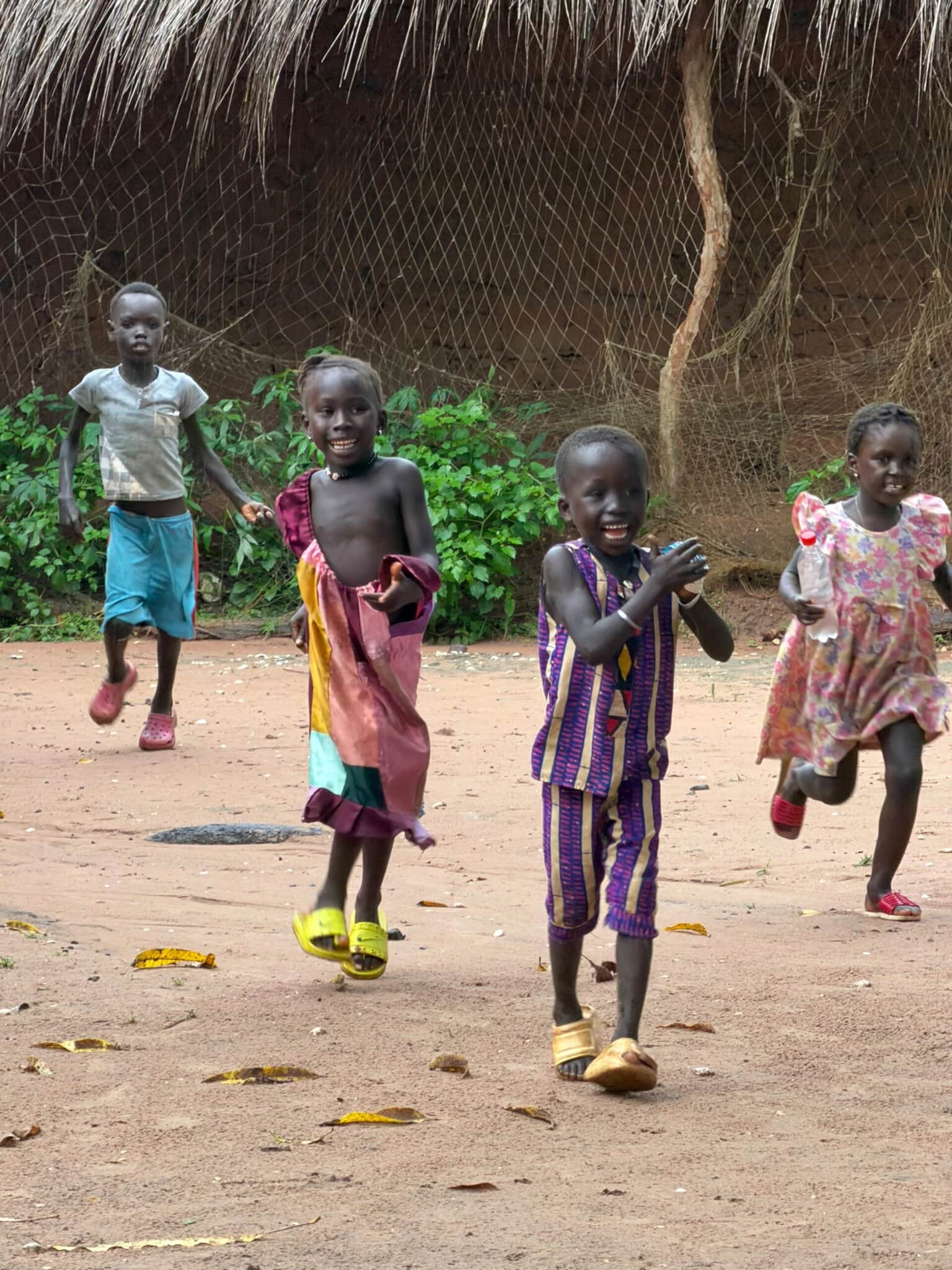
Young children with large, curious eyes came next. One child, about 3 or 4 years old, walked up to me and shook my hand. He held on to my finger as we walked around his village. The clean, healthy pigs ignored us completely as they walked freely outside the village.
What happens at a Bijagós village dance?
Sonia, the amazing local guide, stepped out from a cluster of huts, where an earlier performance was wrapping up. She led us to the center courtyard of the next cluster. Fresh hay hung from the thatched roofs around it. Chairs and hay mats sat in the shade of the eaves, on raised ground, so every visitor had a comfortable seat.
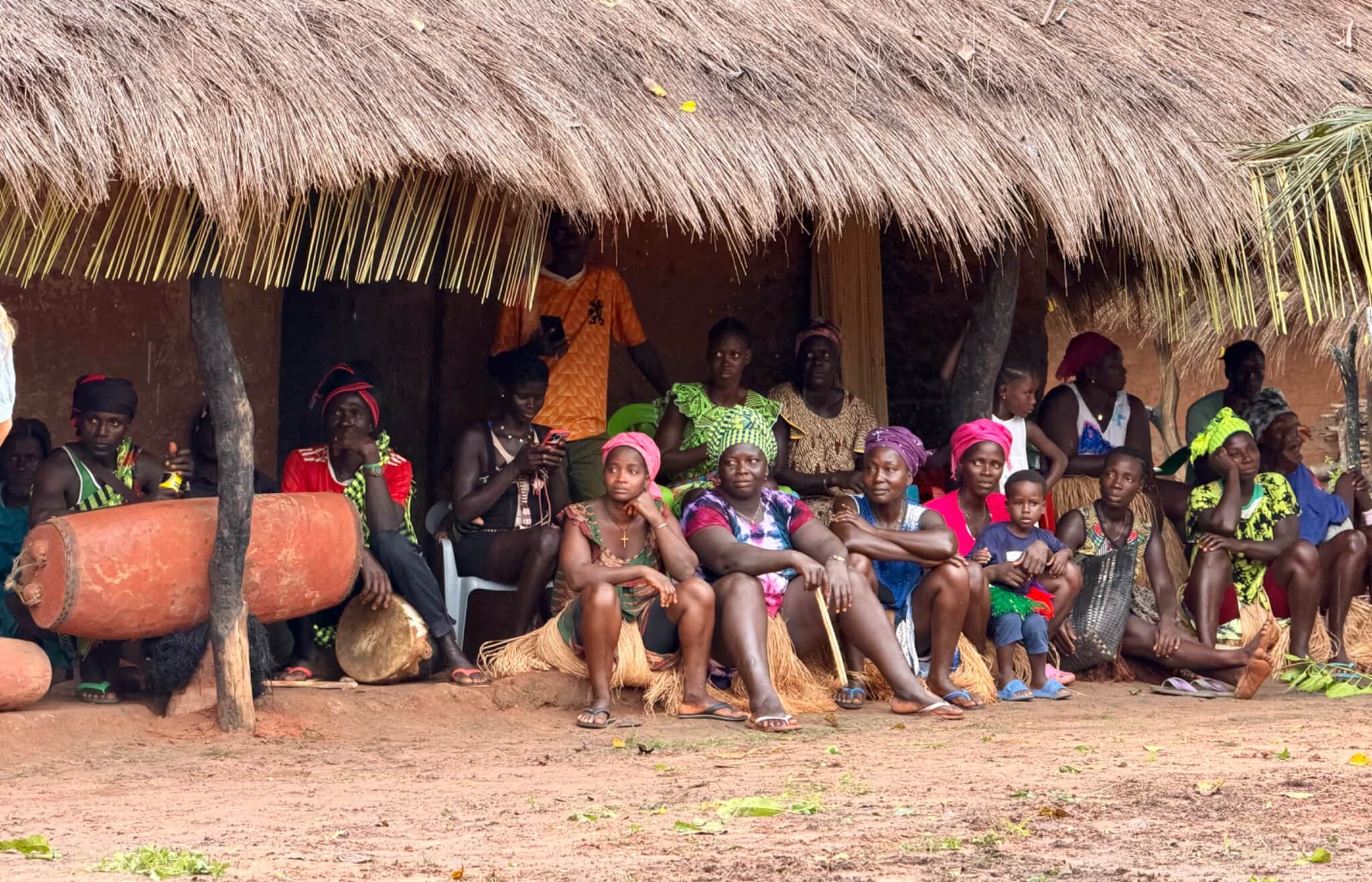
The commotion built slowly. Village children, adults, and chickens streamed in to watch. Dancers, drummers, and organizers looked busy. A woman sat behind me with a baby in her lap, enthusiastically yelling out instructions. Sonia introduced her as the village “queen”. That must mean a lot considering they have a matrilineal society.
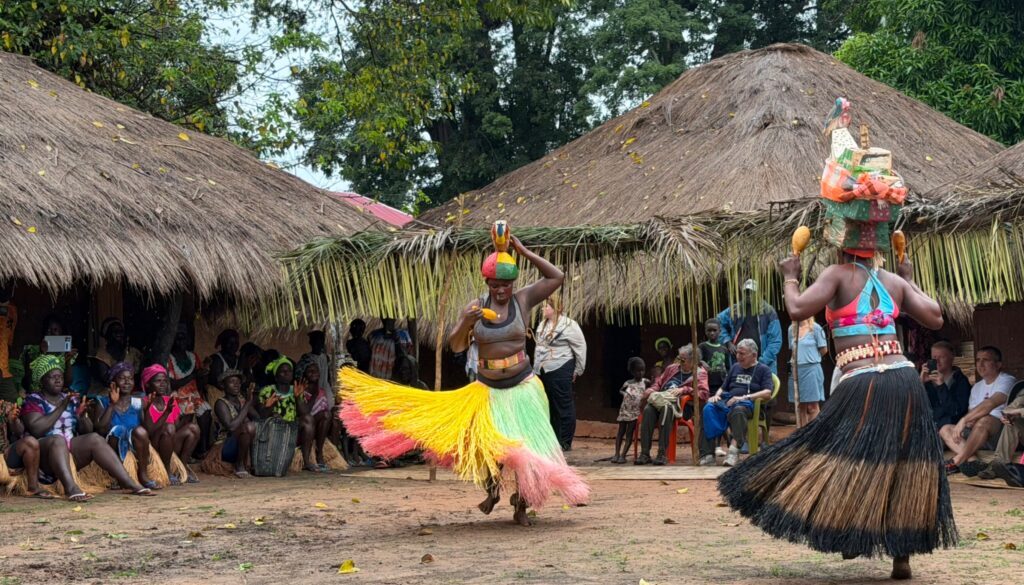
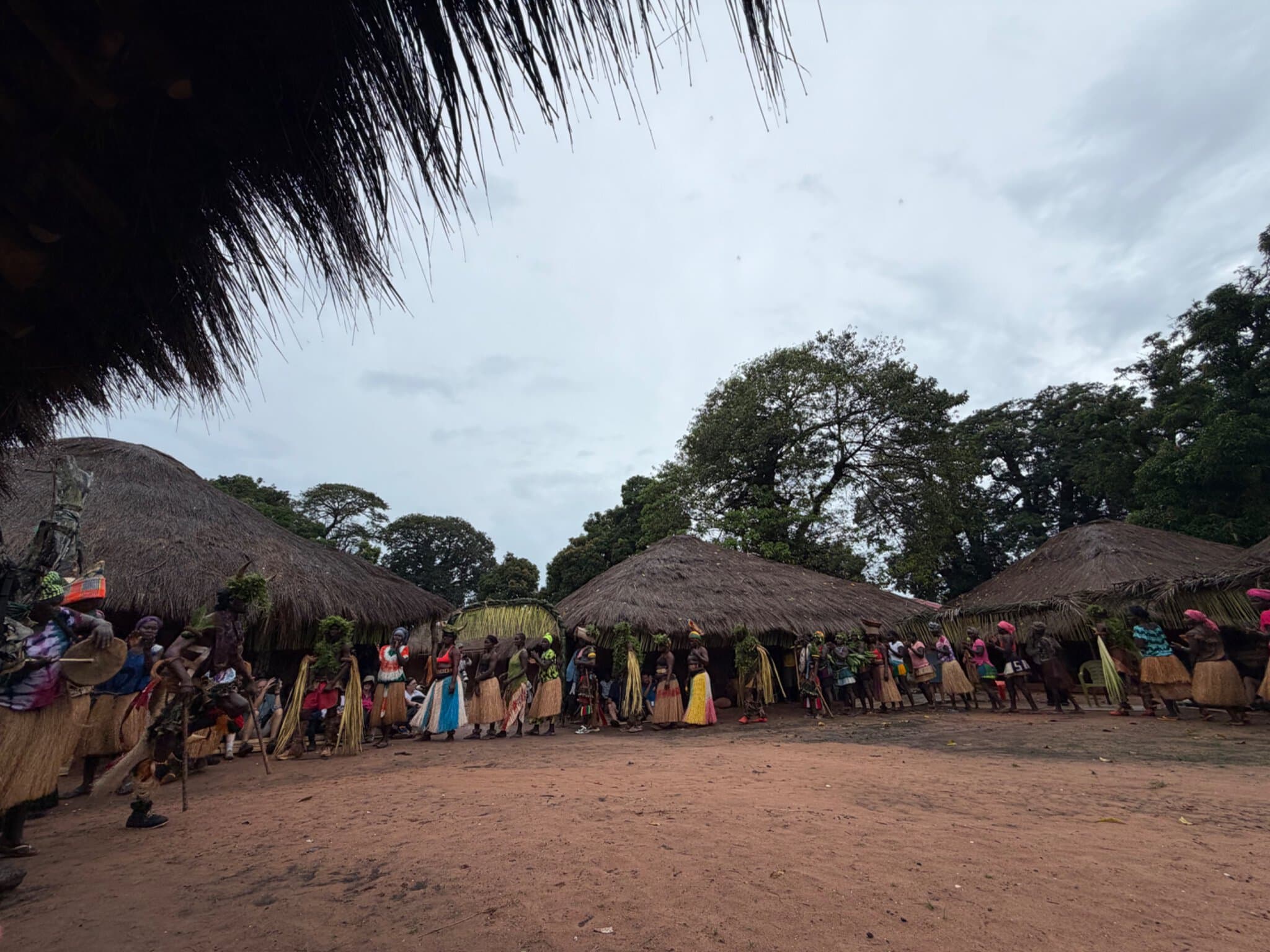
Soon, the drums started, and the dancers swayed into the courtyard in single file. The crowd erupted. People clapped to the rhythm and cheered in Bijagó words we couldn’t understand. The dancers fed off the crowd’s energy. The crowd fed off the dancers. The cycle of excitement kept growing.
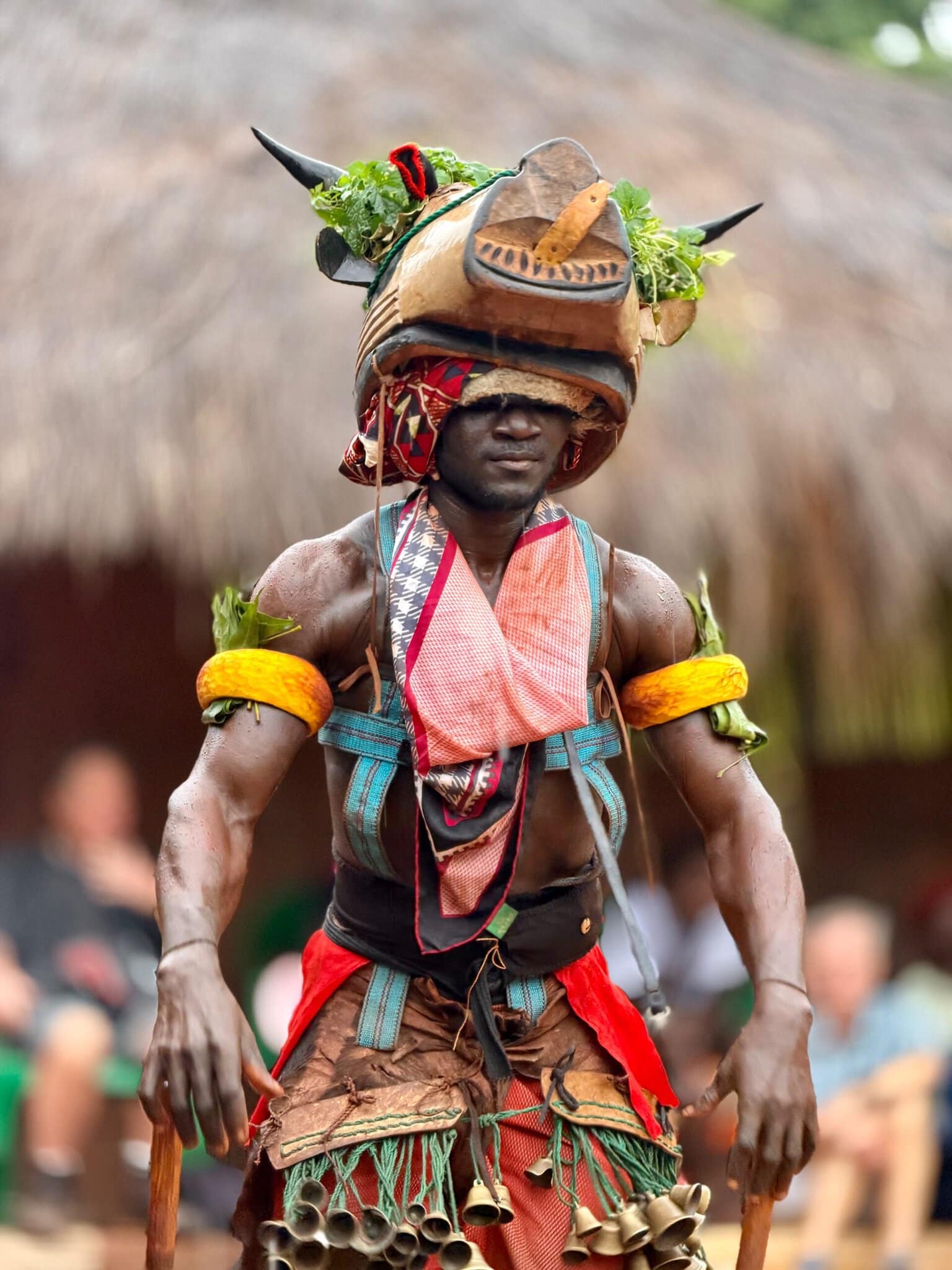
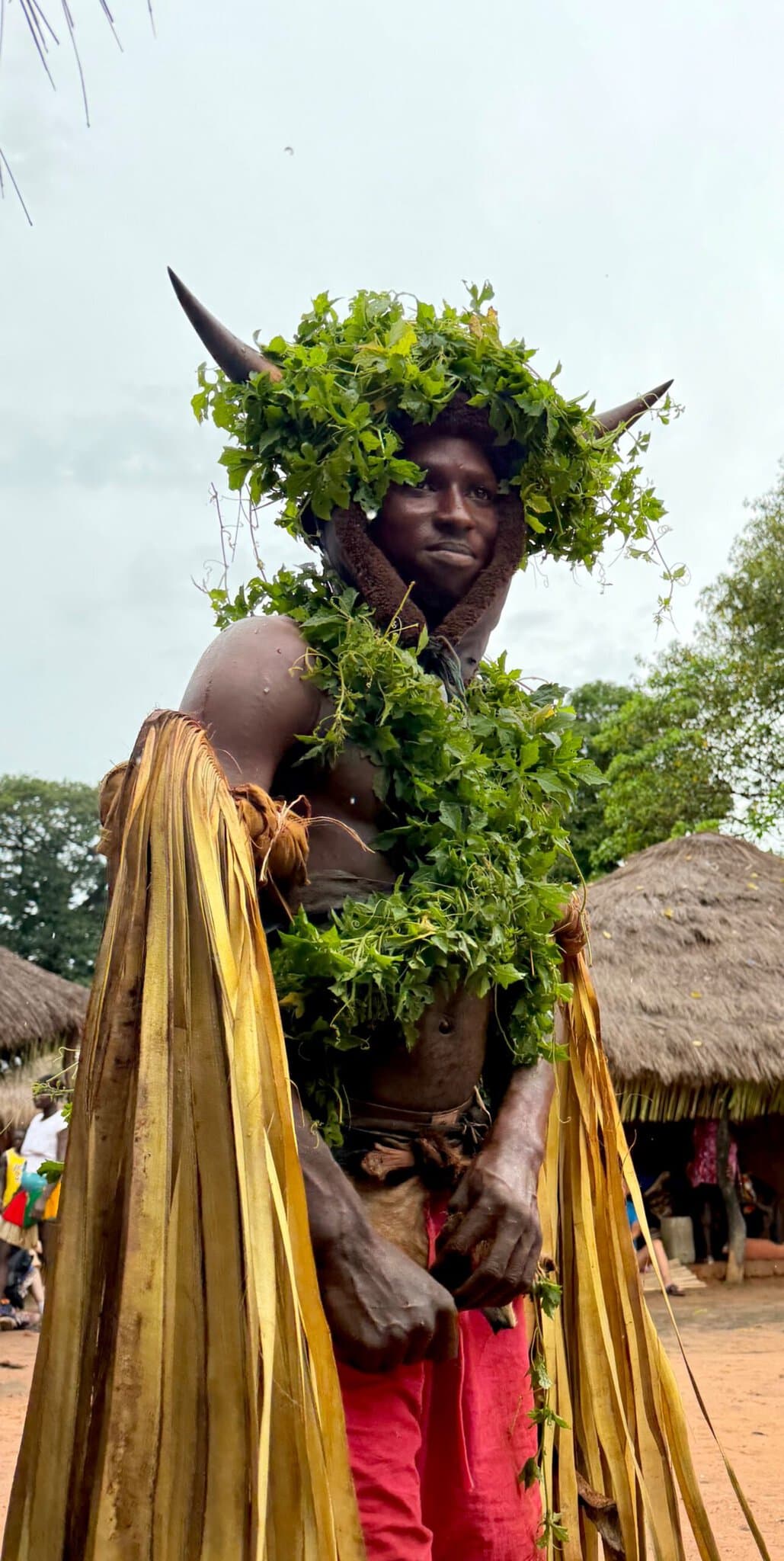
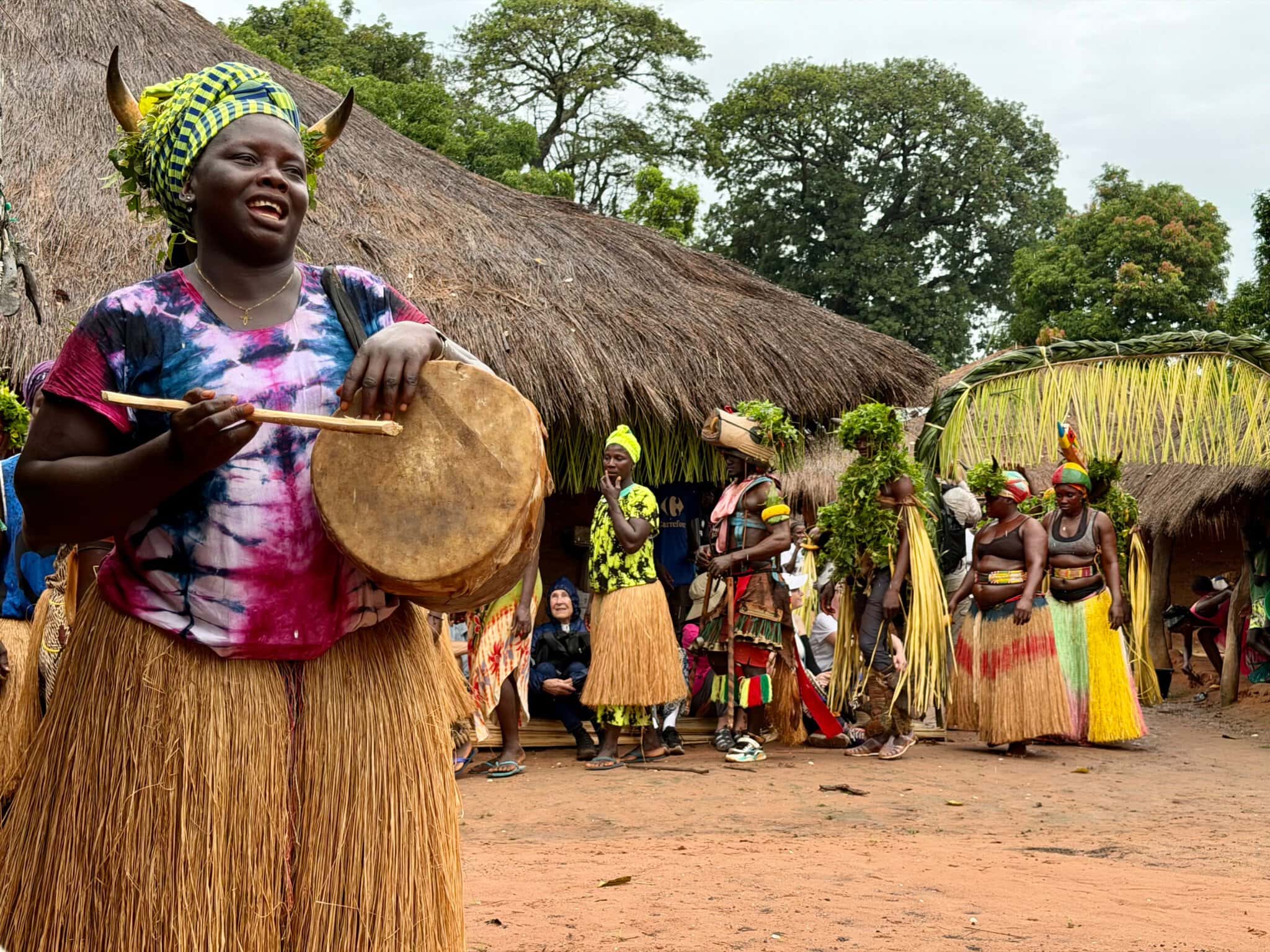
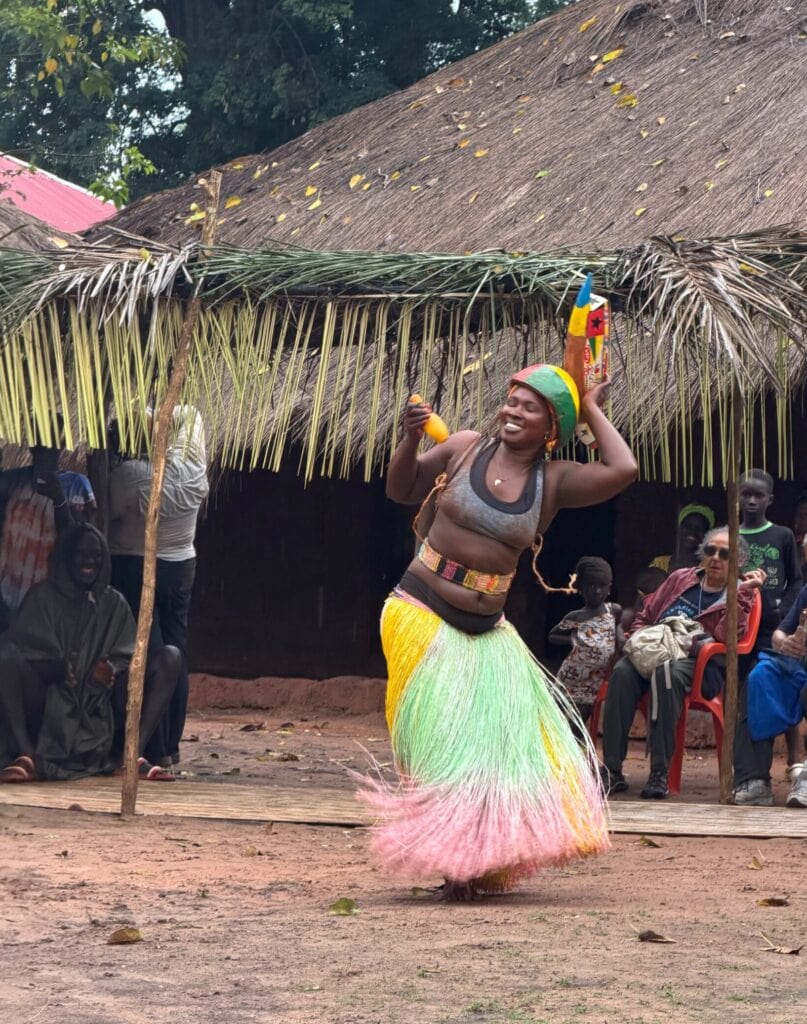
The villagers performed a high-energy ritual dance known as the Kunde (or Nianbe). It did not feel like a show staged for tourists. The dancers wore carved masks, including a bull mask, along with animal headpieces and woven fiber skirts. The masks and headgear have significant meaning in African tribes. The thunderous drums and the intense movement were electrifying.
Women sang, played hand drums, and danced freely beside the men. Its a clear display of equal right and status in society.
The most advanced dancers stomped their feet and struck their sticks to the fastest drumbeats.
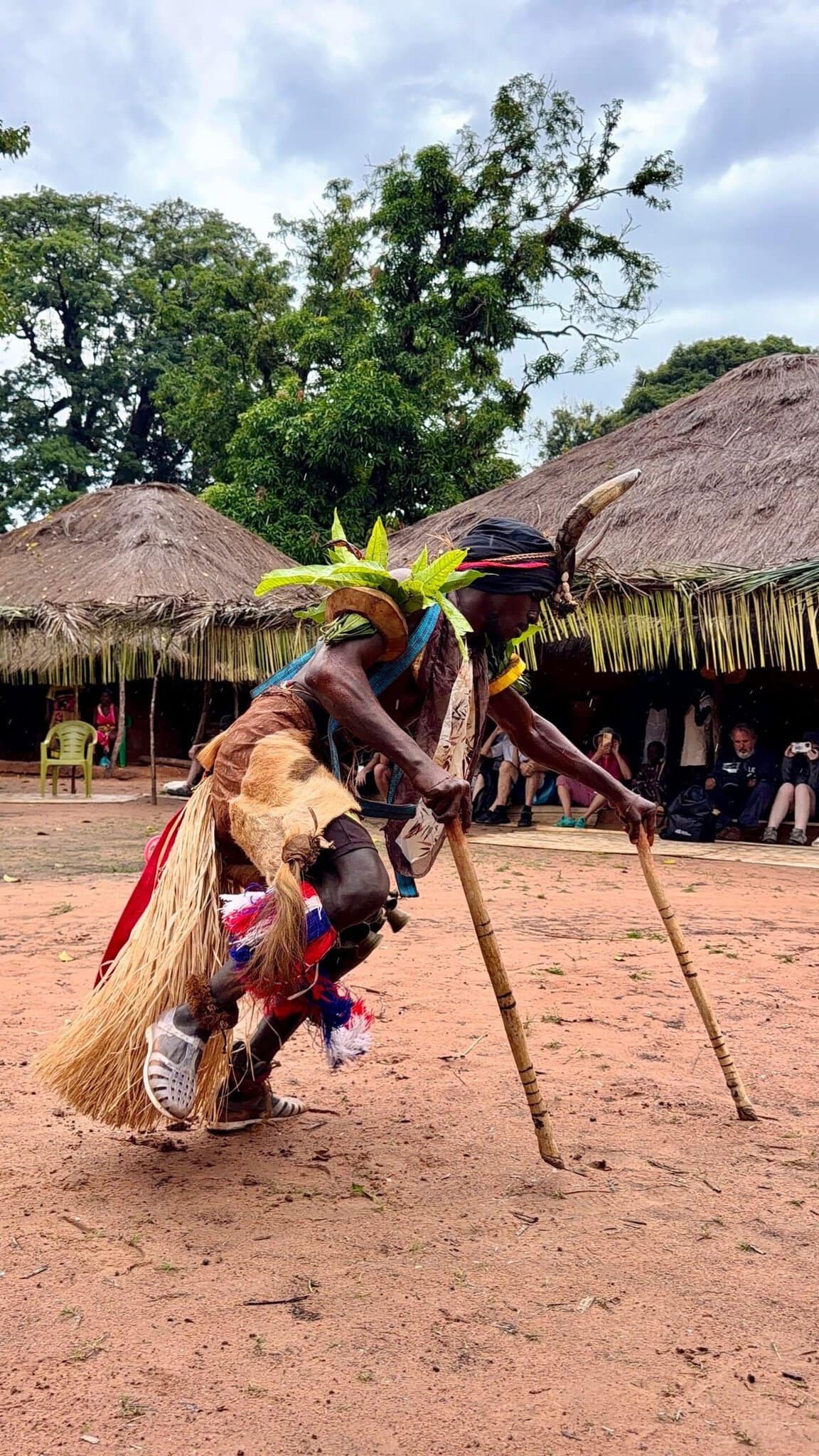
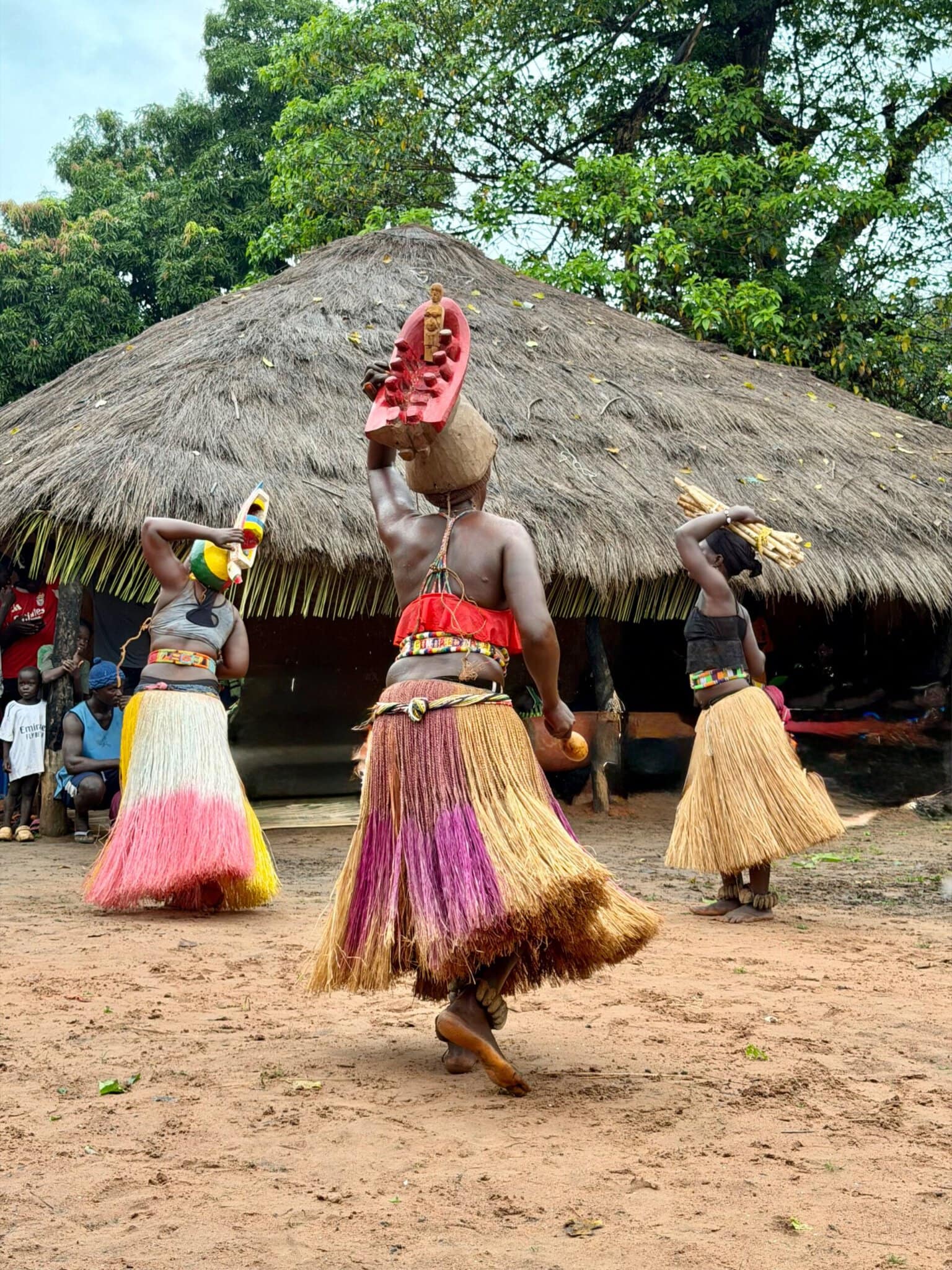
The costumes changed from one dancer to the next. Some wore crowns and collars of fresh leaves, curved horns and capes of dried palm fiber. Others wore carved bull masks with leaves tucked around the horns, yellow armbands, and skirts hung with small brass bells. Many women wore long raffia skirts in yellow, pink, green, and black.
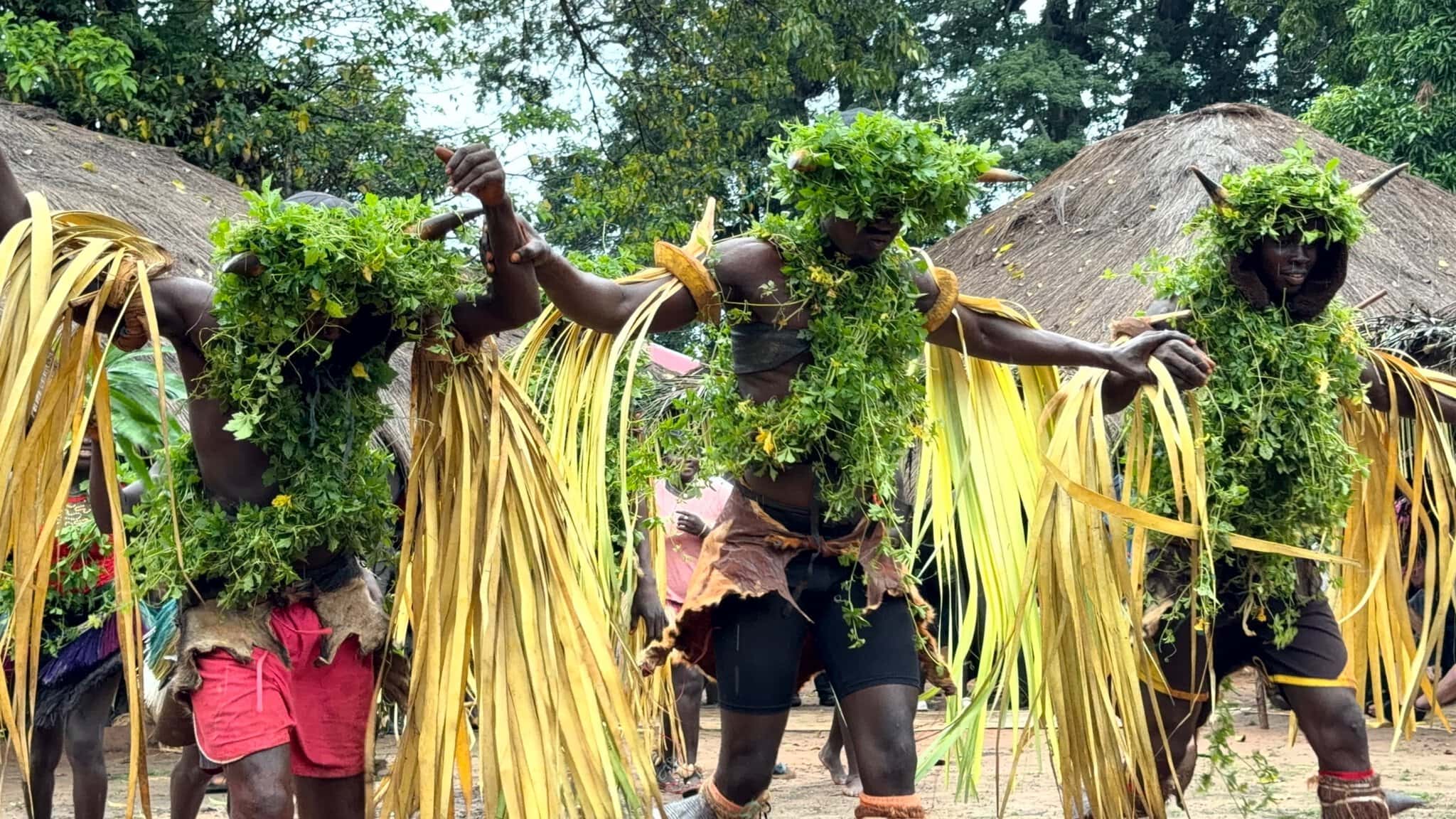
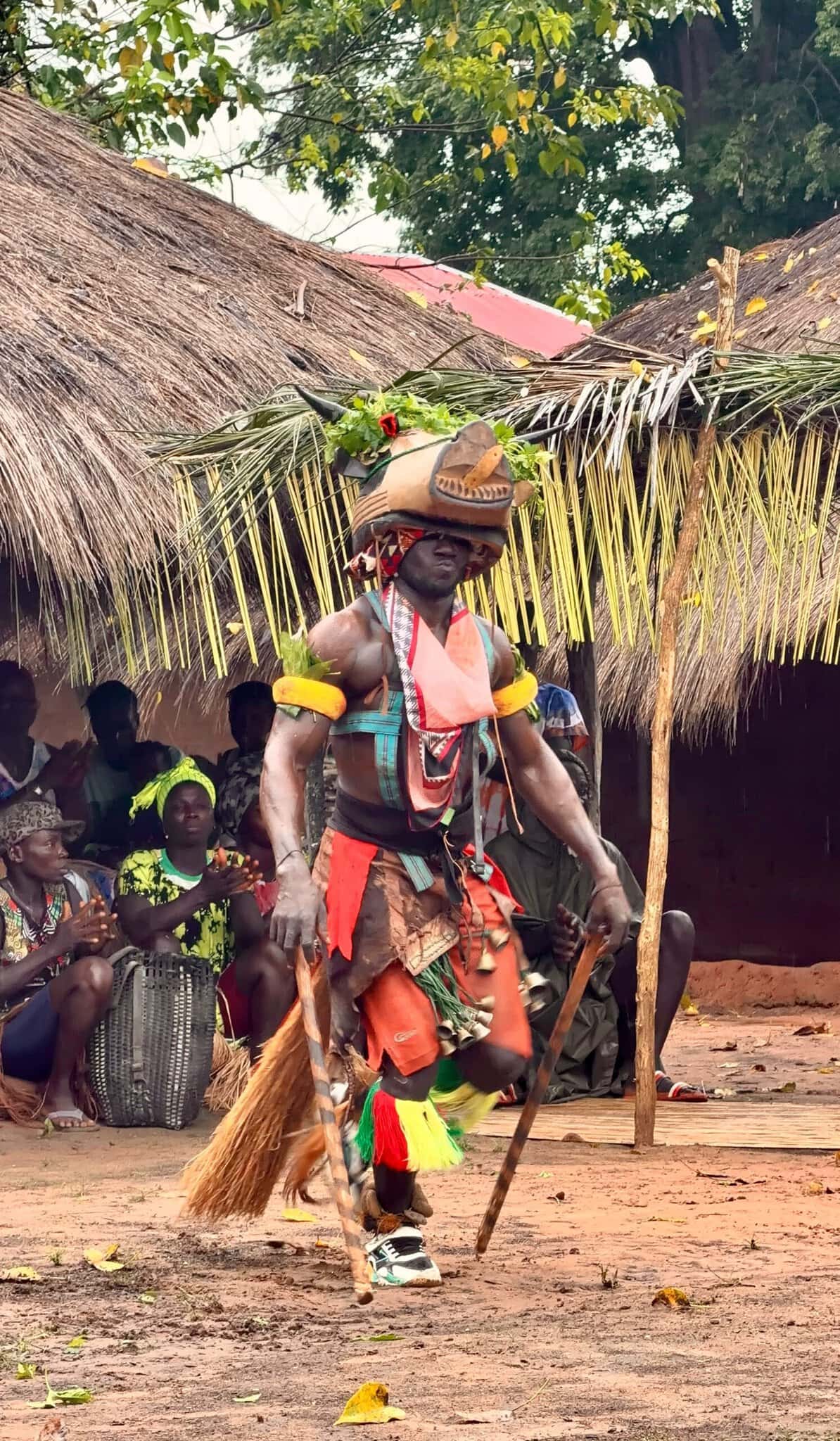
The bull mask belongs to a wider Bijagós tradition. The Brooklyn Museum describes Bijagós ox masks as part of young men’s initiation ceremonies. Wikipedia says the coming-of-age masks also depict sharks and stingrays. The bull masks we saw fit that tradition.
One dancer balanced a painted wooden boat on her head and shook two gourd rattles. She smiled through the whole dance.
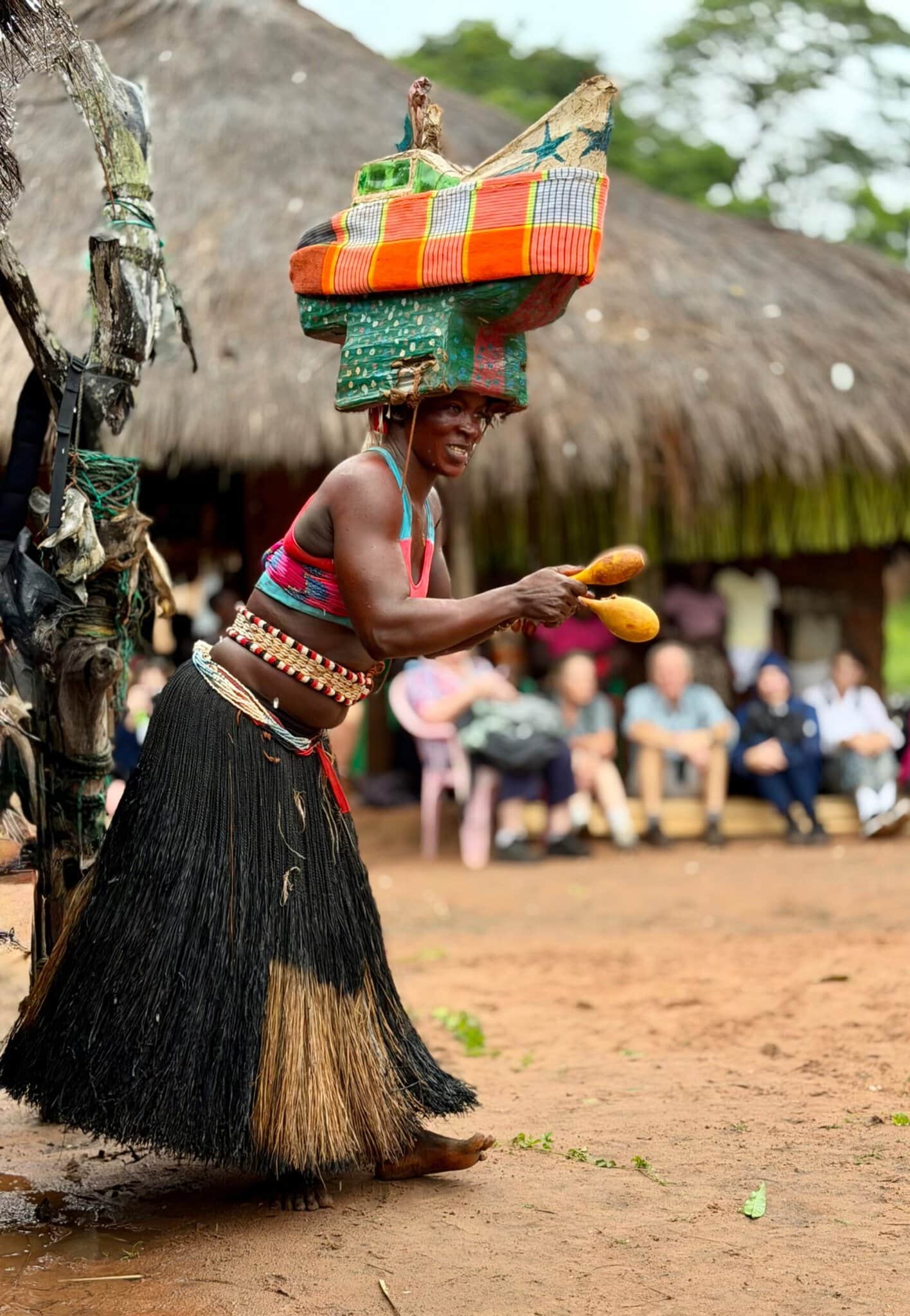
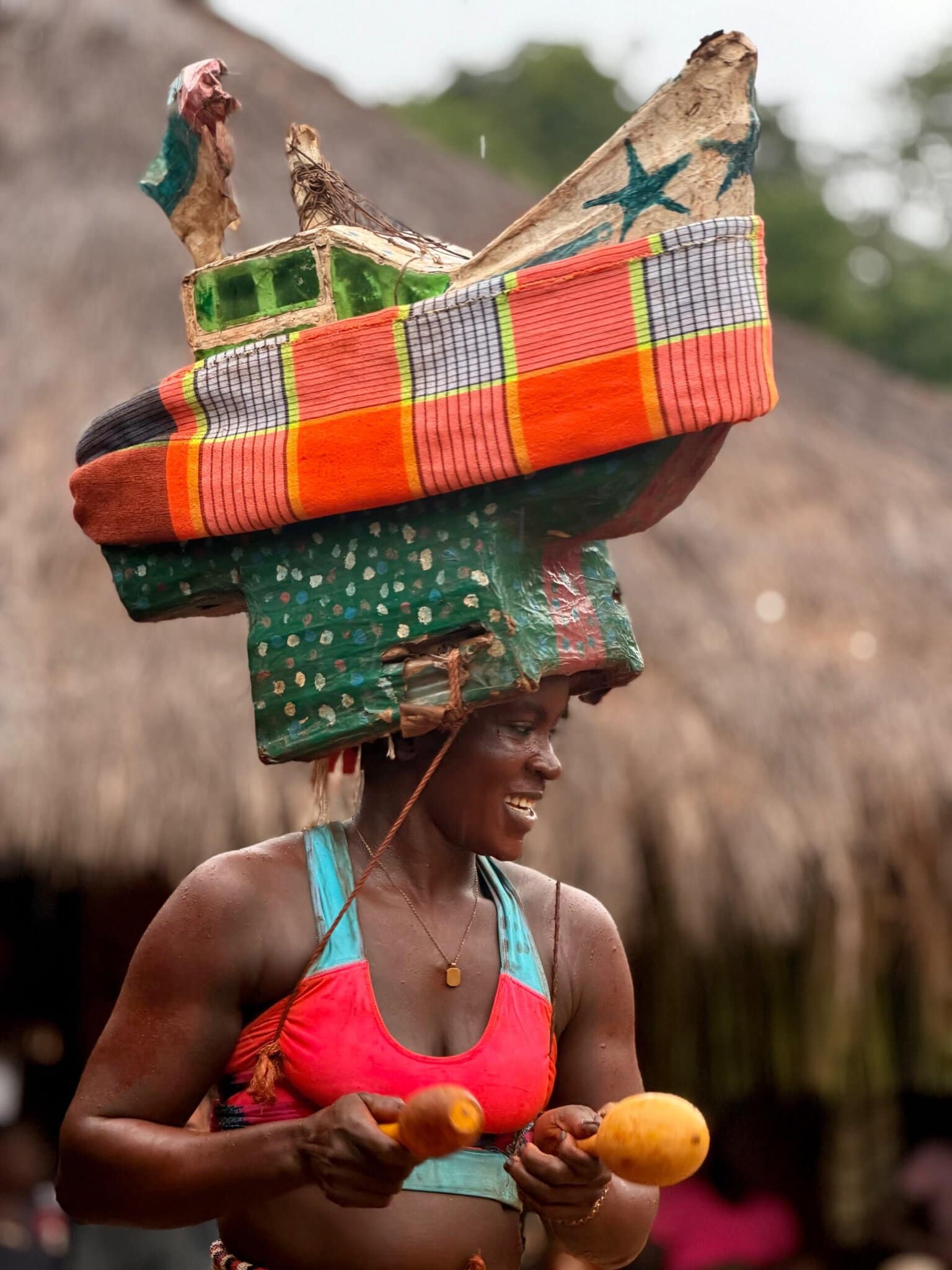
Other women spun across the courtyard in raffia skirts, and the crowd cheered them on.
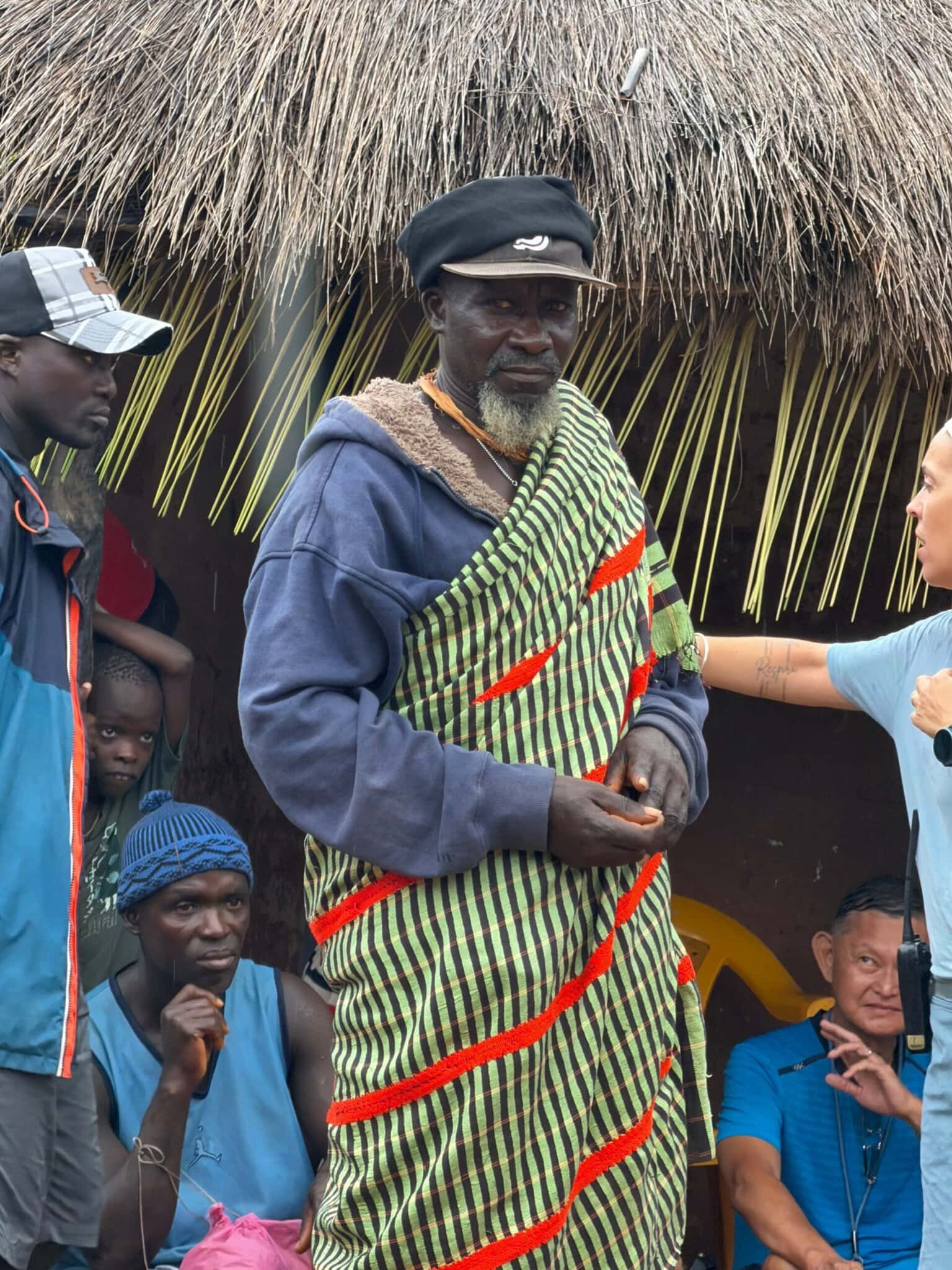
The village “king” gave a speech at the end of the performance. A young man translated it from their language into Portuguese for Sonia, and Sonia translated it into English. He said the villagers were truly happy to have us. They were grateful to Sonia for bringing visitors to share their culture. She was a man of few words and a very humble disposition, a rare signt for a king or queen in any society.
It was the most authentic village performance we have ever seen. The party would go on without us. For the village, our visit was a festival: anticipation, preparation, performance, then an elaborate feast and dancing late into the night. I won’t be surprised if some palm wine gets involved at night.
How do the Bijagós mark the stages of life?
We also learned about the Bijagós age-set system, called the Manchang. Here is the version we heard from Sonia. Over a lifetime, each person passes through a hierarchy of seven age tranches. A person moves up a level after specific initiation rites, known as the Fanado. Each stage carries its own social duties, labor expectations, and spiritual roles.
Three of the stages show how the system works:
| Stage | Who | What they do |
|---|---|---|
| Canha | Children, from about the age of seven | Observe traditions and help around the village |
| Cabaro | Young adults | Men do the heavy physical labor, clear farmland, harvest palm nuts, and prepare for the major initiation |
| Homem Grande and Mulher Grande | The elders | Hold social wisdom and spiritual authority after initiation |
No one drifts casually from one stage to the next. Each step has initiation criteria and a ritual.
Is Bijagós society matriarchal?
Bijagós society is often described as a matriarchy, but that is not true. According to our guide Sonia and Wikipedia, it is matrilineal, and scholars disagree on how far women’s authority extends. Lineage, family name, clan membership, and land rights pass through the mother’s line. Women also hold real social power. They manage household economics, choose their partners, and play central roles in ancestral spiritual rites. Men are the face of the village and hold equal power.
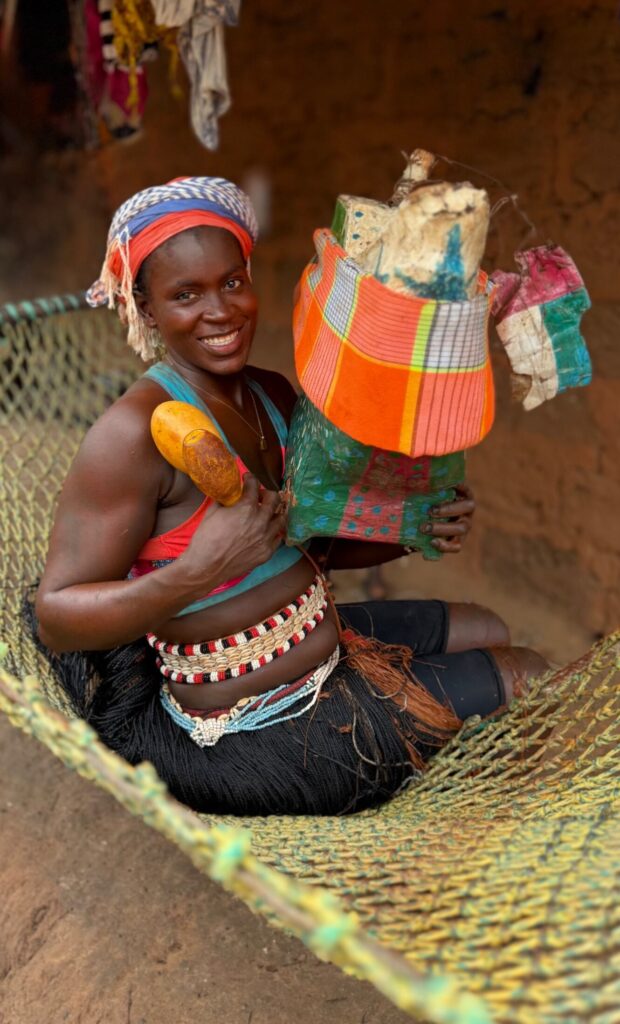
Our host explained how marriage works in Bijagos. A formal marriage is a huge and expensive event with many ceremonies. Once a couple is married, families do their best to keep the couple together. Because of that, she said, most people simply have children with whoever they choose at the time. Therefore, only the mother is certain, so the child carries her name, legacy, and inheritance. Since partnership is not bound for life, it’s hard to know the biological father. The level of freedom and equality in the ancient Bijagos tribes and many tribes in Africa was truly quite refreshing.
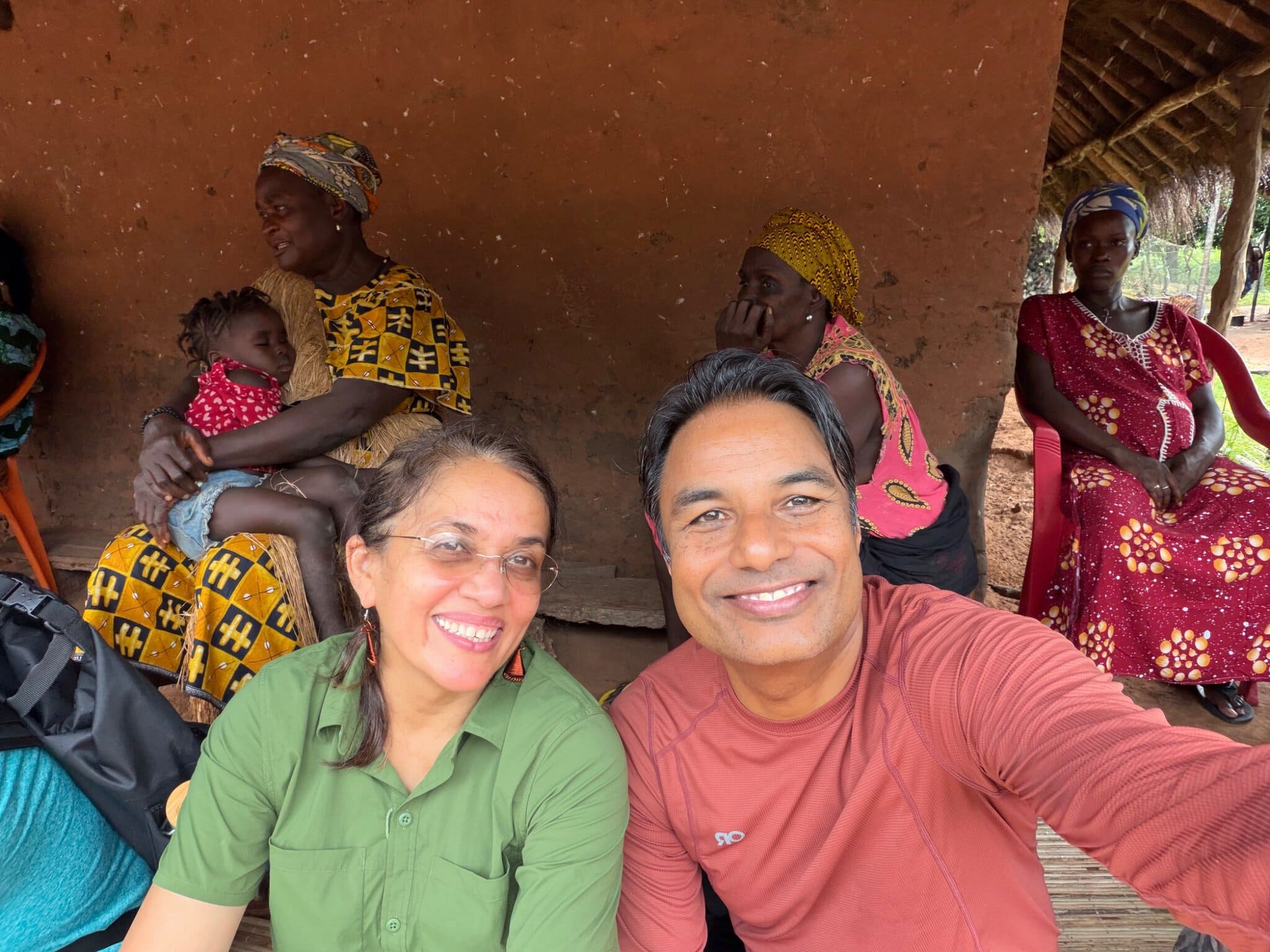
Traditionally, people here do not know their birthdates. They know the season and the year’s big event, like the year of the flood or the year of the fire.
How are the dancers’ skirts and red palm oil made?
We spent an hour touring the villages and seeing daily life up close.
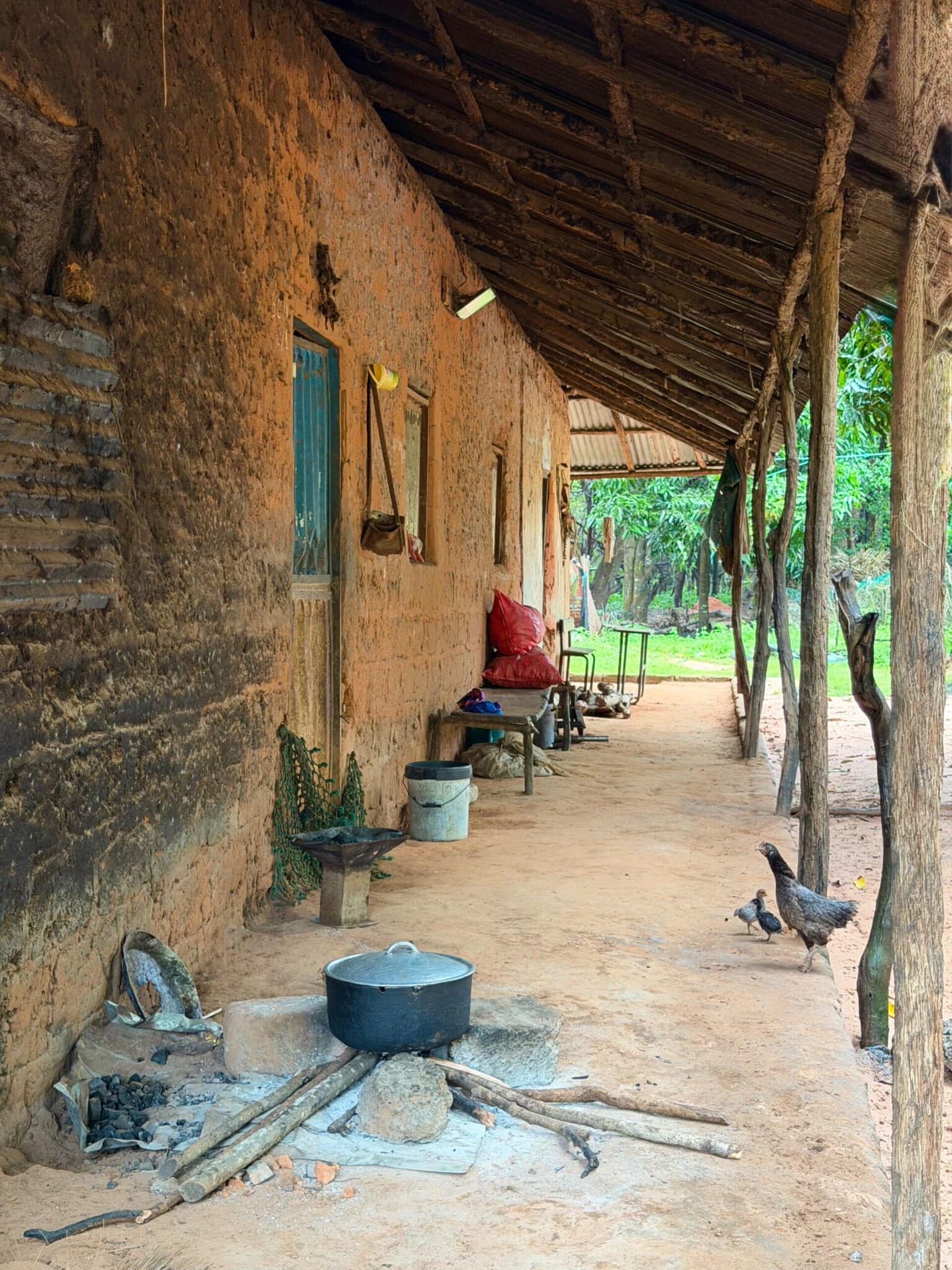
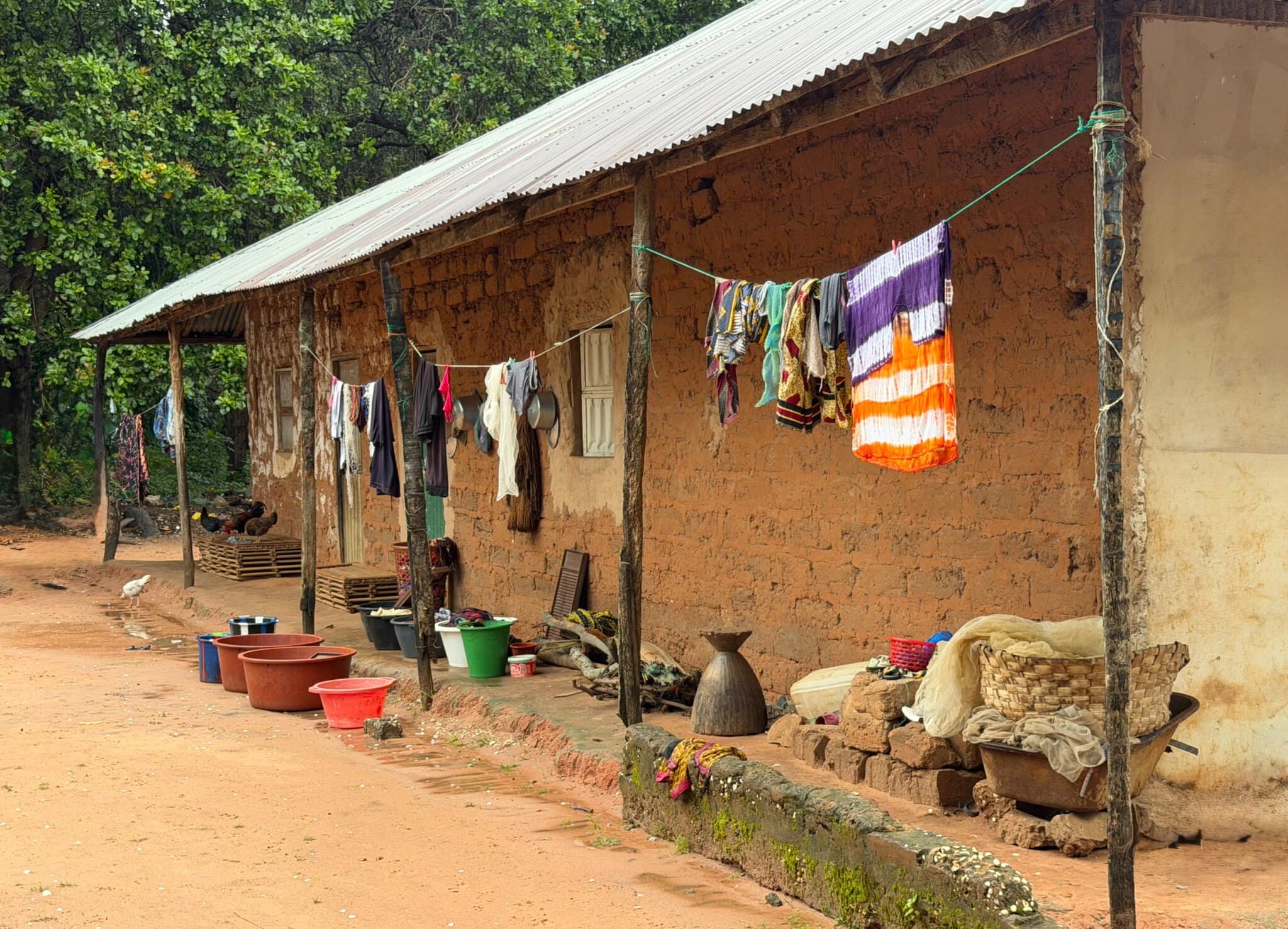
The dancers’ skirts are made from palm leaf raffia. The women dry the young leaves, shred them, and knot them by hand. The result is the heavy grass skirt we saw in the courtyard.
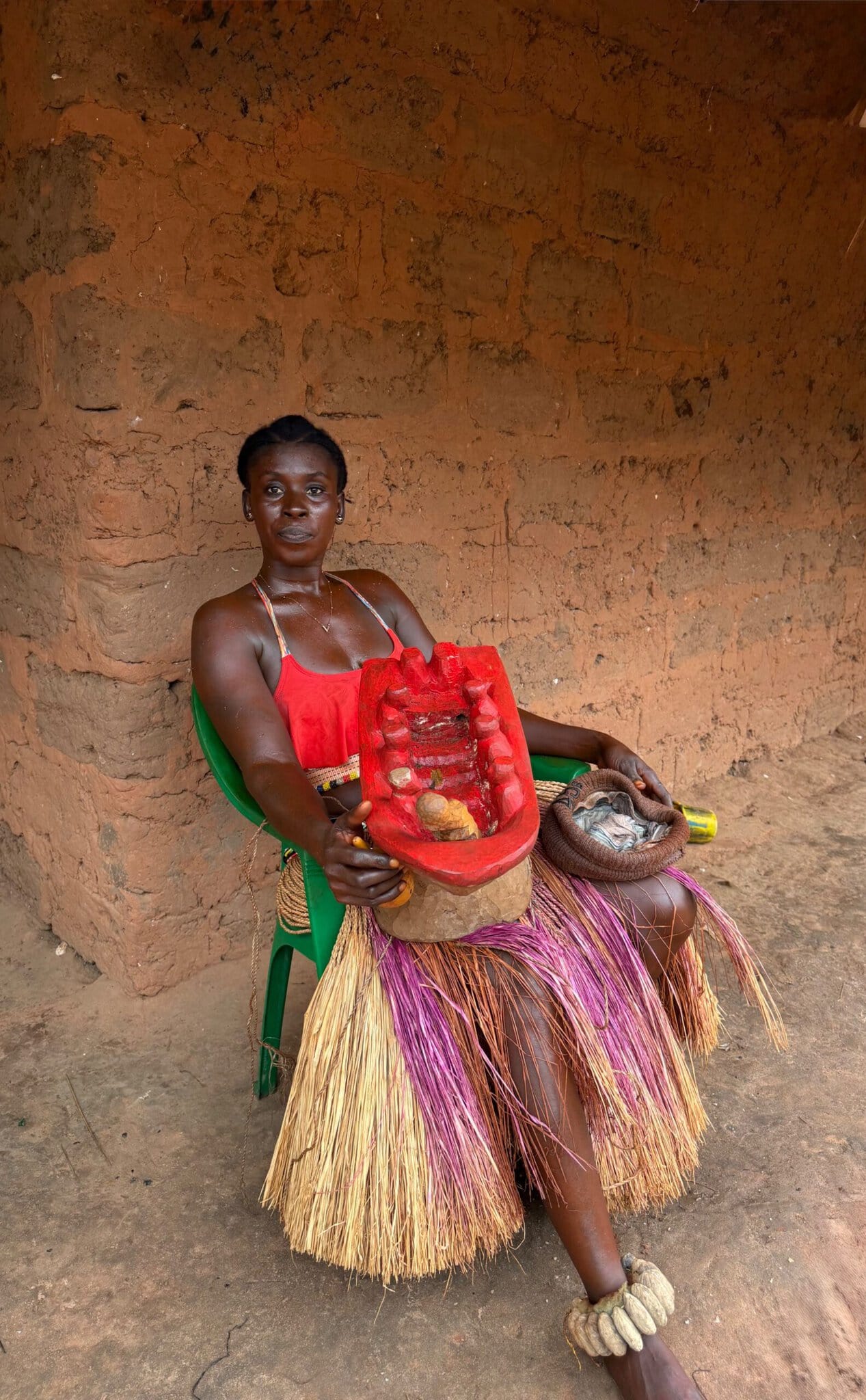
Red palm oil takes more steps. We walked through the whole traditional process. Young men of the Cabaro age group climb tall palms and cut down the heavy fruit clusters. The red fruits are plucked and boiled in massive iron pots over open wood fires to soften the pulp. The pulp is mashed in wooden mortars. It is squeezed with water to extract the pure, rich red oil.
Sonia and her husband gave us a tour of the palm oil-making process. She showed the differences between the local palm oil and the unhealthy palm oil from the industry that has flooded the market. Here’s our vide on YouTube.
The oil goes into daily cooking and into sacred offerings. The same oil feeds the family and the spirits.
What makes the Bijagós Islands unusual?
We learned more interesting stories after some research –
| Topic | What we learned |
|---|---|
| A World Heritage Site since 2025 | The archipelago became Guinea-Bissau’s first World Heritage Site in July 2025, according to IUCN. UNESCO listed it for its coastal and marine ecosystems, not for its culture. It credits the site’s good condition largely to how local communities manage their resources. |
| Many islands, few people | The archipelago has 88 islands and islets. About 30,000 people live on 20 of them, according to Anadolu Agency. |
| A delta in the Atlantic | UNESCO calls it the only active deltaic archipelago on Africa’s Atlantic coast. |
| Hippos in the sea | According to UNESCO, it is the only place on the continent where hippos live in seawater almost permanently. |
| A turtle nursery | Five of the seven sea turtle species visit the islands, according to UNESCO. On Poilão Island, green turtles laid more than 62,000 nests in 2020. |
| A navy that beat Portugal | Per Wikipedia, a Portuguese force sent to conquer the islands in 1535 was destroyed by the islanders’ navy. Portugal did not formally annex the islands until 1937. |
| The cashews on the trail | Cashew makes up about 90% of Guinea-Bissau’s exports, according to Frontiers in Sustainable Food Systems. |
Bijagós Islands at a glance
| Detail | Our visit |
|---|---|
| Place | Carache and Caravela, Bijagós Archipelago, Guinea-Bissau |
| Visited | September 19 and 20, 2026 |
| How we got there | By ship, then Zodiac landings on the beach |
| The walk | About 2 km, mostly flat, from the beach to the village |
| Local guide | Sonia, who runs a lodge and leads tours of the islands |
| What we saw | A masked dance performance, a speech by the village king and the making of red palm oil |
Leaving Carache and Caravela
We felt immensely lucky. The Bijagós gave us a glimpse of a way of life they preserve fiercely, hold deeply sacred and share with heart. We hiked back past the white sand beaches to our boat.

Last Updated on November 26, 2026 by Jyoti Baid