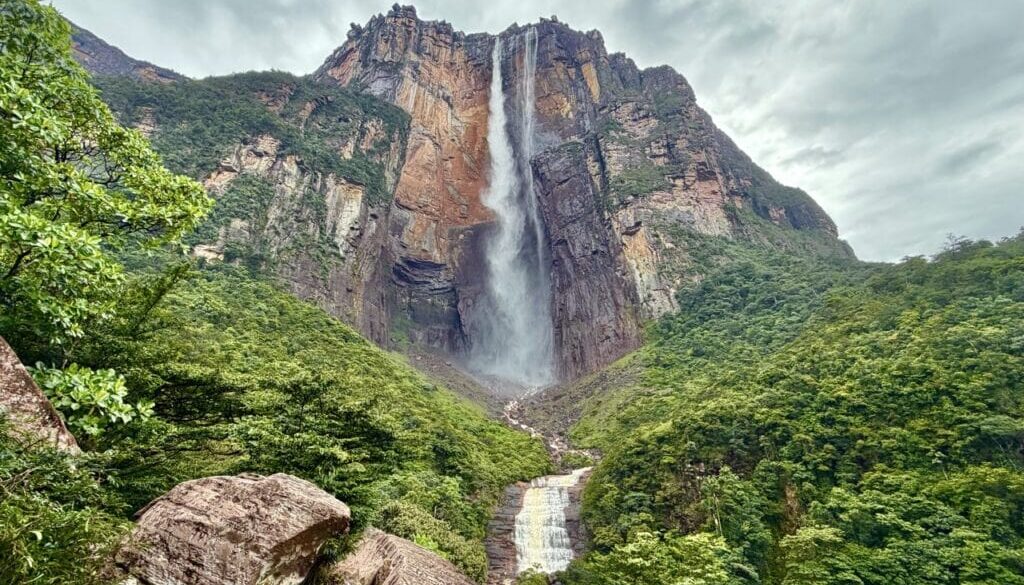
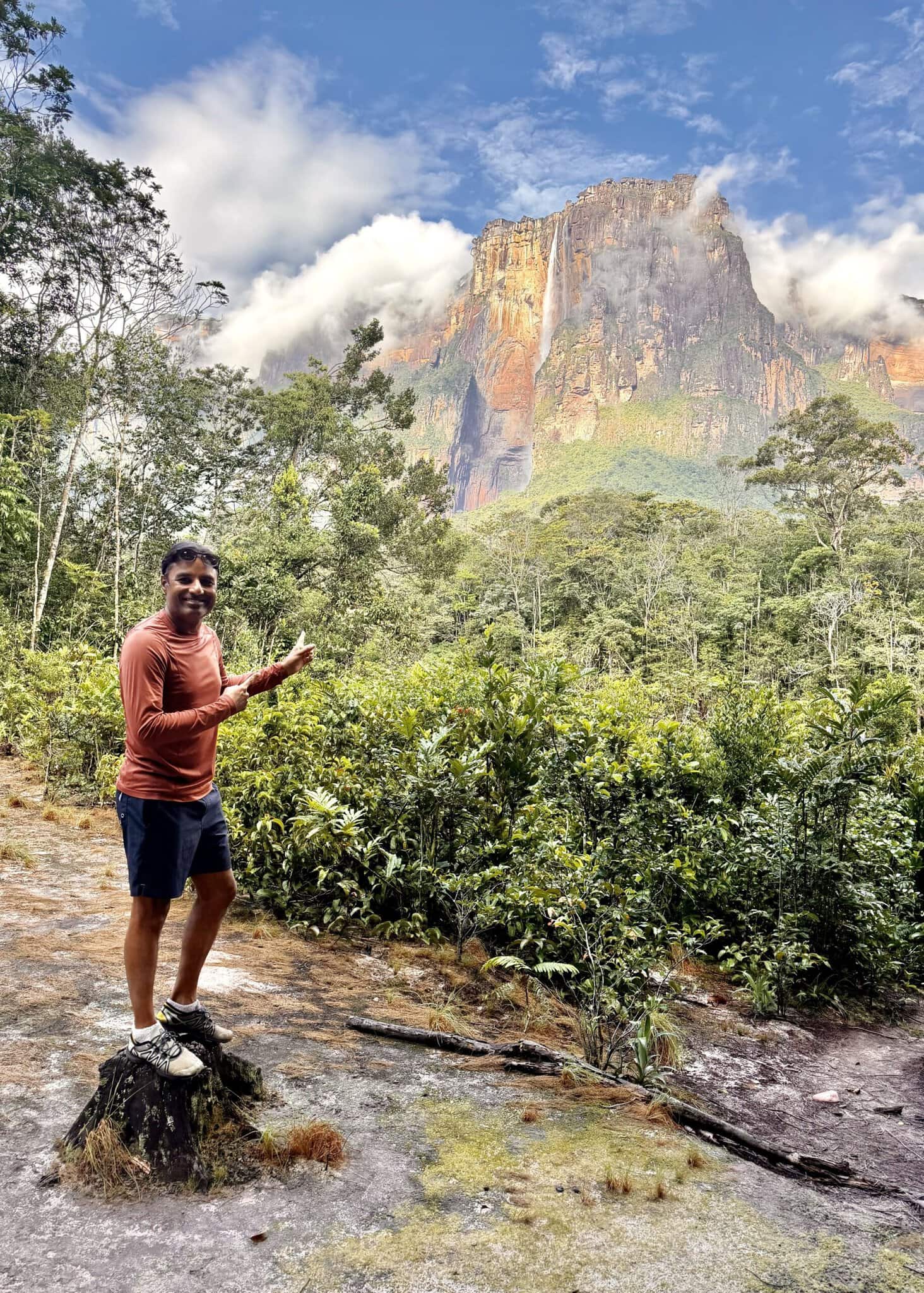
Angel Falls, Salto Ángel in Venezuela, is the world’s tallest and remotest waterfall, plunging almost a kilometer off the edge of Auyan Tepui in Canaima National Park, a UNESCO World Heritage site in southeastern Venezuela. I ventured on a four-day trip from Caracas to Canaima, including the two-day expedition by motorized canoe and jungle trek to the base of the falls. I am writing this for experienced travelers planning an expedition to Canaima and wanting a first-hand account of what the journey actually involves, from the visa window to the hammock camp.
The Trip I Almost Didn’t Take
Angel Falls has been on my list for as long as either of us can remember. The world’s tallest waterfall, hidden in one of the most remote corners of the planet, accessible only by a small plane ride and river canoe, in a country most of our American friends consider completely off-limits. That combination was either a reason to go or to stay away, and for years, I couldn’t quite decide which.
The story started a couple of years before I actually went. I looked into the Venezuelan visa process seriously, read the requirements, and backed away. At the time, US citizens needed an apostille on their police clearance certificate, a bureaucratic process that takes weeks and considerable effort. The crime rate in Caracas was high enough that a Venezuelan friend, someone who knows the country well and loves it deeply, said point-blank: “Absolutely not. I will come to your house and tie you to a chair if you try to go.” When a local tells you that, you listen.
In 2026, things shifted. Venezuela’s government began issuing e-visas, a process that was, briefly, remarkably simple. No fees, no documents, and the visa arrived in four days. That window has since narrowed again, requirements have become a bit more complicated since I traveled, but catching it at the right moment felt like a sign. The Venezuelan friend’s advice had changed too, from “do not go” to “be careful and don’t let your guard down. Let me know if you need help from my family in Venezuela.” Not a ringing endorsement, exactly, but a meaningful shift. My daughter’s first reaction when she found out was “Oh dear!” I went anyway.
“Some journeys live up to the dream. This one exceeded it.”
What followed were six days that broke more stereotypes than any of us knew we were carrying and delivered one of the most genuinely extraordinary experiences in our years of travel across seven continents. Venezuela is complicated, and real, and worthy. The people are some of the warmest I have met anywhere. The landscape is unlike anything else on earth. And Salto Ángel, standing at its base with the roar filling the night, is more magnificent and giant than you can imagine.
Caracas: One Day in Bolívar’s City
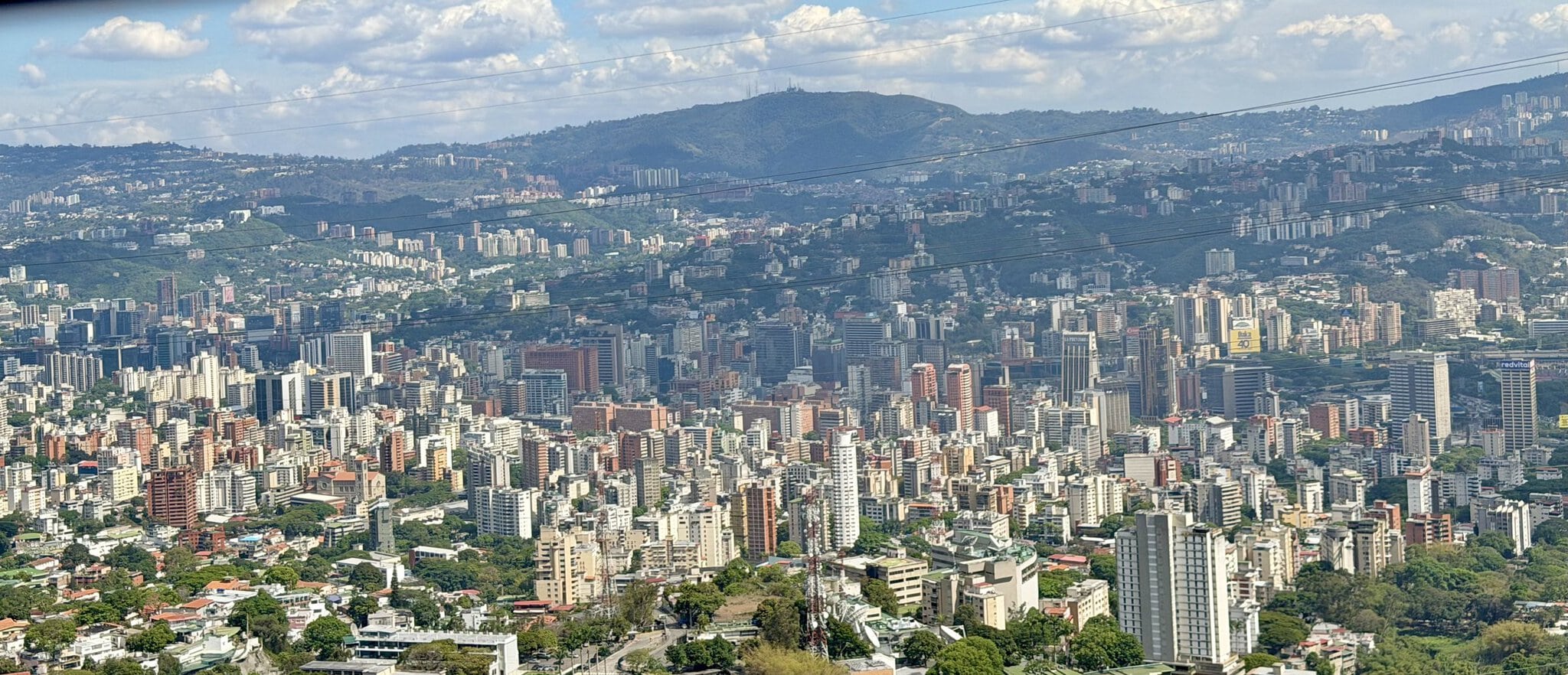
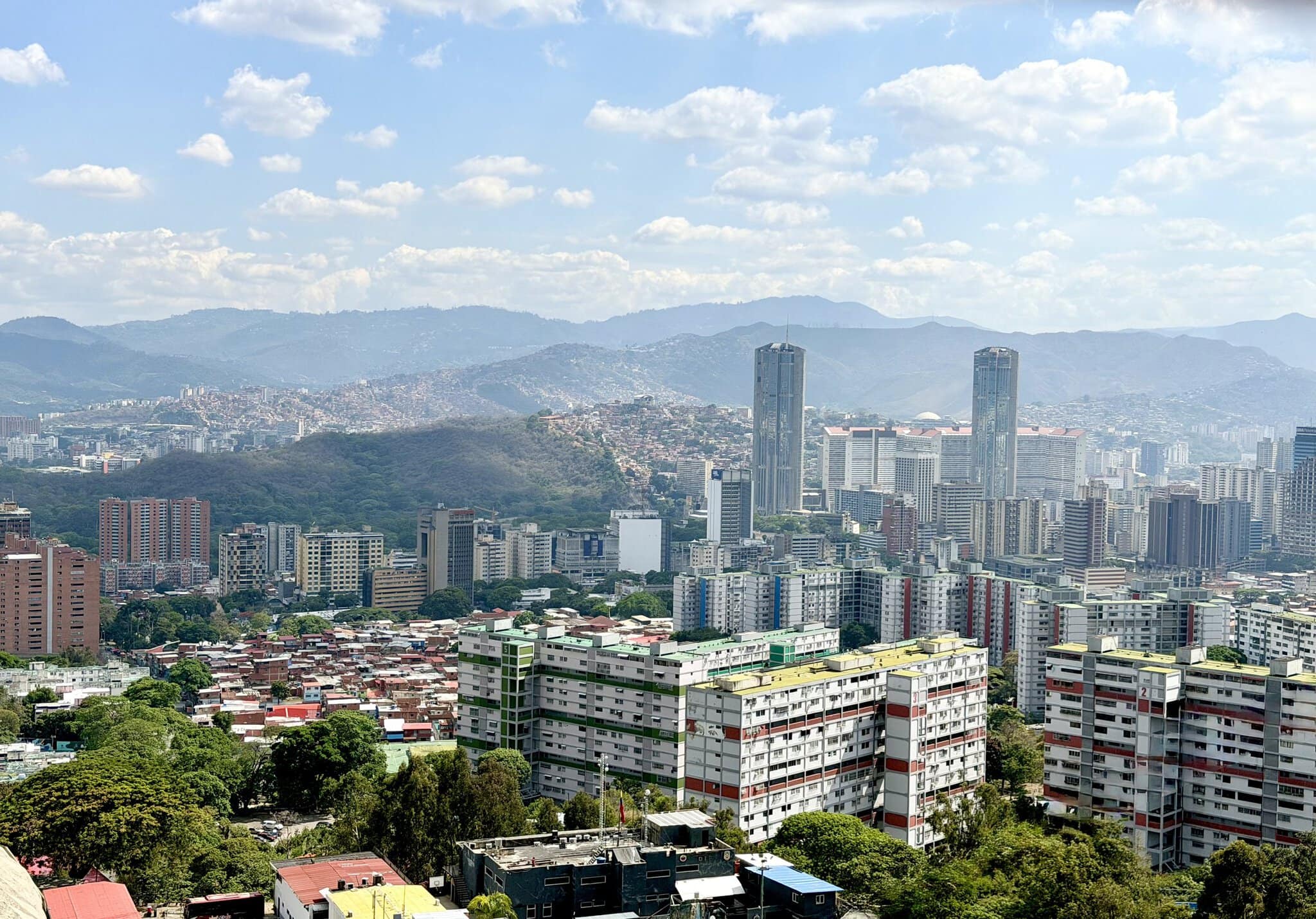
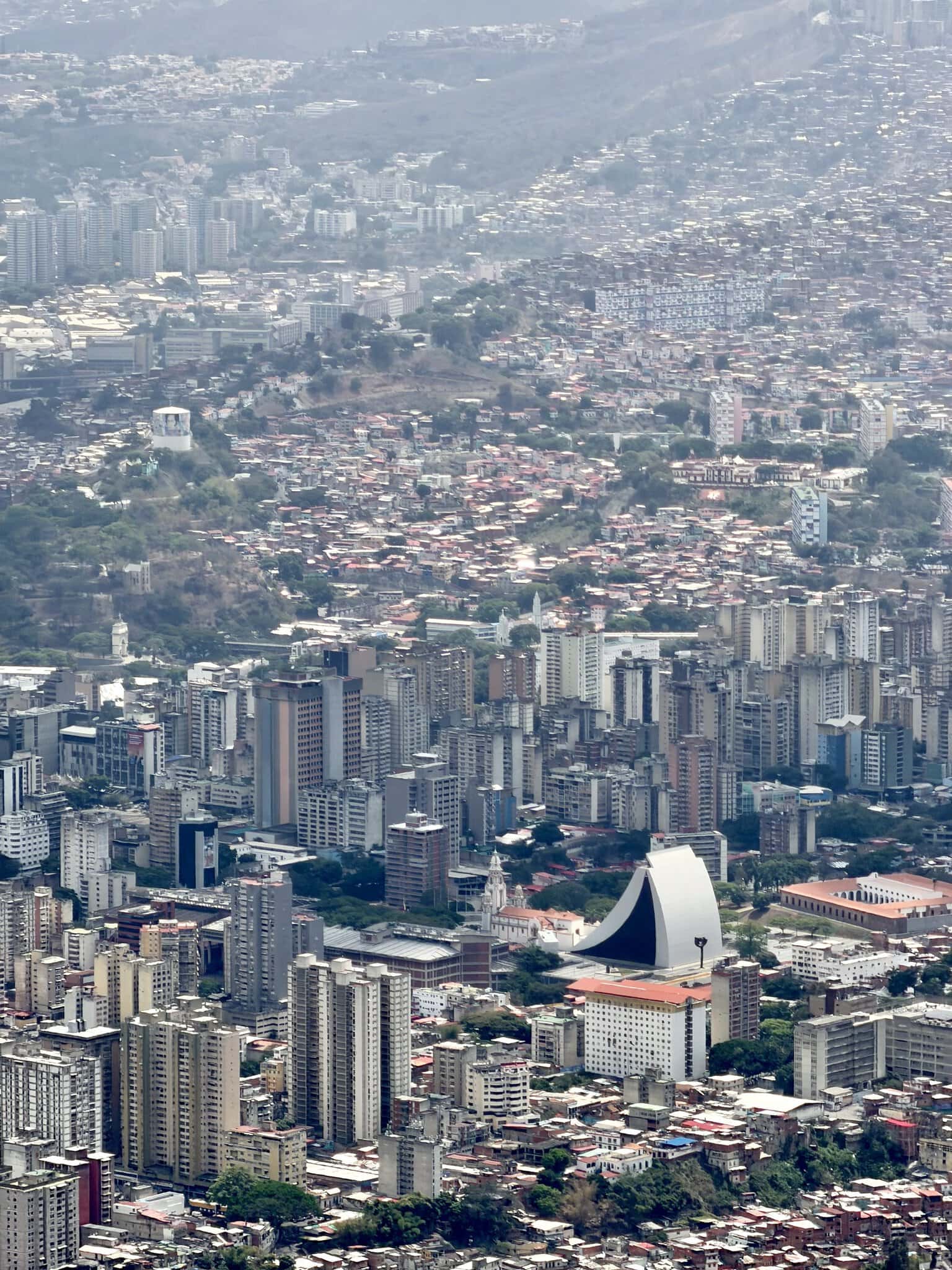
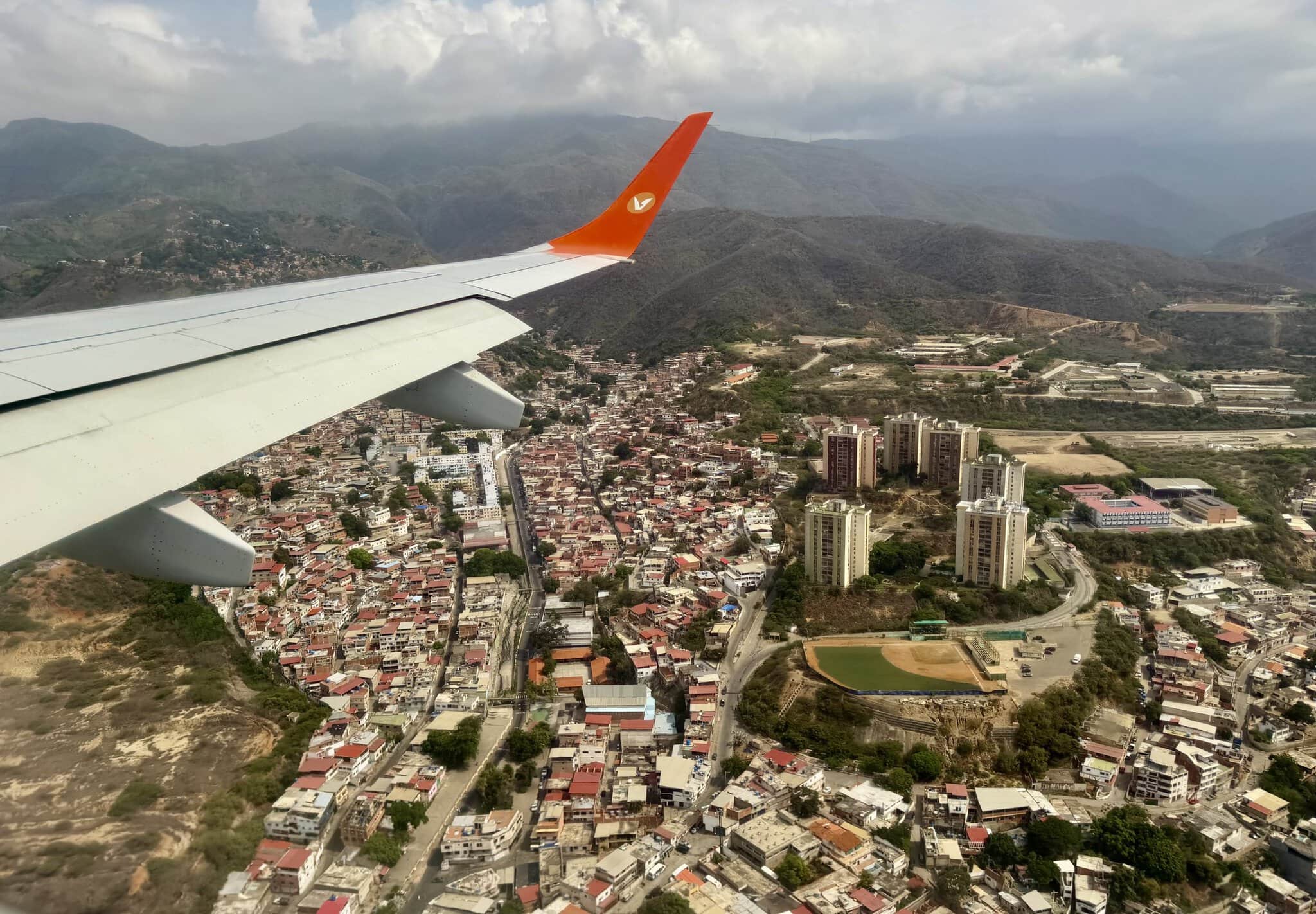
A day in Caracas is worth your time, even if you’ve come primarily for Canaima. The city is layered in ways that catch you off guard: the American consulate was being renovated and preparing to reopen when I visited, a visible sign of a shift. The barrios climb the steep hillsides in every direction, dense and chaotic from a distance, and then you walk into the colonial center and find a city where history is still alive and respected.
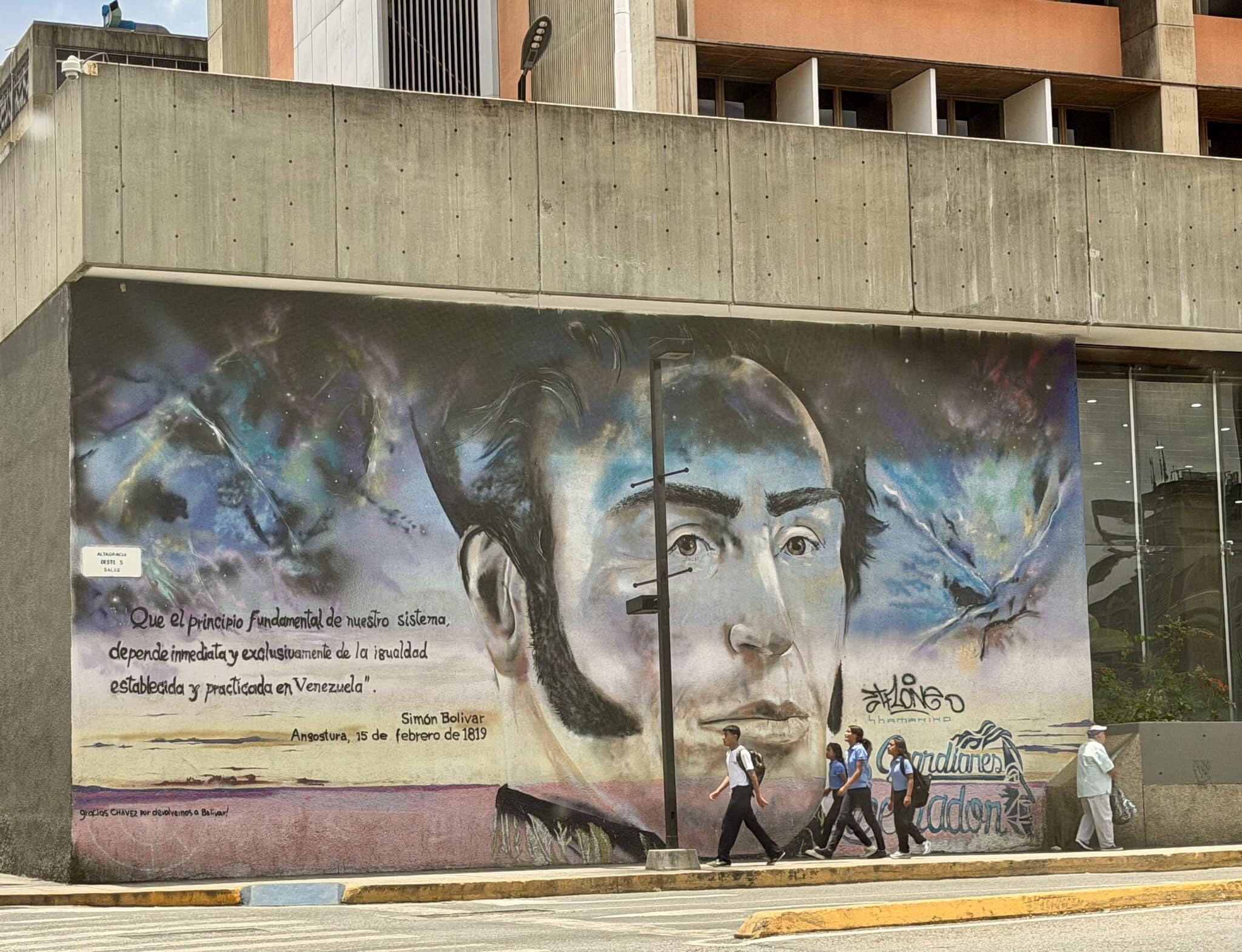
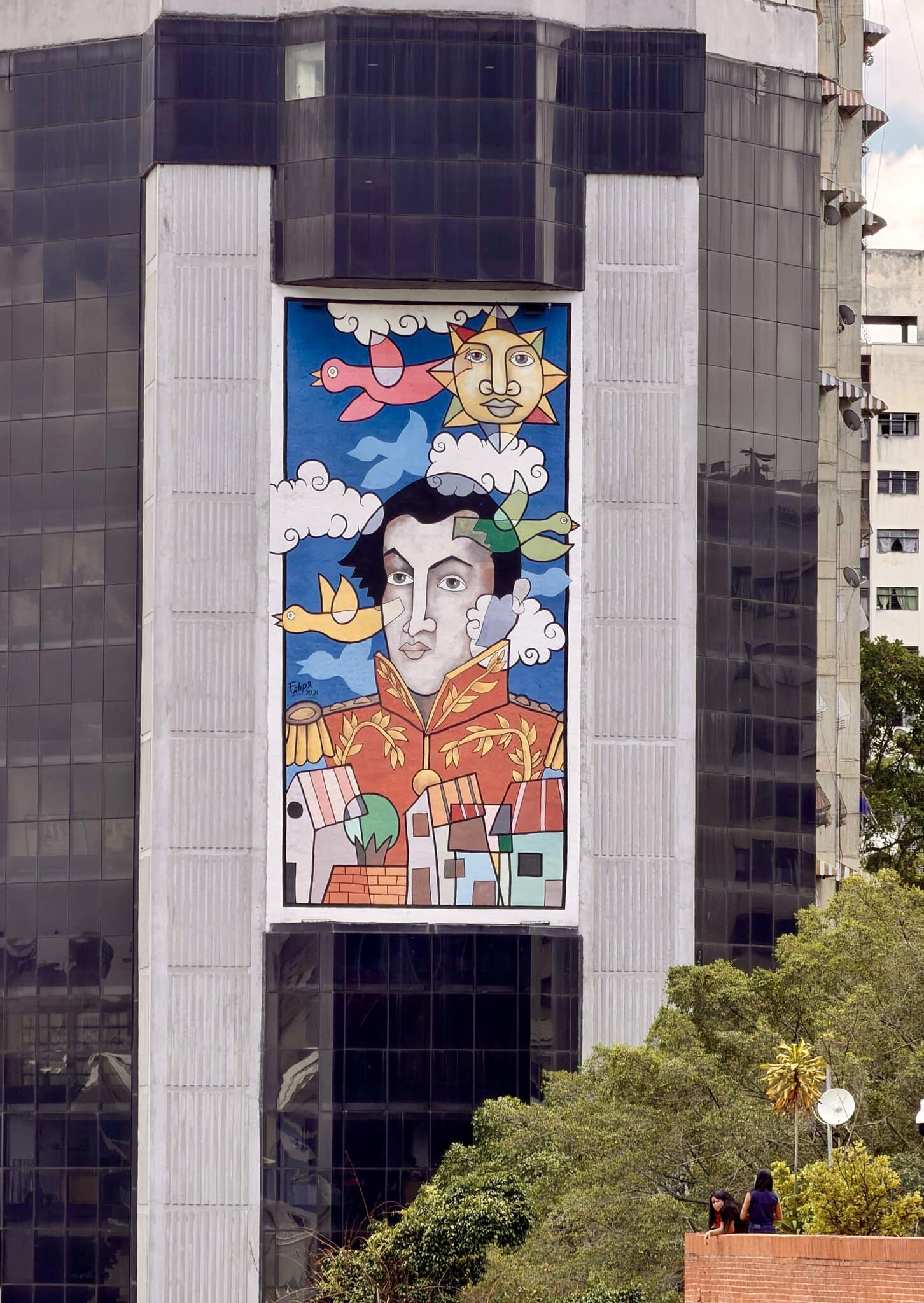
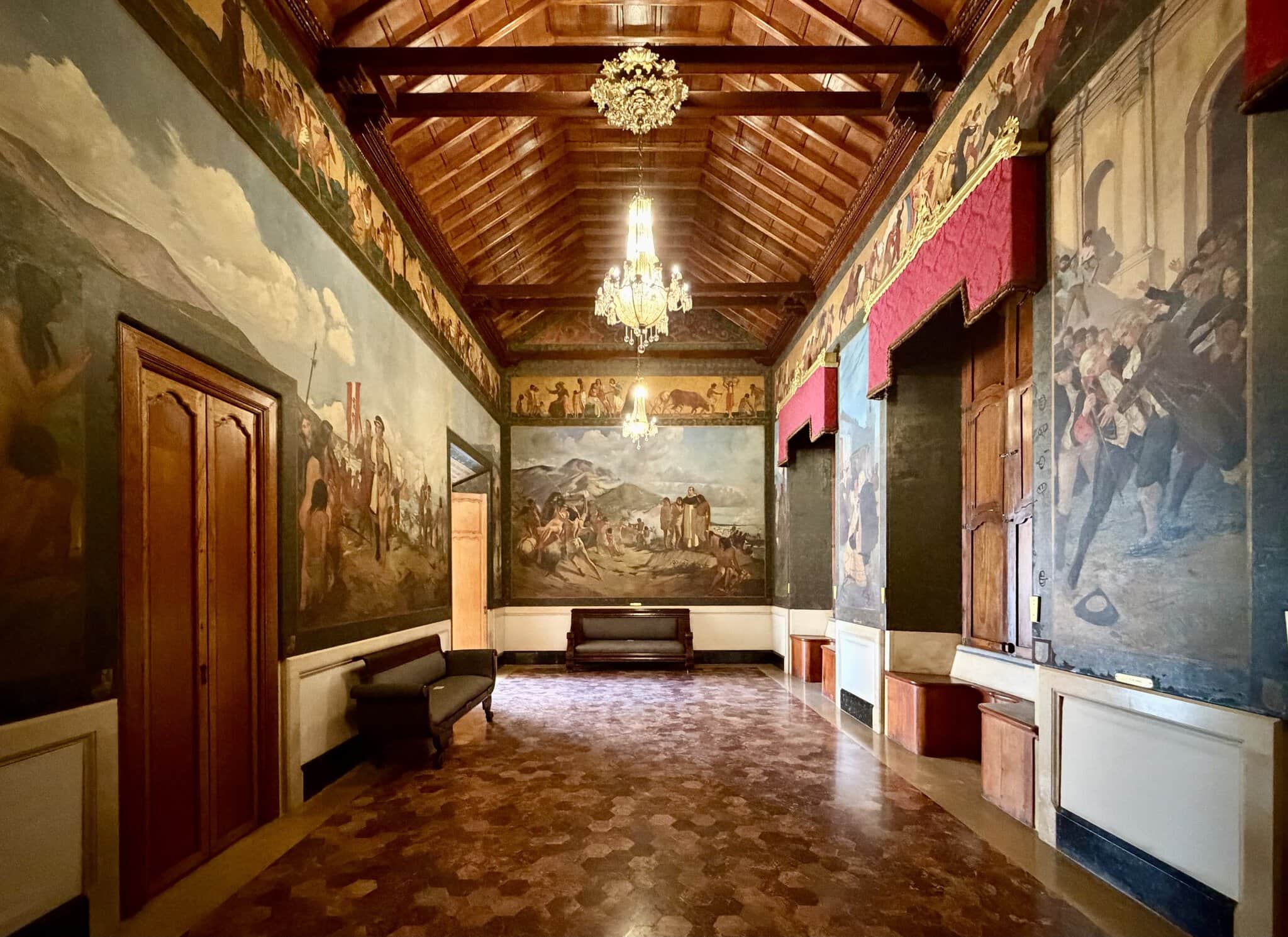
Simón Bolívar is everywhere in Caracas. His story is depicted in the museum named for him; he is on the currency and on the walls. Full-building murals, spray-painted portraits with quotes from his 1819 Angostura address, still feel urgent 200 years later. He is on the coins, in the name of the international airport, and in the national pantheon, where he is entombed with a full ceremonial guard. You cannot spend a day in Caracas without, viscerally, understanding what Bolívar means to this country and to the Latin American story more broadly. He liberated Venezuela, Colombia, Ecuador, Peru, and Bolivia from Spanish colonial rule – five nations across a continent. Venezuela has never stopped celebrating that fact.
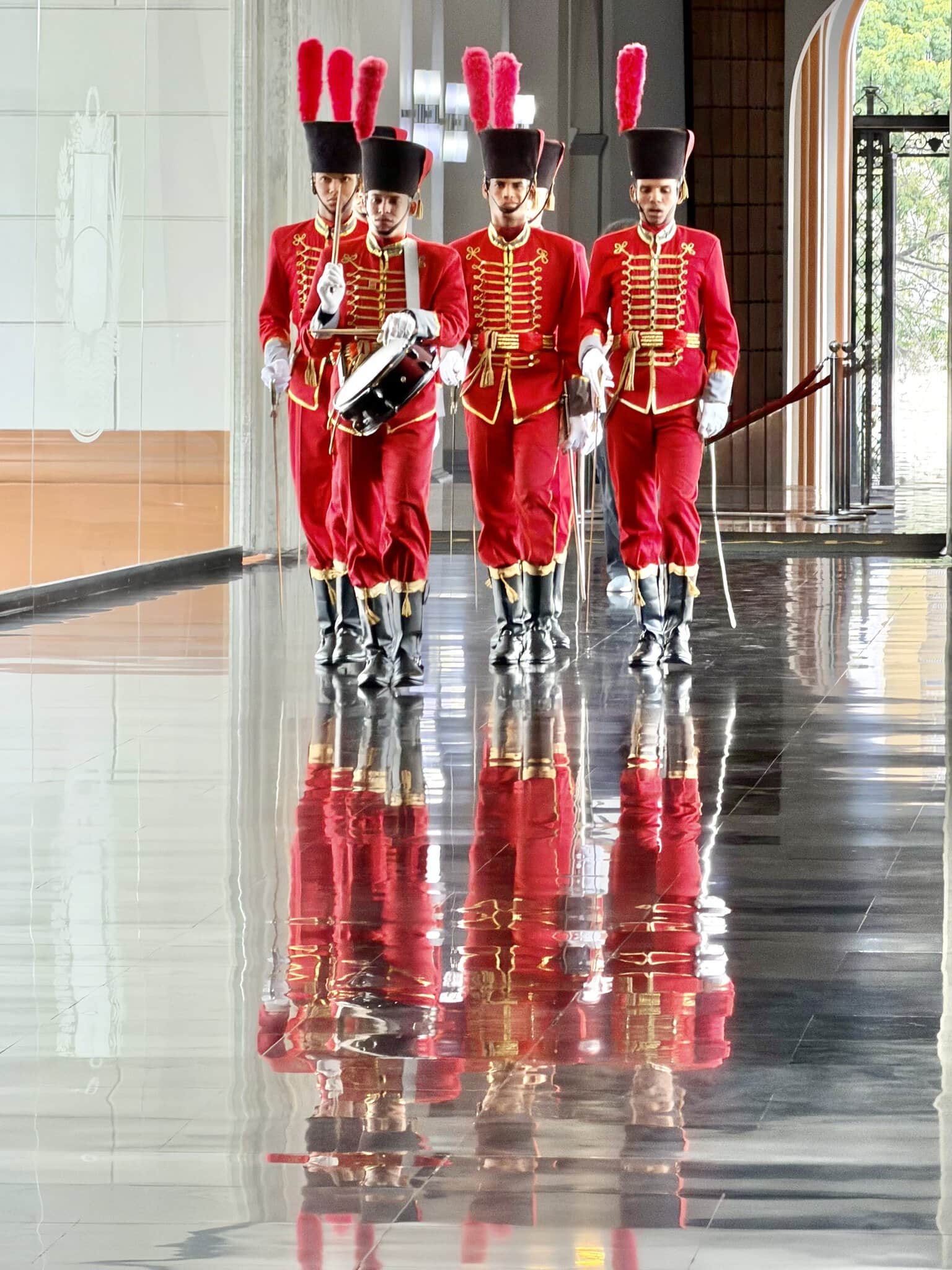
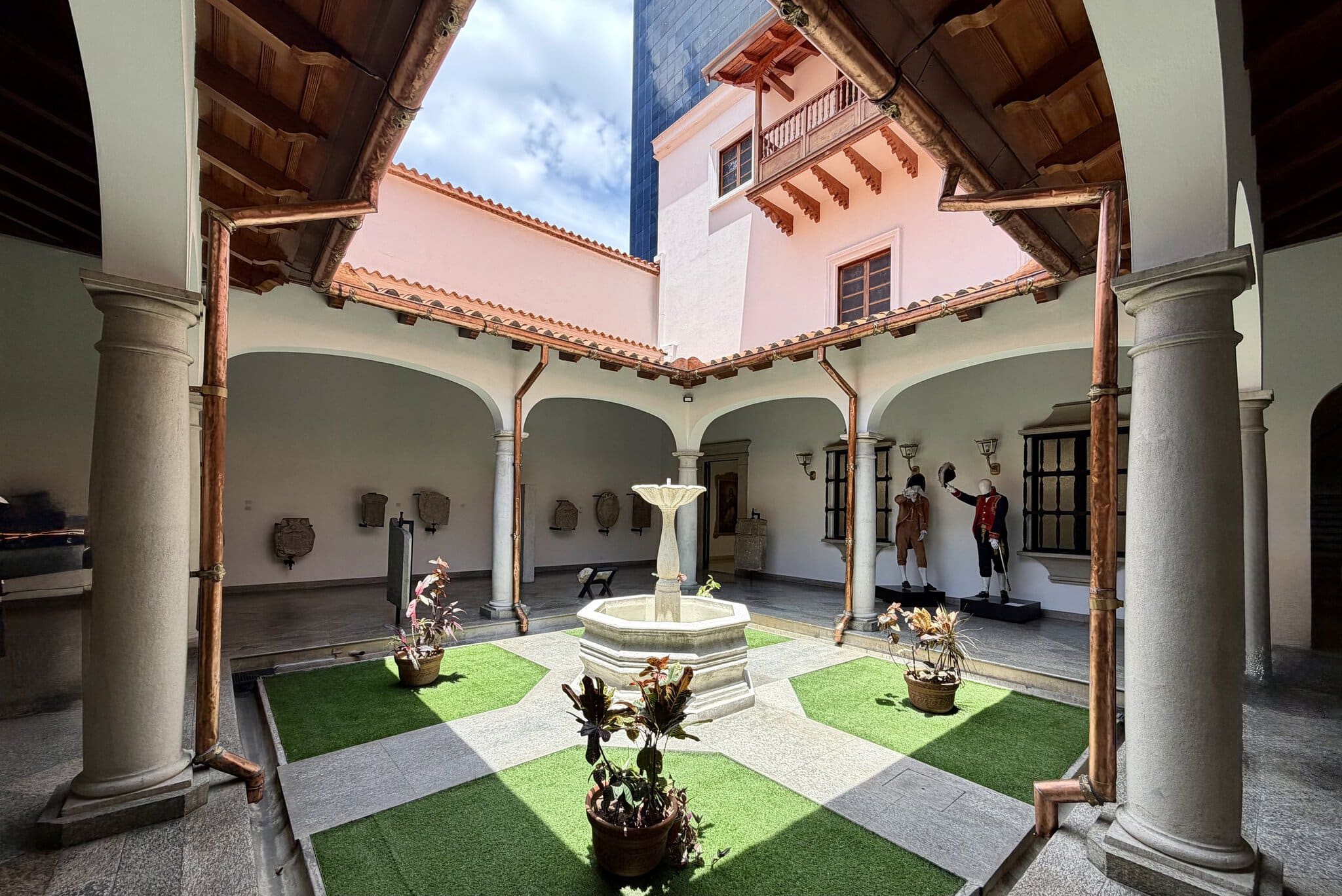
The Casa Natal de Simón Bolívar, the colonial house where he was born in 1783, is worth an hour of your time. The national Pantheon, a short walk away, holds his remains and stages a changing of the guard in a theatrical setting: soldiers in red-and-gold dress uniforms moving across a marble floor polished to mirror perfection, the reflection doubling every movement.
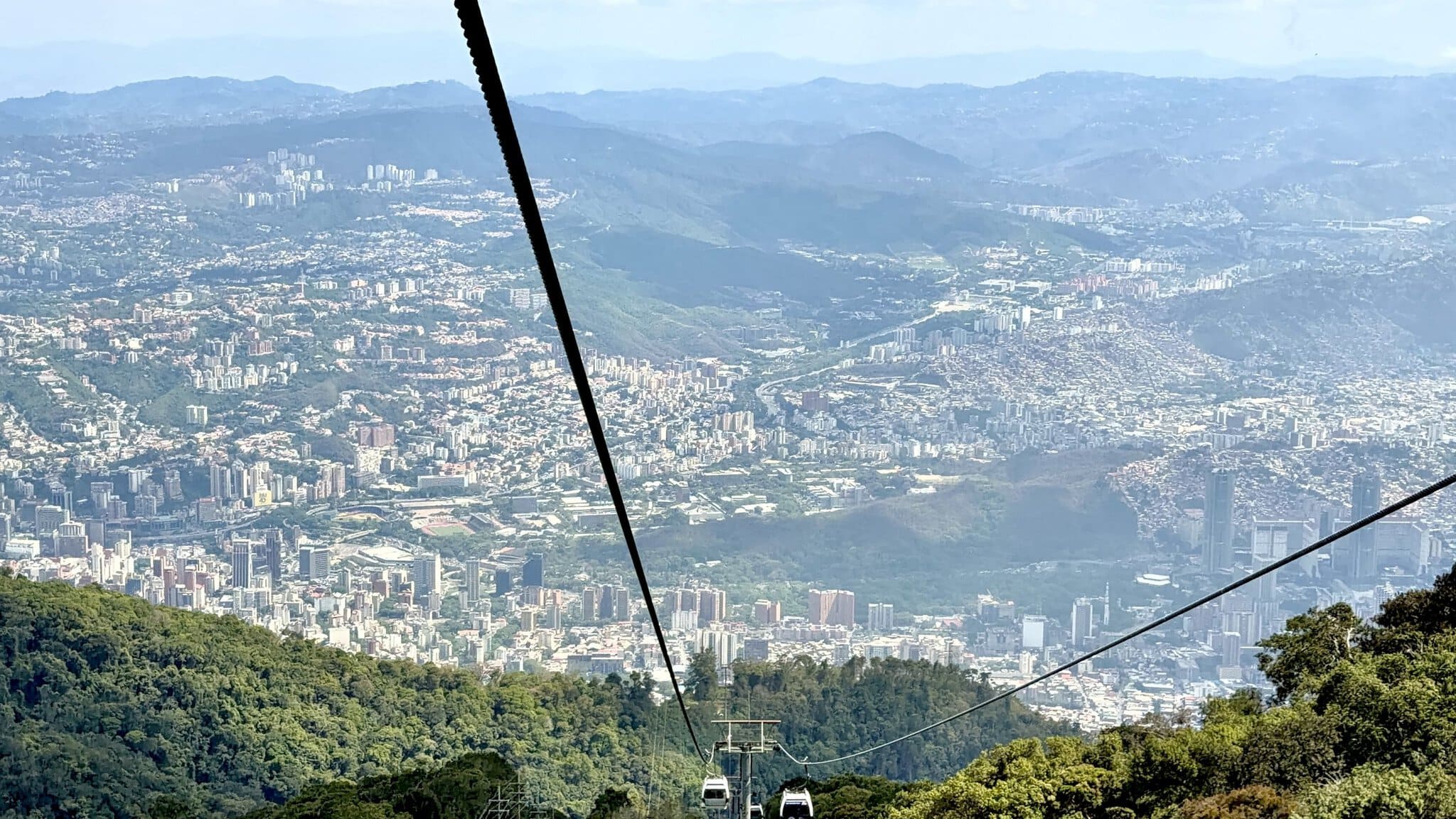
From the city center, take the Teleférico de Warairarepano up the mountain. The cable car climbs to the summit of El Ávila, the mountain range that separates Caracas from the Caribbean Sea, and the view from the top recalibrates your sense of scale. On one side: Caracas spreading across its valley in every direction, impossibly dense, skyscrapers shoulder-to-shoulder with red-roofed barrios climbing every available hillside, the whole city hazy in the afternoon light. On the other: the Caribbean.
Why “Salto” Is the Only Honest Word for This
Before you go to Canaima, it helps to understand what you are actually looking at. Not all waterfalls are the same, and the names we use for them shape what we expect.
Spanish has several words for waterfall. Catarata and cascada both describe water falling in the conventional sense: a river meets a cliff edge and tumbles down it. Salto is different. It means leap. A jump. And when you see Salto Ángel for the first time, you understand immediately why the Venezuelans got this right, and the rest of us got it wrong. The water doesn’t cascade down the face of a cliff. It leaves the edge of a plateau at full speed and falls through open air for nearly a kilometer before it touches rock again. That is not a cascade. That is a leap.
The platform it leaps from is an ancient geological formation called a tepui, from the Pemon word meaning “house of the gods.” These flat-topped sandstone mountains are among the oldest rock formations on Earth, dating back roughly 1.8 billion years, when present-day South America was part of the ancient supercontinent Gondwana. Over billions of years, the surrounding softer rock eroded away, leaving these sheer-sided plateaus standing alone above the jungle, their summits cut off from the world below.
Auyan Tepui, Devil’s Mountain in Pemon, is the largest of them, covering roughly 700 square kilometers. Its summit is an isolated ecosystem, home to species found nowhere else on Earth. When Arthur Conan Doyle wrote *The Lost World* in 1912, he based his imaginary plateau on descriptions of these formations: a place so isolated that prehistoric life might have survived, undisturbed, atop a table of ancient rock. He was not far wrong. The summit of Auyan Tepui has orchids, carnivorous plants, and creatures that evolved in complete isolation from the jungle below.
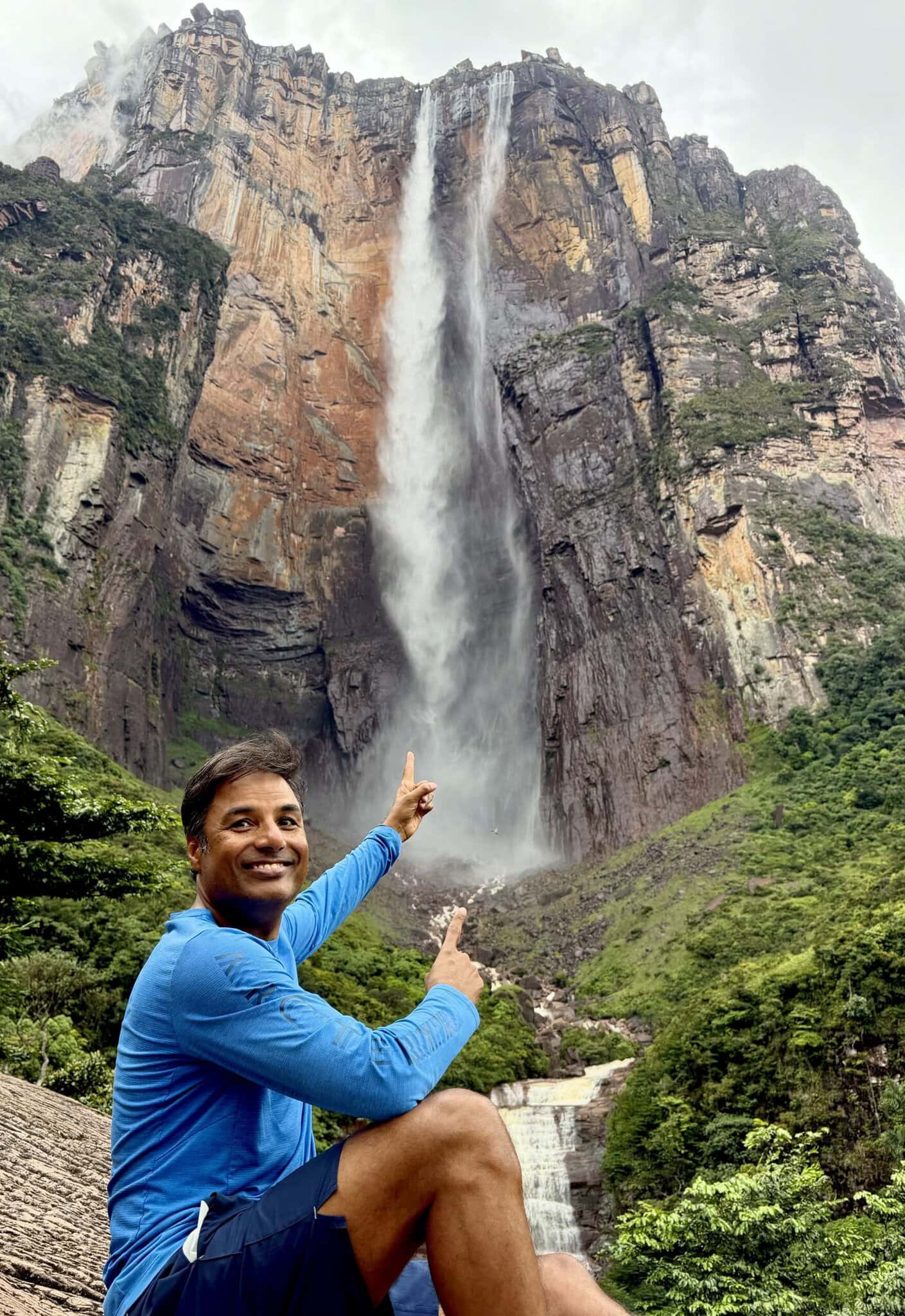
Angel Falls drops off the edge of this plateau. The water gathers on the summit, runs to the rim, and then falls 807 meters in a single, uninterrupted drop before hitting a lower ledge and falling a further 172 meters. Total height: 979 meters — three times the height of the Eiffel Tower, or roughly 2.5 times the height of the Empire State Building. For sheer volume and drama at the base, Victoria Falls on the Zambia-Zimbabwe border is the more theatrical spectacle. Angel Falls is quieter from a distance, and then you get close. From a distance, the falls do not look violent. The water moves in that impossibly fluid, almost cotton-like way, soft and dreamy against the massive dark rock face. Then you get close, and the full force of it hits you.
The falls were documented by outsiders in 1937, when American aviator Jimmy Angel made a forced landing on the Auyan Tepui summit while searching for gold. He and his wife spent eleven days hiking off the tepui after their plane got stuck. The falls bear his name in English. The Pemon had their own name long before he arrived: Kerepakupai Merú, meaning “waterfall of the deepest place.” Venezuela officially renamed the falls Kerepakupai Merú in 2009, though Salto Ángel remains widely used.
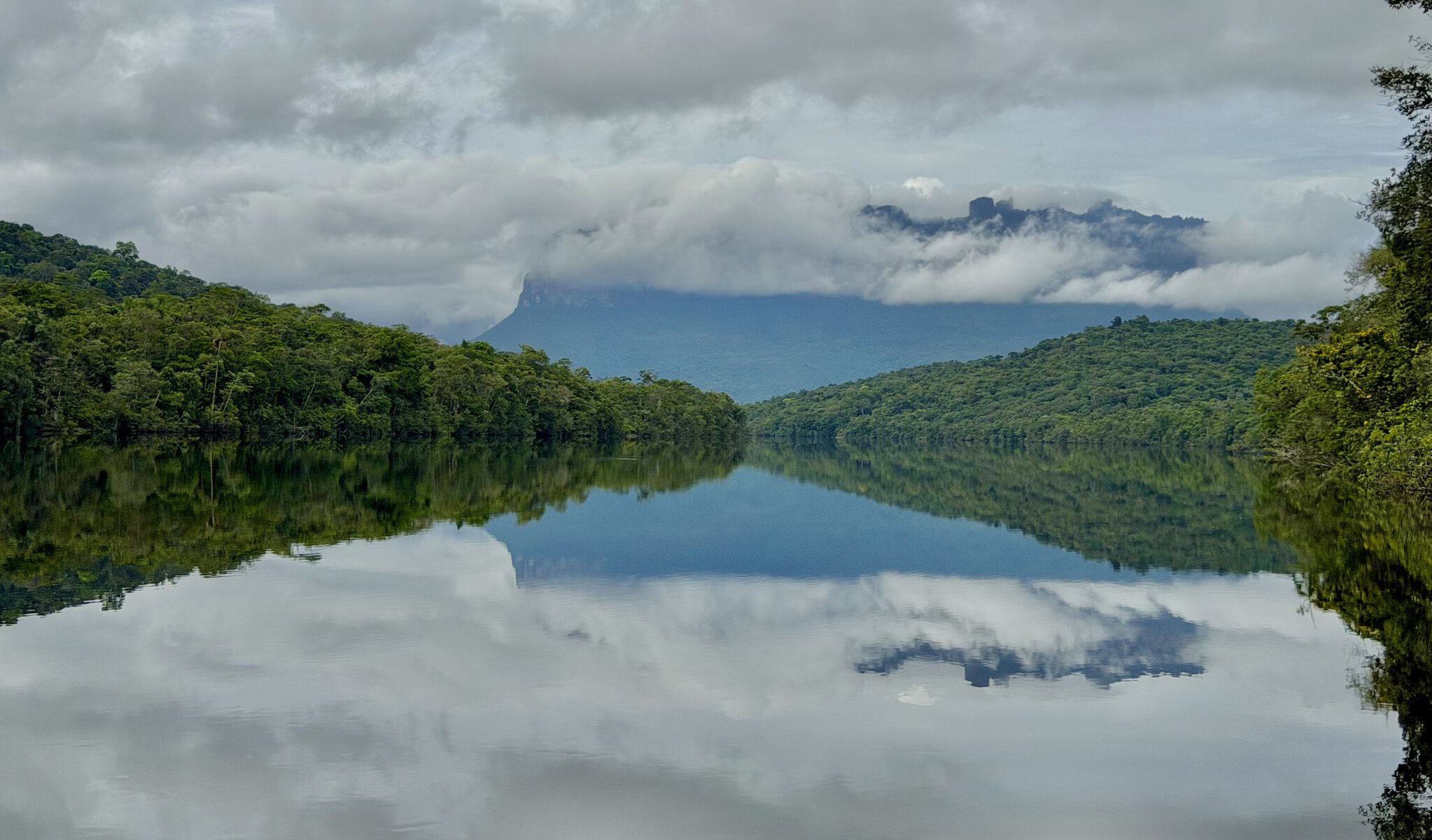
Arriving at Canaima: The Airport at the Edge of the World
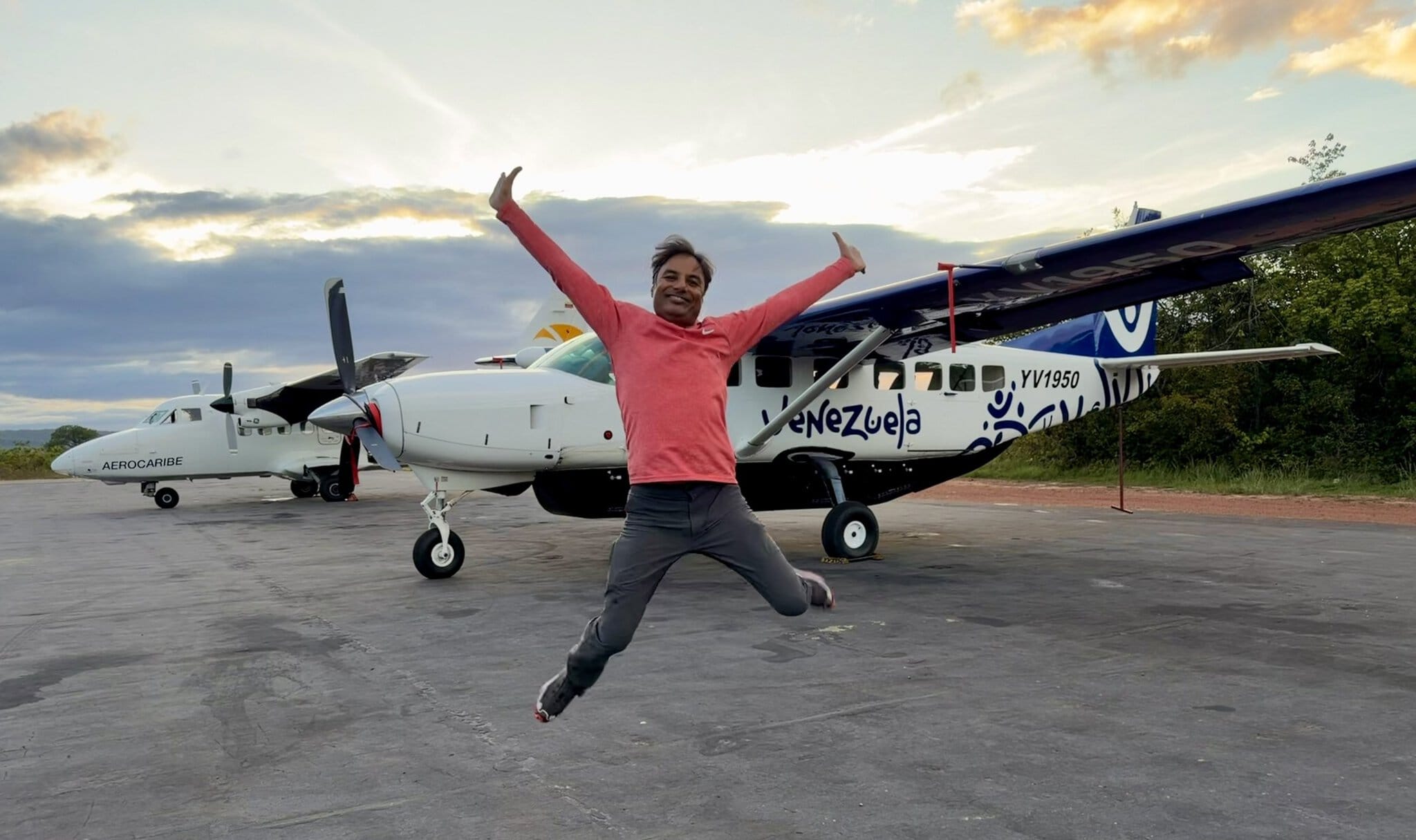
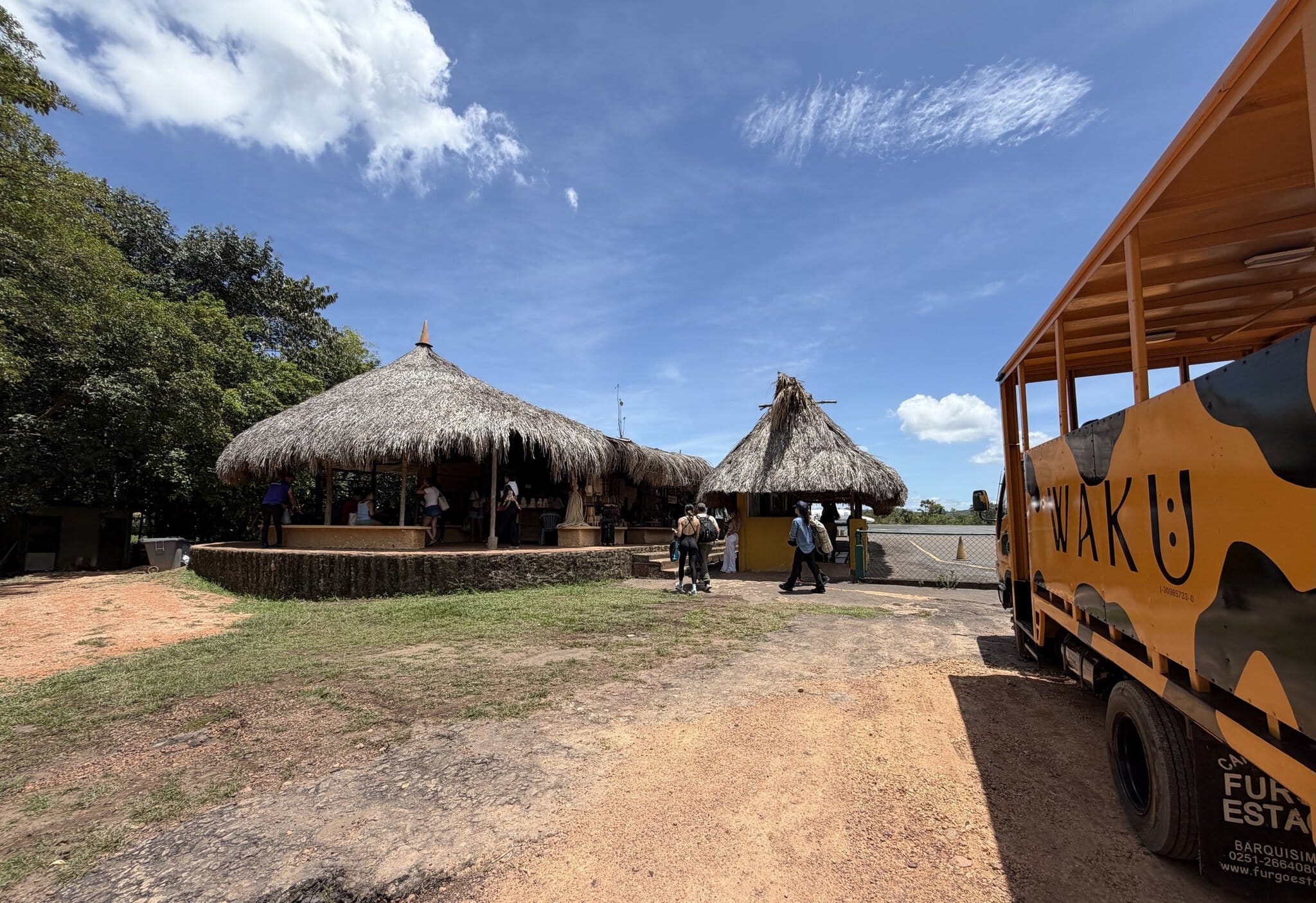
Getting to Canaima requires a short domestic flight from Caracas or Ciudad Bolívar. The Canaima airstrip is, and this is said with deep affection, not an airport in any conventional sense. It consists of two thatched-roof churuata huts. The larger of the two is the departure hall, with just enough space to fit a plane full of people if everyone breathes in. The arrival hall is smaller still. When the plane lands, passengers essentially walk through it, pay the Canaima National Park entrance fee, and climb into the lodge truck waiting outside.
The luggage system deserves its own mention. Your bags are sent directly to your lodge. You do not collect them. On the return journey, I discovered that my luggage had been sent ahead to the airstrip well before I was. A small group of travelers looked at each other, looked at the map, and decided to walk — a lifetime first, and through a national park in Venezuela with a tepui on the horizon.
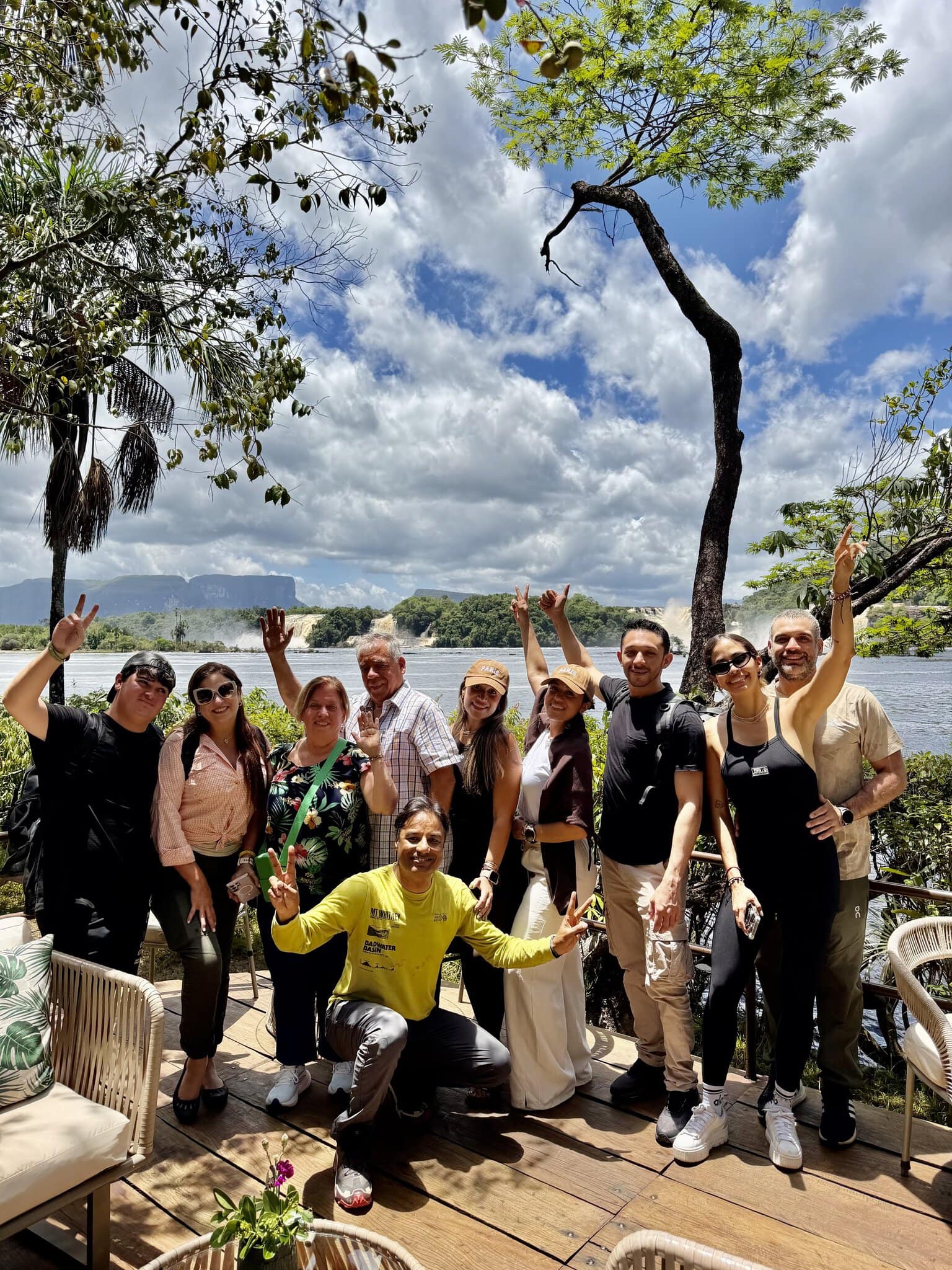
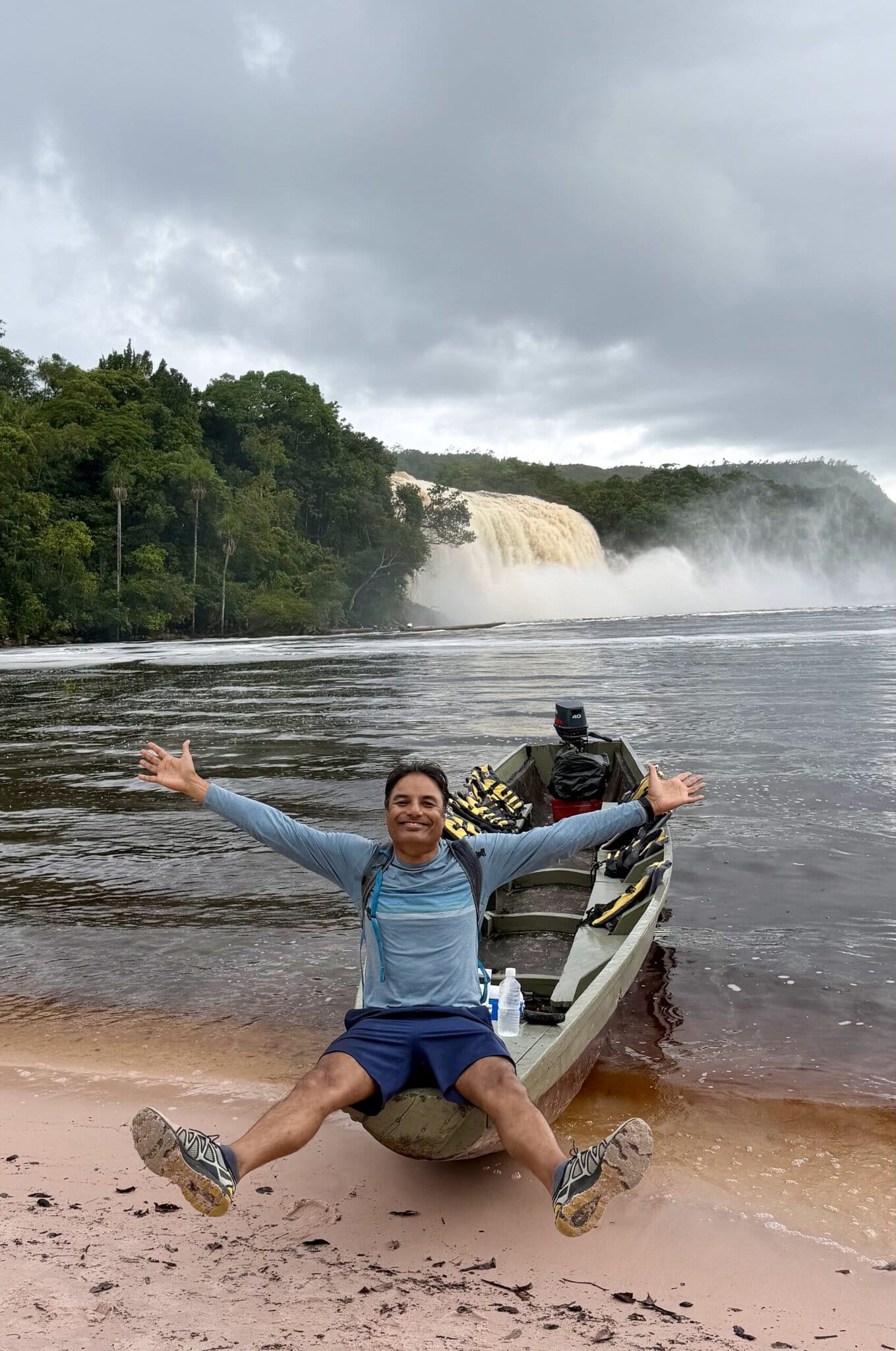
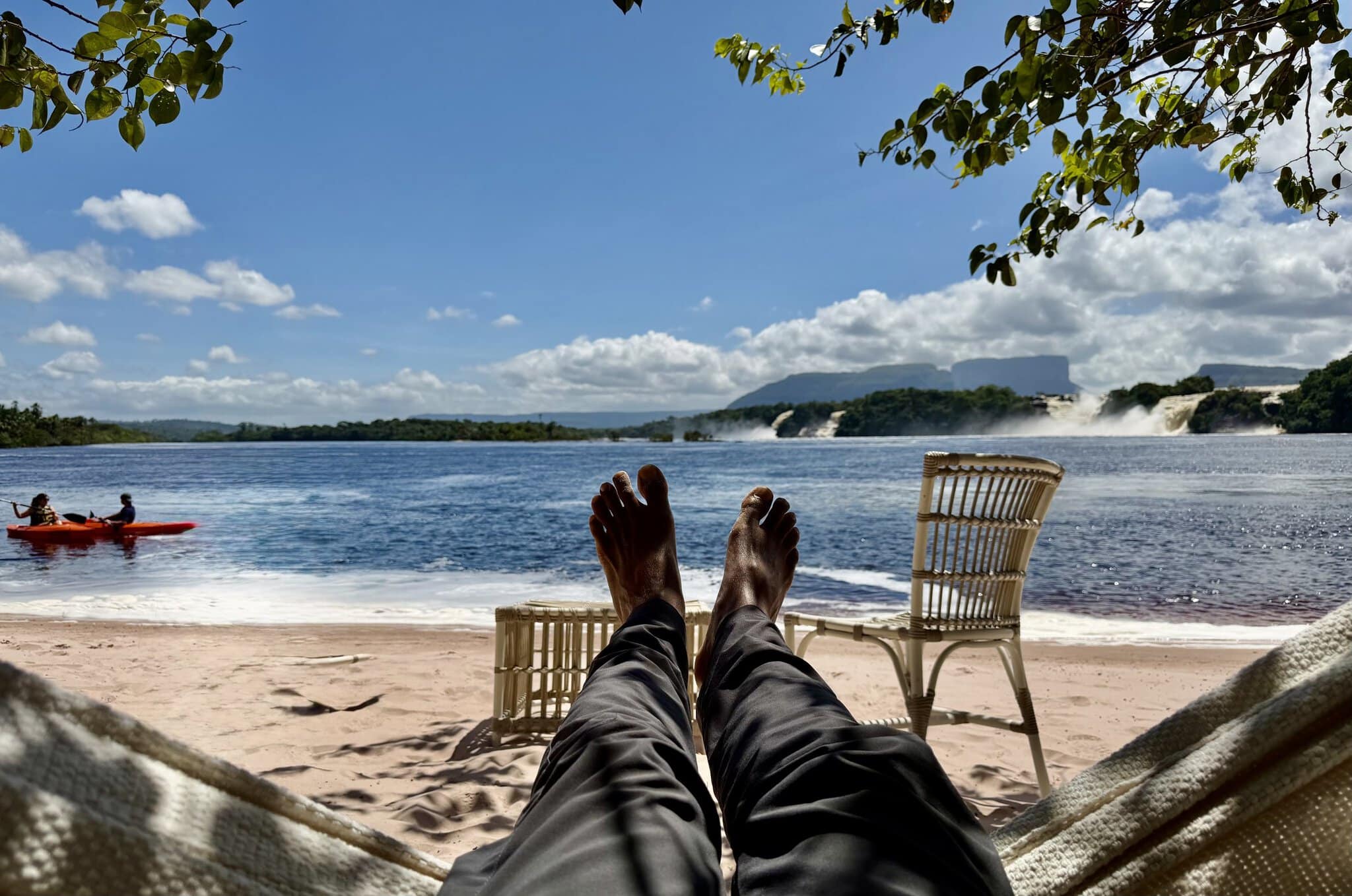
Campamento Canaima sits on a promontory overlooking Laguna Canaima, the lagoon at the heart of the park. From the terrace, you have an unobstructed view of three waterfalls tumbling into the lagoon: Salto Hacha, Salto Ucaima, and Salto Golondrina. The open-air dining room, the sounds that fill the night, and the sense that you have genuinely arrived somewhere rare — everything about it earns the name.
Long-haul travel to South America doesn’t cross many time zones, yet it’s worth planning with our jet lag protocol after 30 years of crossing time zones, covering what actually works.
The Lagoon Falls: Salto Hacha and Salto El Sapo
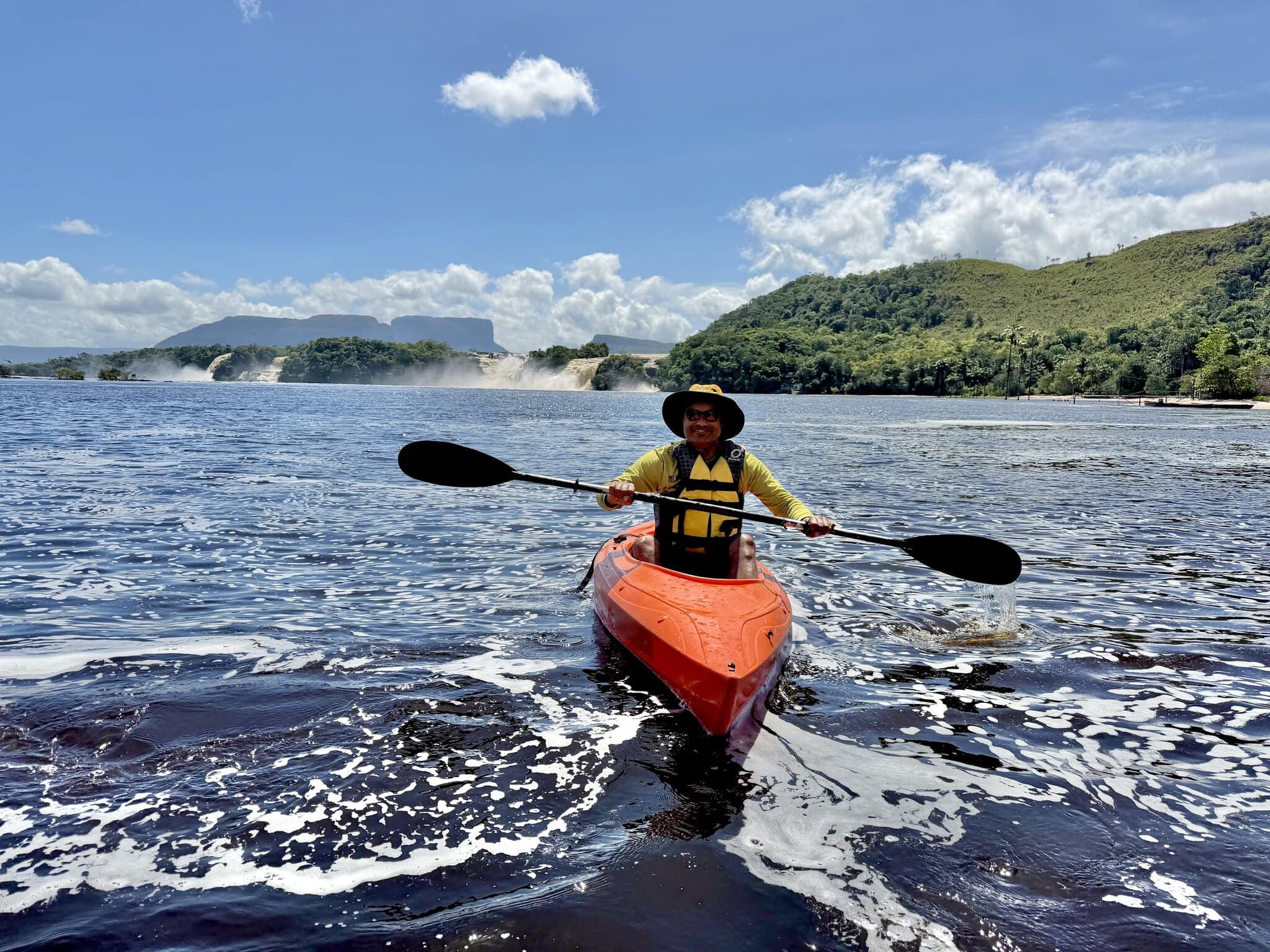
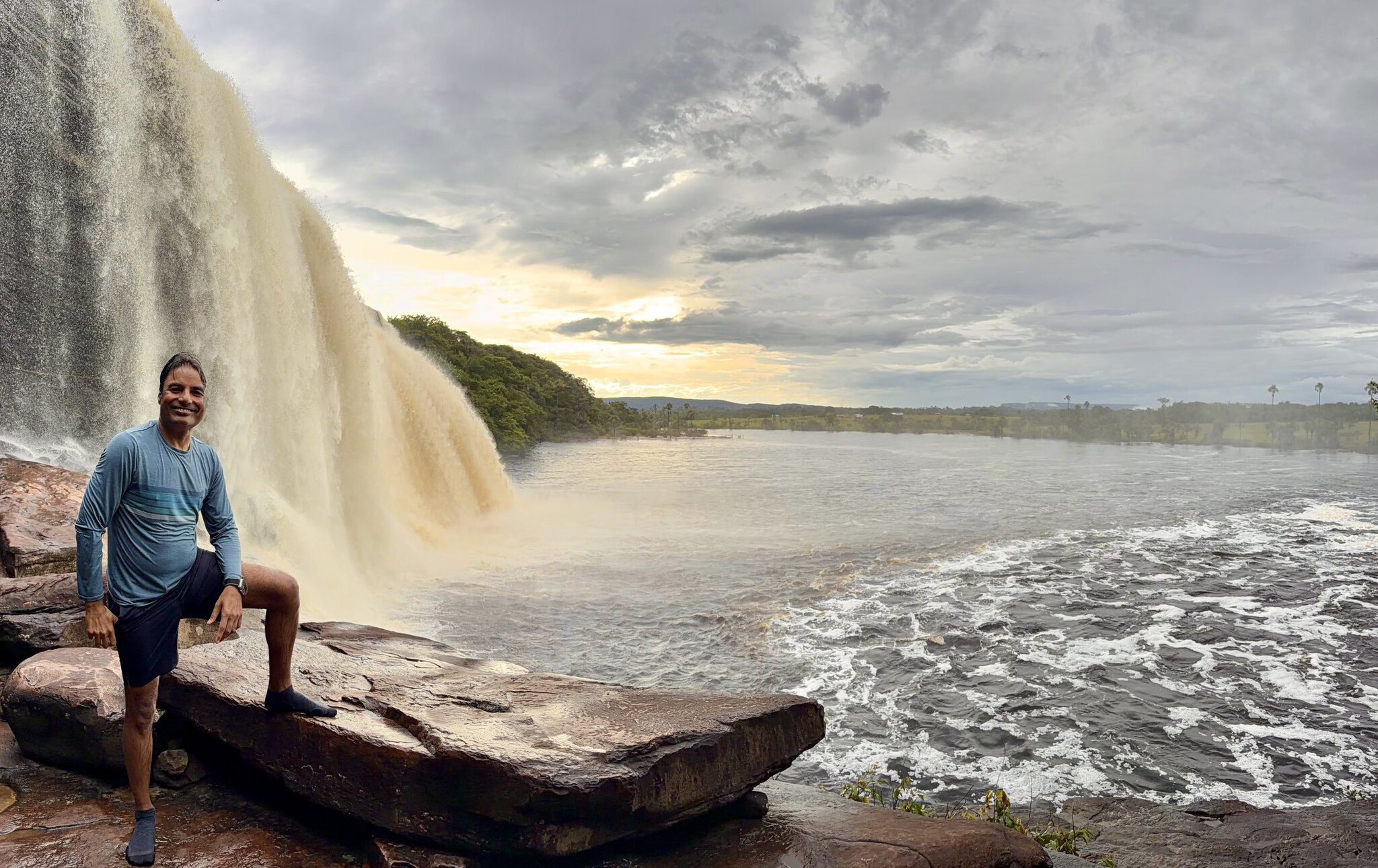
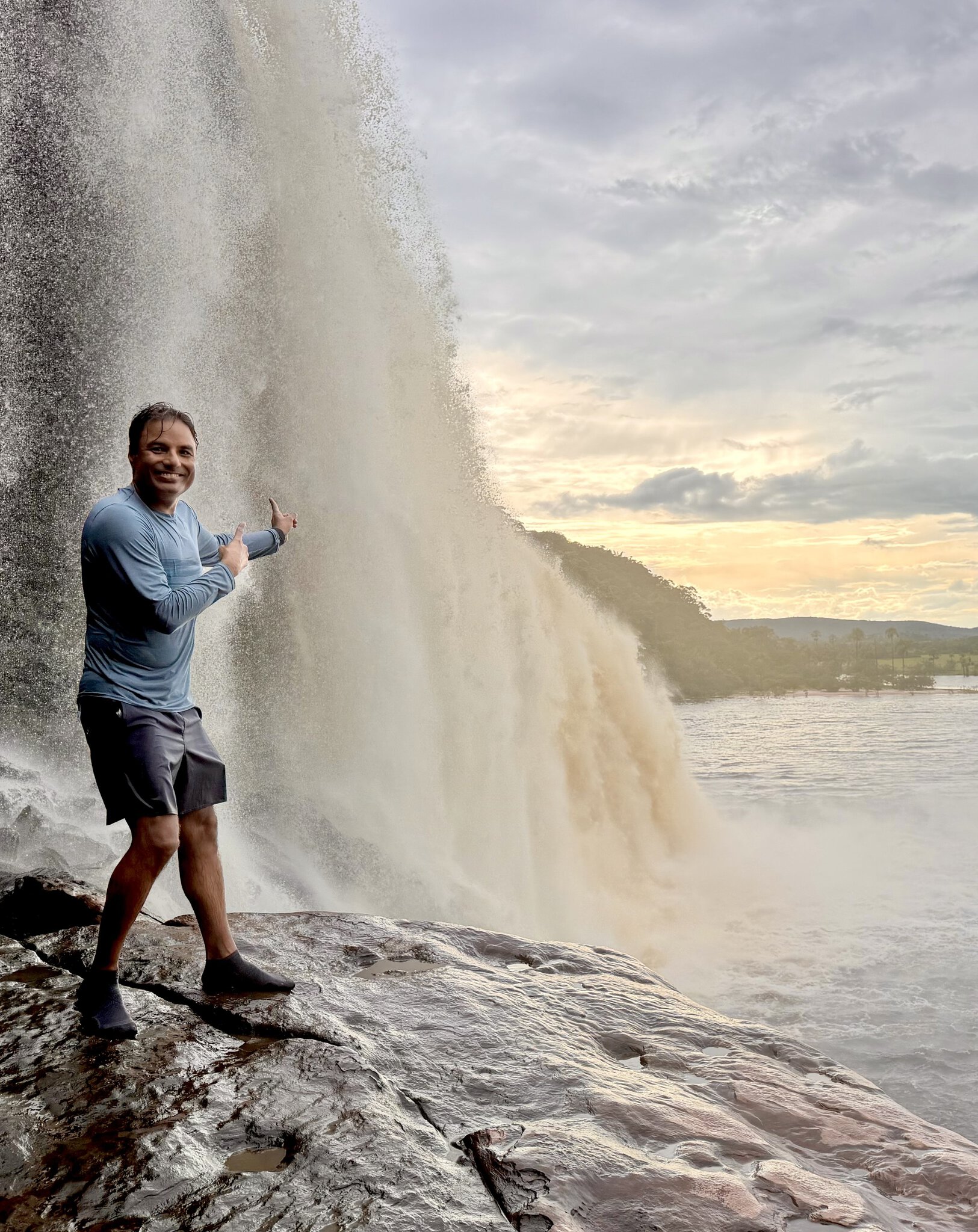
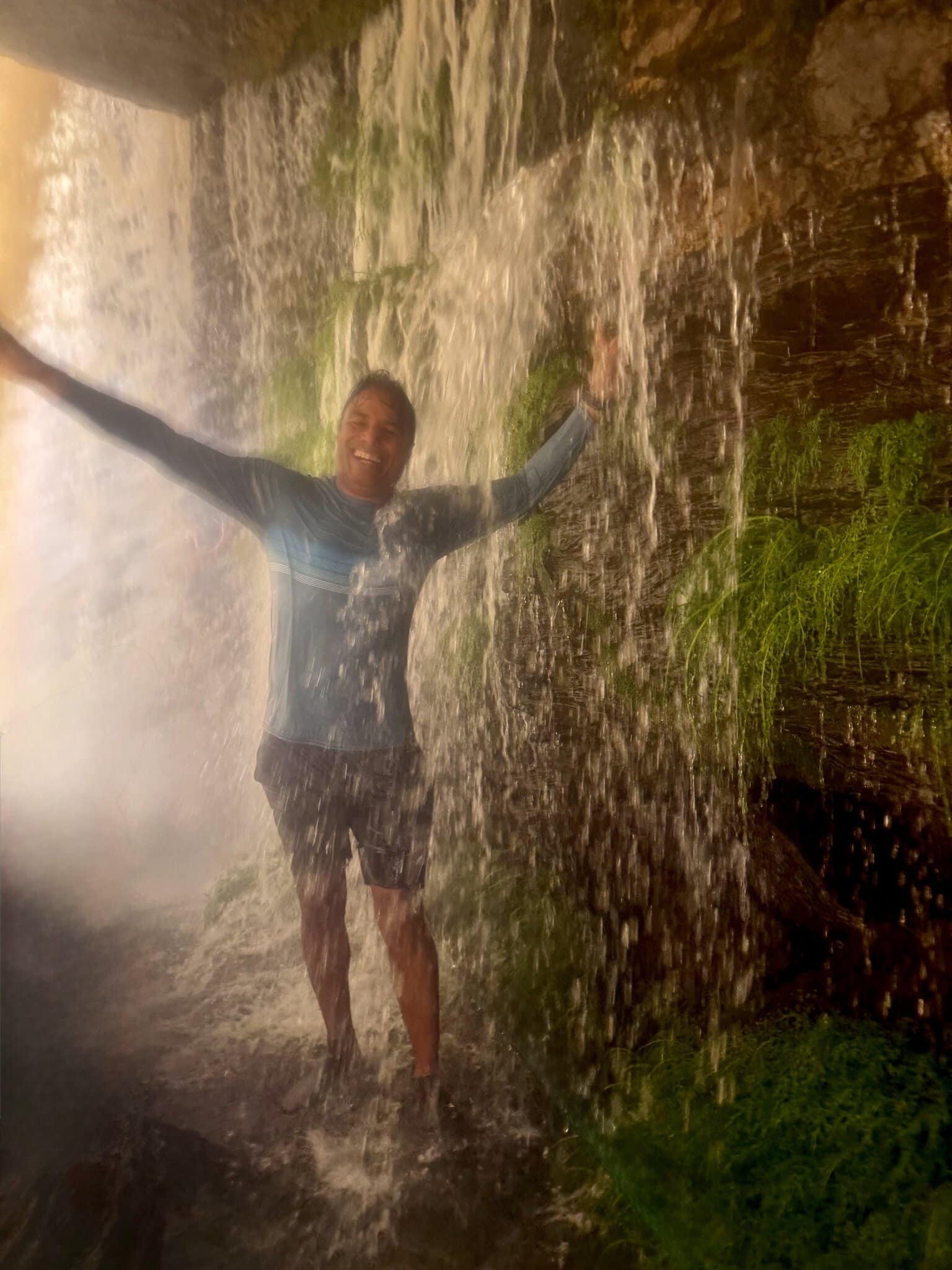
Two of the falls near Canaima, Salto Hacha and Salto El Sapo, allow visitors to walk directly behind the curtain of water. In any other country, either one would be the headline attraction. Here, they are the warm-up.
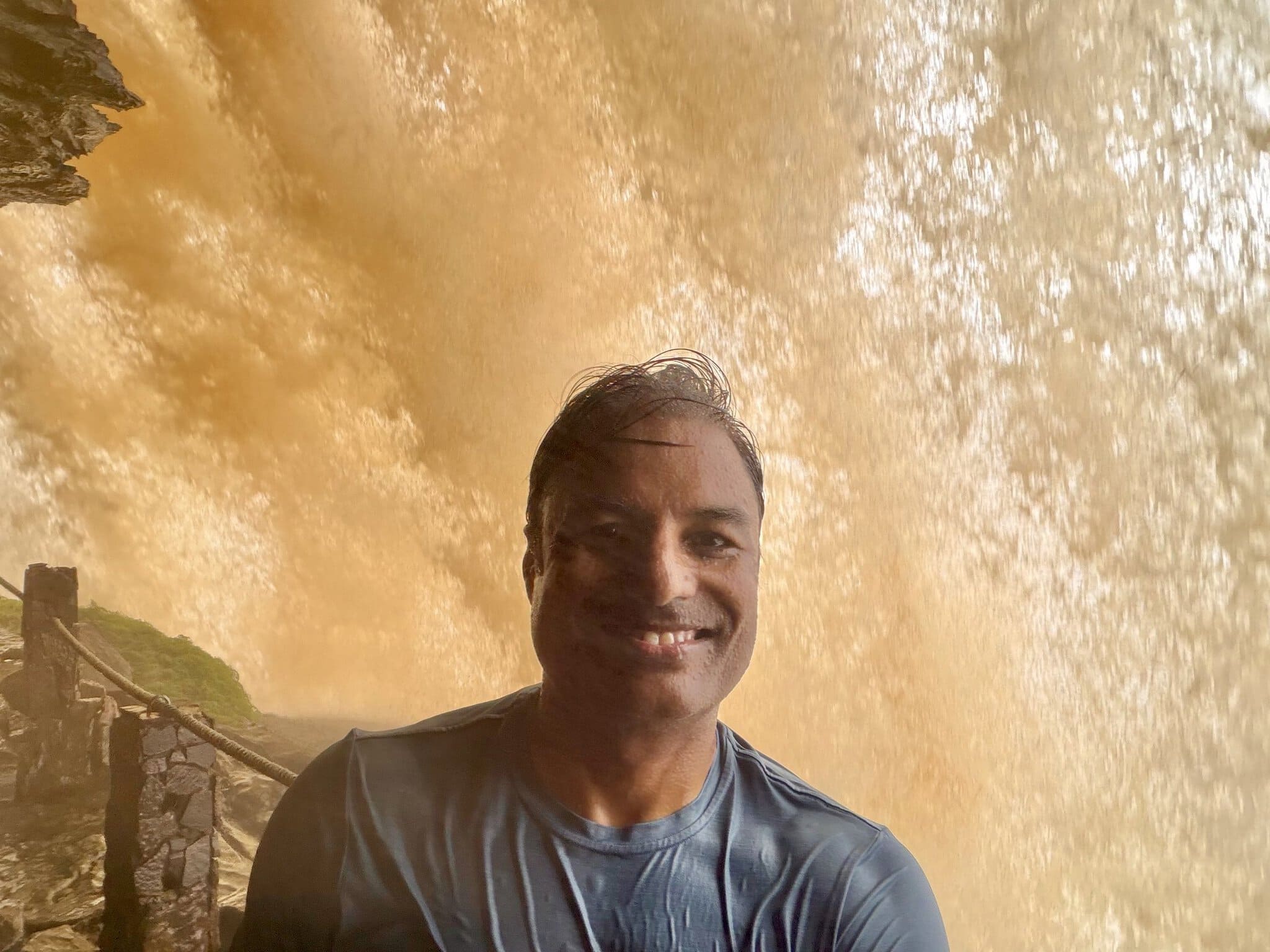
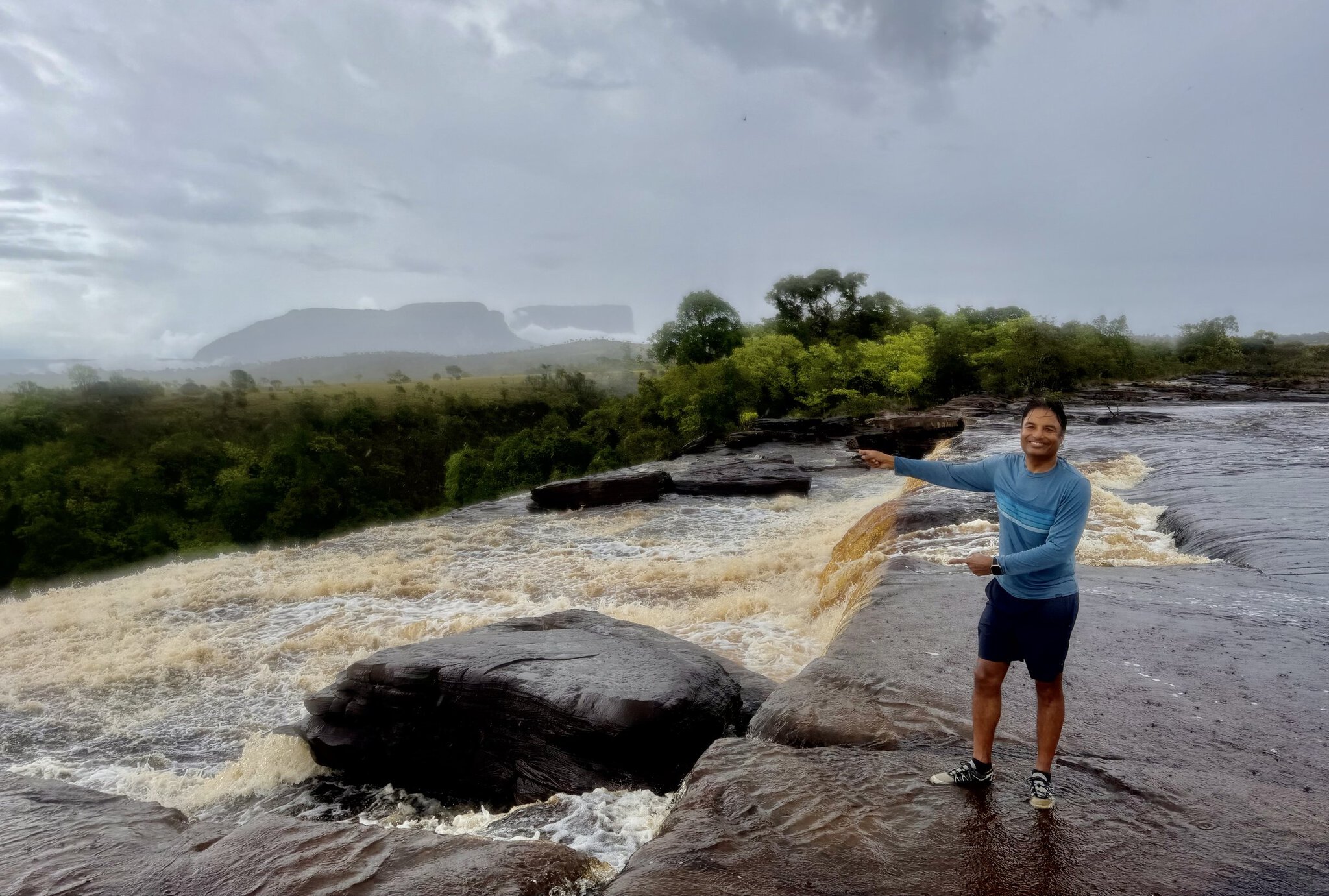
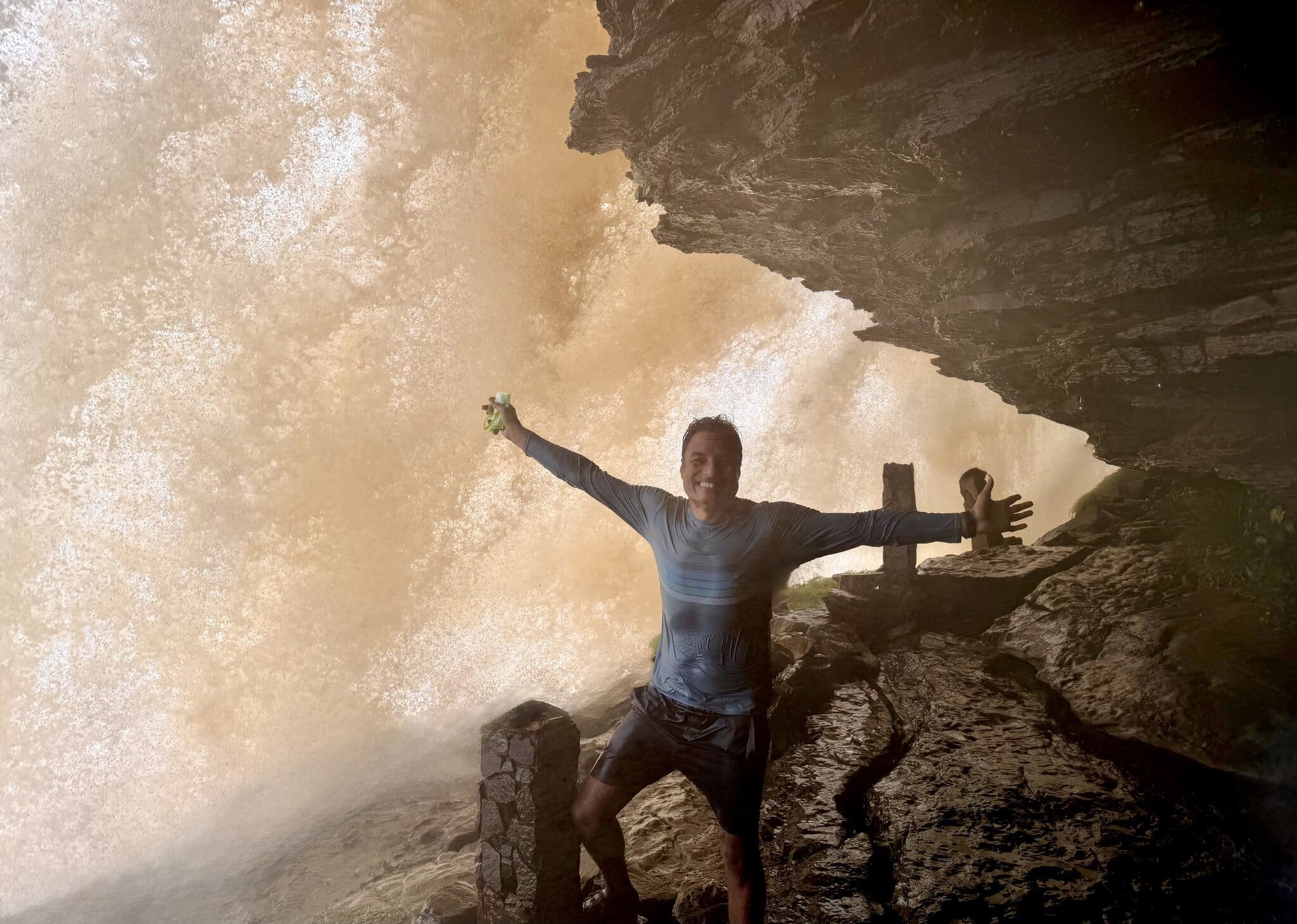
Salto Hacha (known to the Pemon as Waka Wena) tumbles into Canaima Lagoon and has a well-worn path that takes you right to the edge of its curtain. The water is that extraordinary tannin red-brown color, deep amber-gold, stained by centuries of decomposing jungle vegetation. Walking behind it means you come out the other side completely drenched, grinning, and entirely unwilling to care about your dry clothes.
Salto El Sapo (Pemon name: Sarinpa) is longer and more powerful, with a broader, more theatrical curtain of water. “Sapo” means frog in Spanish, though the falls look nothing like one. You walk behind it on a narrow path cut into the rock face, the full force of the water roaring inches from you. At golden hour, with the lagoon going orange behind you and the tepui outlined against the sky, it is almost too beautiful to absorb.
These falls would stop most trips cold. At Canaima, they are Tuesday.
The Two-Day Expedition to Salto Ángel
How difficult is the Angel Falls expedition?
The expedition is rated high difficulty and is not a casual day trip. The official guidance from Campamento Canaima notes it is not recommended for adults over 64 due to the length of the journey, rough river rapids, and the steep, rooted, muddy terrain of the trek. That said, fitness and comfort with physical challenge matter more than age. If you move well on uneven ground and are comfortable in a canoe navigating rough water, the difficulty is entirely manageable.
The River Journey
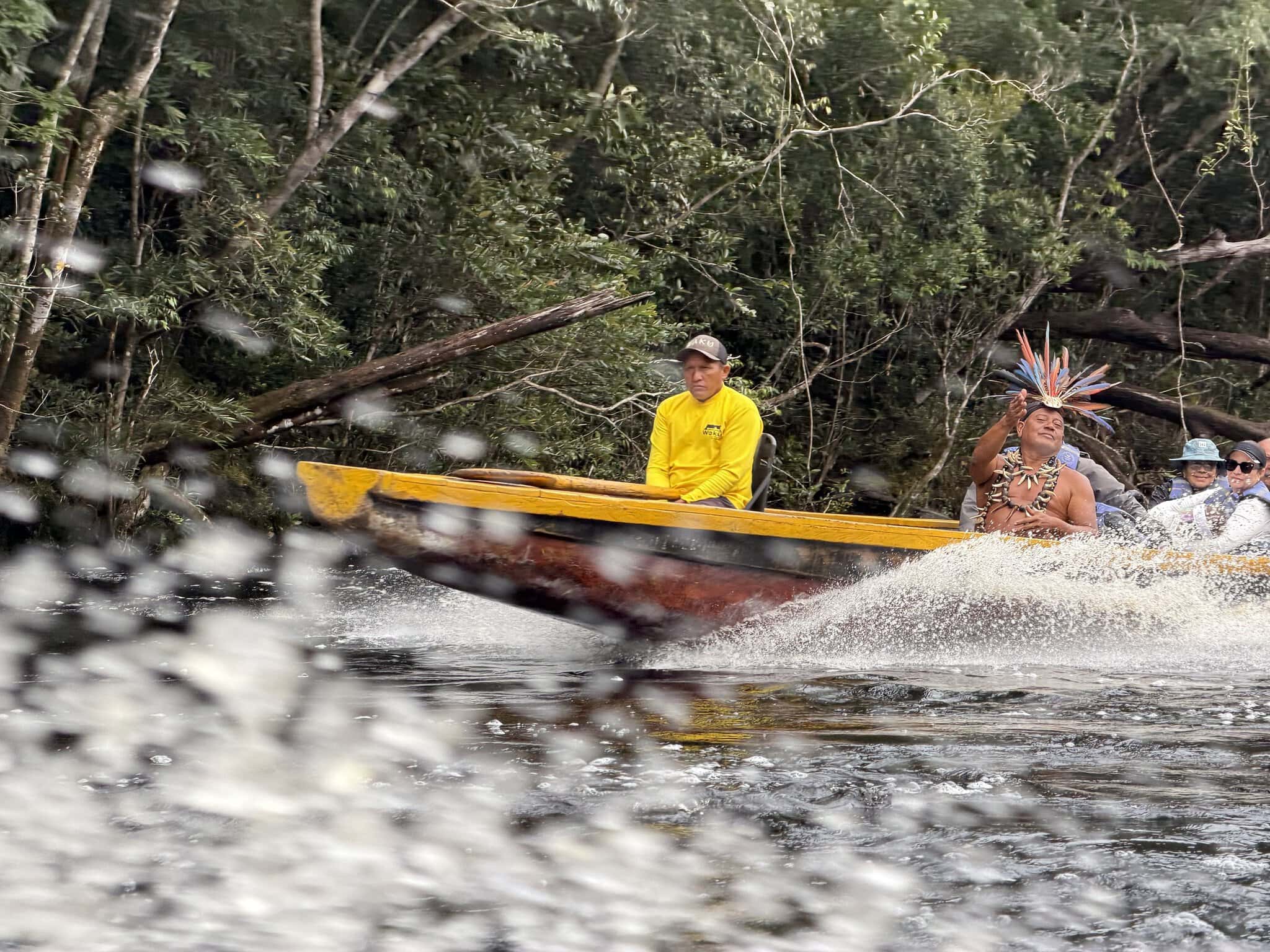
The expedition departs from the lodge by road to Ucaima port, then by motorized canoe on the Carrao River. The canoe is long and low, designed for exactly this kind of river travel.
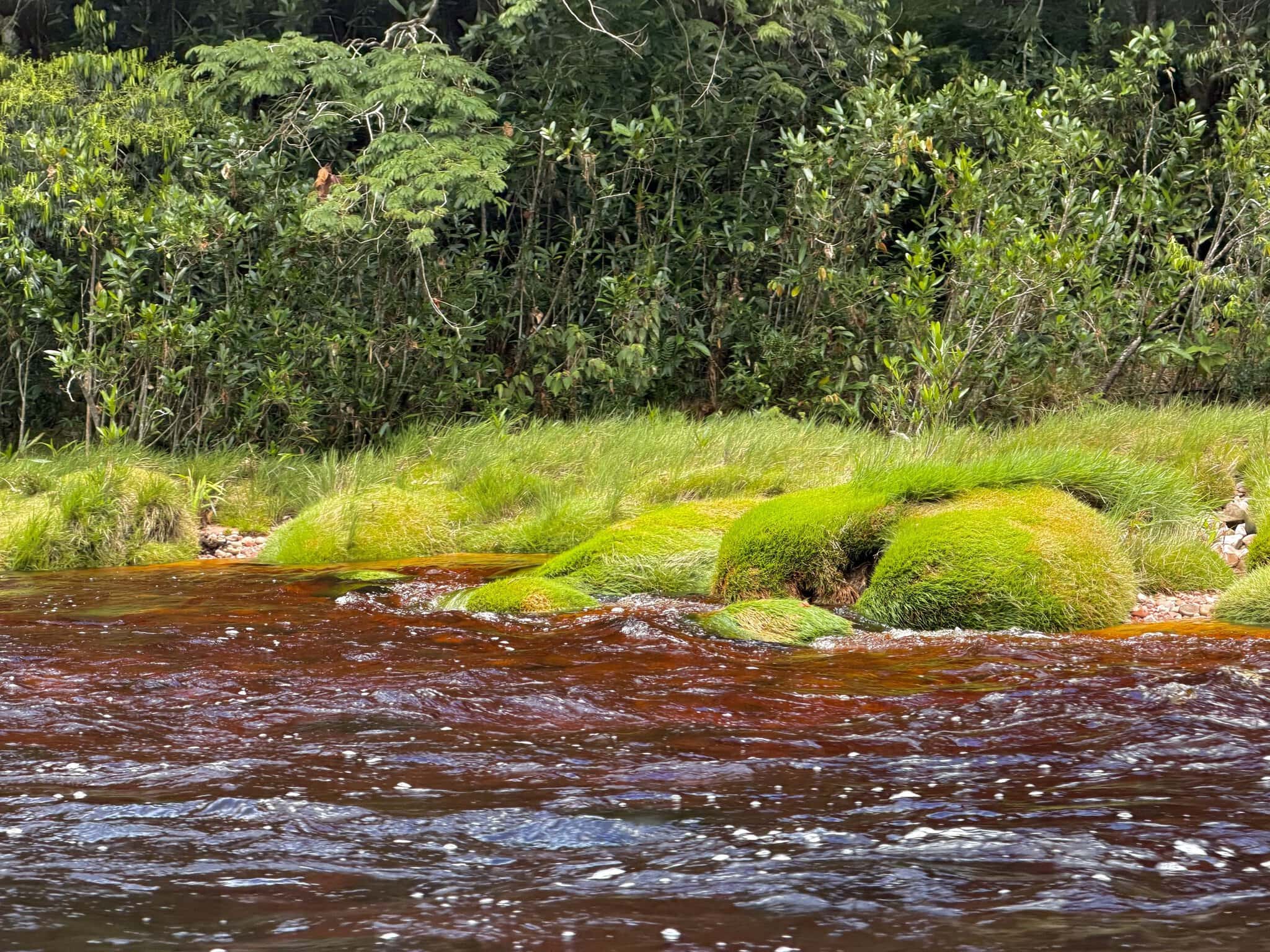
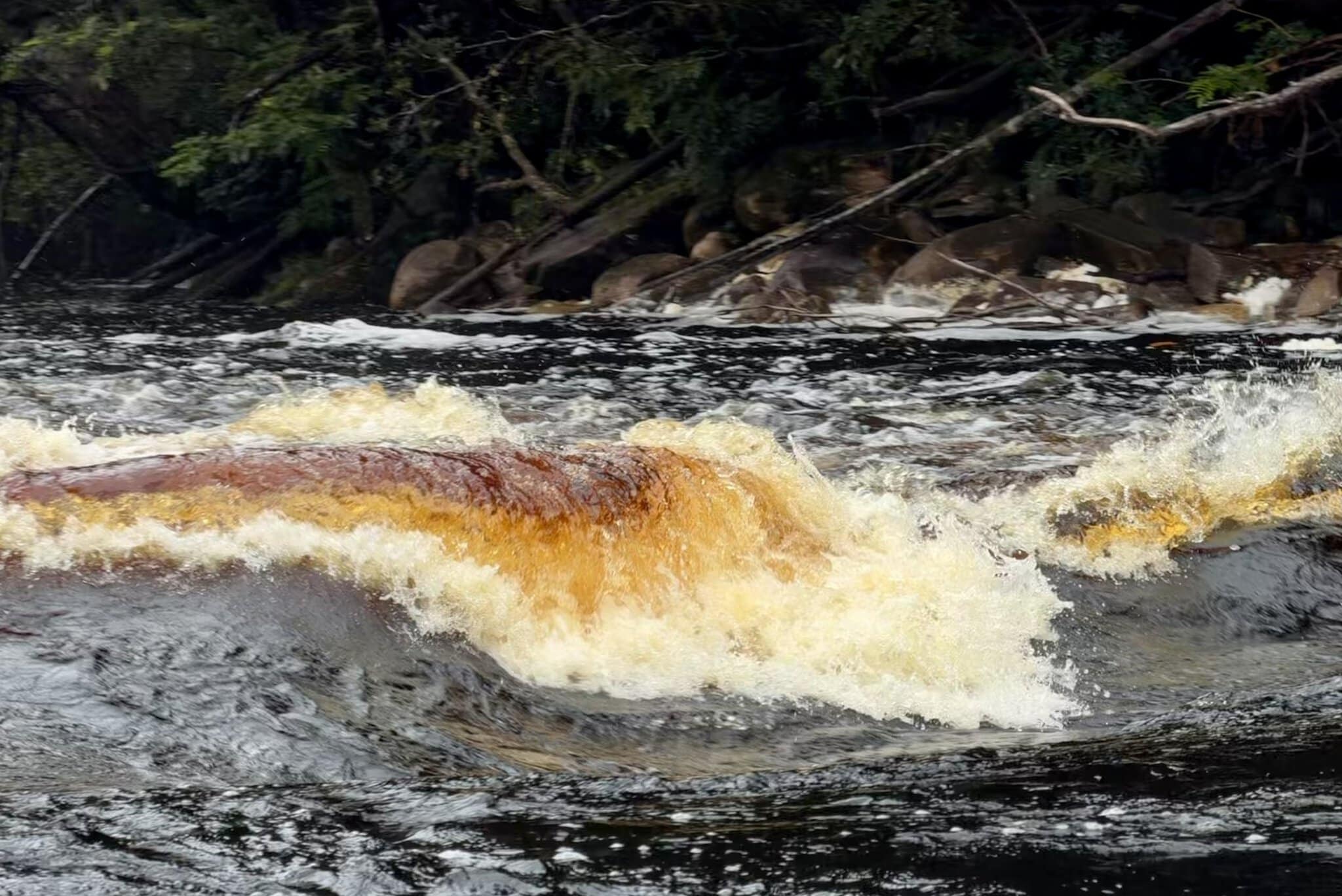
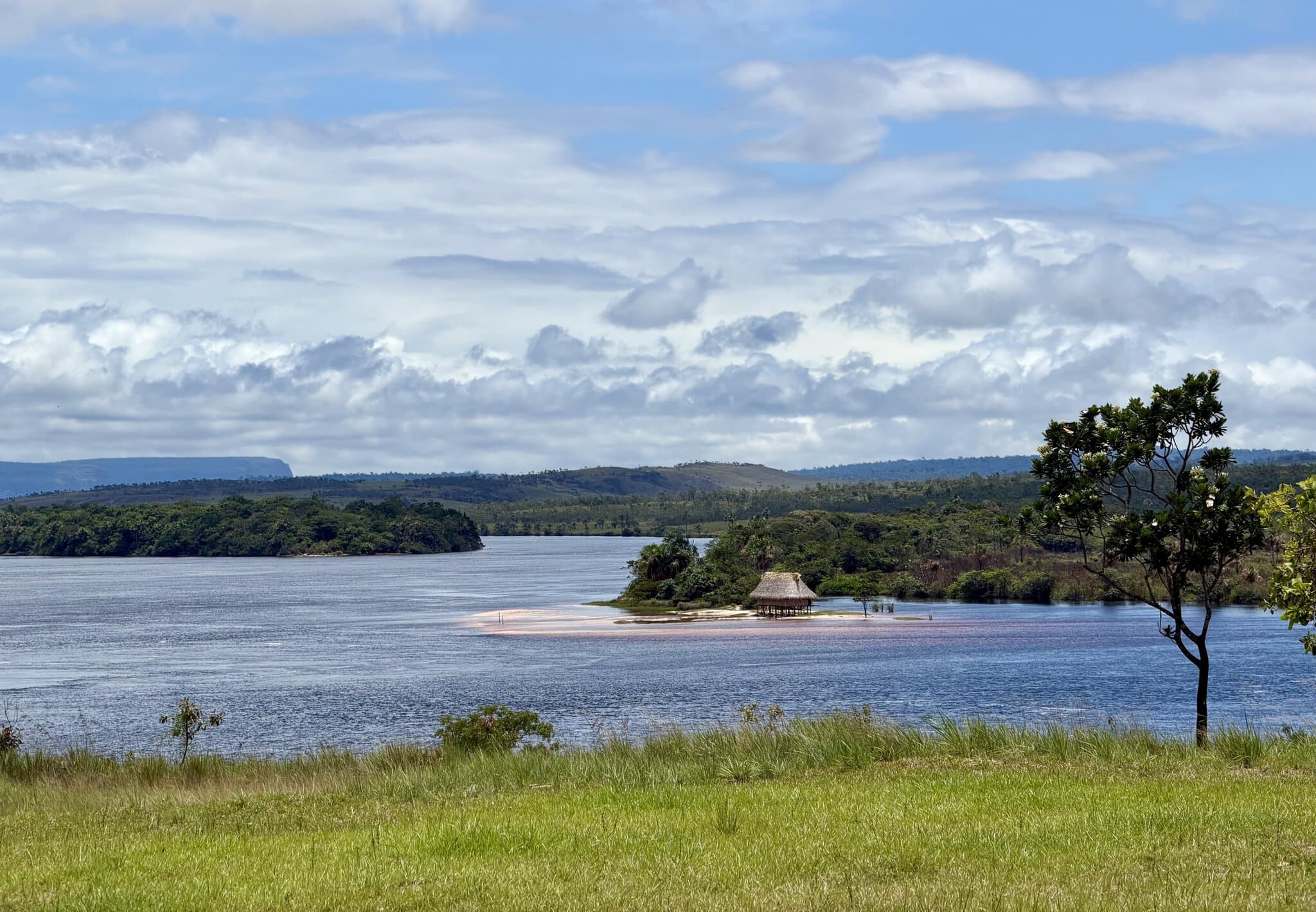
The Carrao runs that extraordinary tannic red-brown that becomes a recurring character in everything about Canaima. It is not pollution or sedimentation. It is tannins from billions of decomposing jungle leaves over billions of years, giving the water a color that photographs like dark amber glass. Paired with the electric green of moss on the riverbanks, it looks almost painted.
The first stop on the river is Mayupa Island, where the rapids are too rough to navigate safely with passengers aboard. The group disembarks and hikes across the island, around 45 minutes, while the guides navigate the canoe around the rapids and meet you on the other side. This portage happens several times over the course of the day, and each time the landscape shifts: open savanna giving way to rainforest, rainforest opening to jungle so dense and green it feels like moving through something alive. The river runs alongside you, white and fast, the whole time.
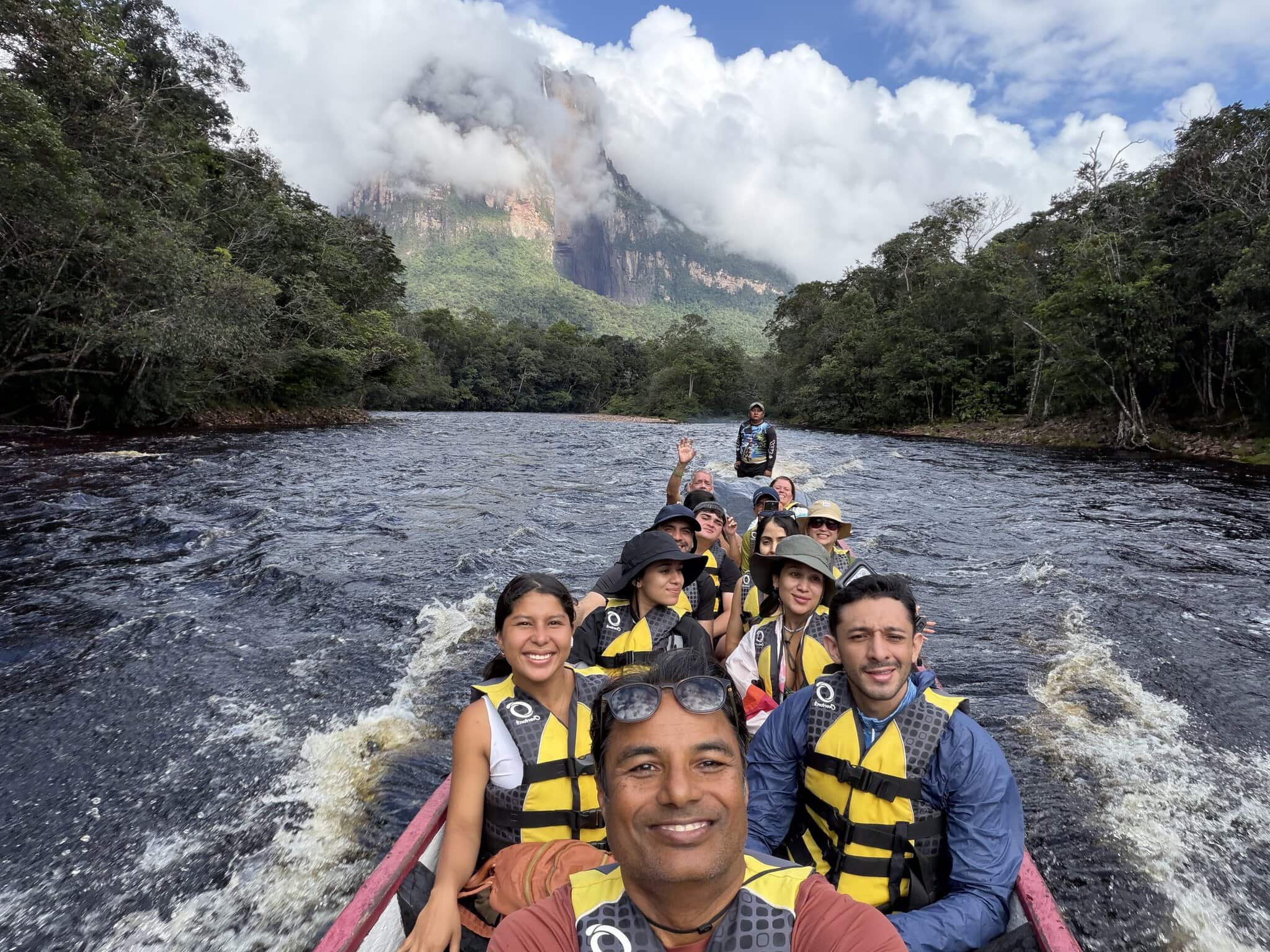
That moment when Angel Falls suddenly appears through the mist behind you and everyone on the boat just goes quiet for a second before the cameras come out. The tannic brown river, the dense jungle walls on either side, and that impossibly tall streak of white water in the clouds above, nothing quite prepares you for it.
The Trek
After lunch on the Churún River, the river that feeds Angel Falls directly from the Auyan Tepui summit, the canoe continues upstream to Raton Island. From there, the trek to the falls lookout begins in earnest.
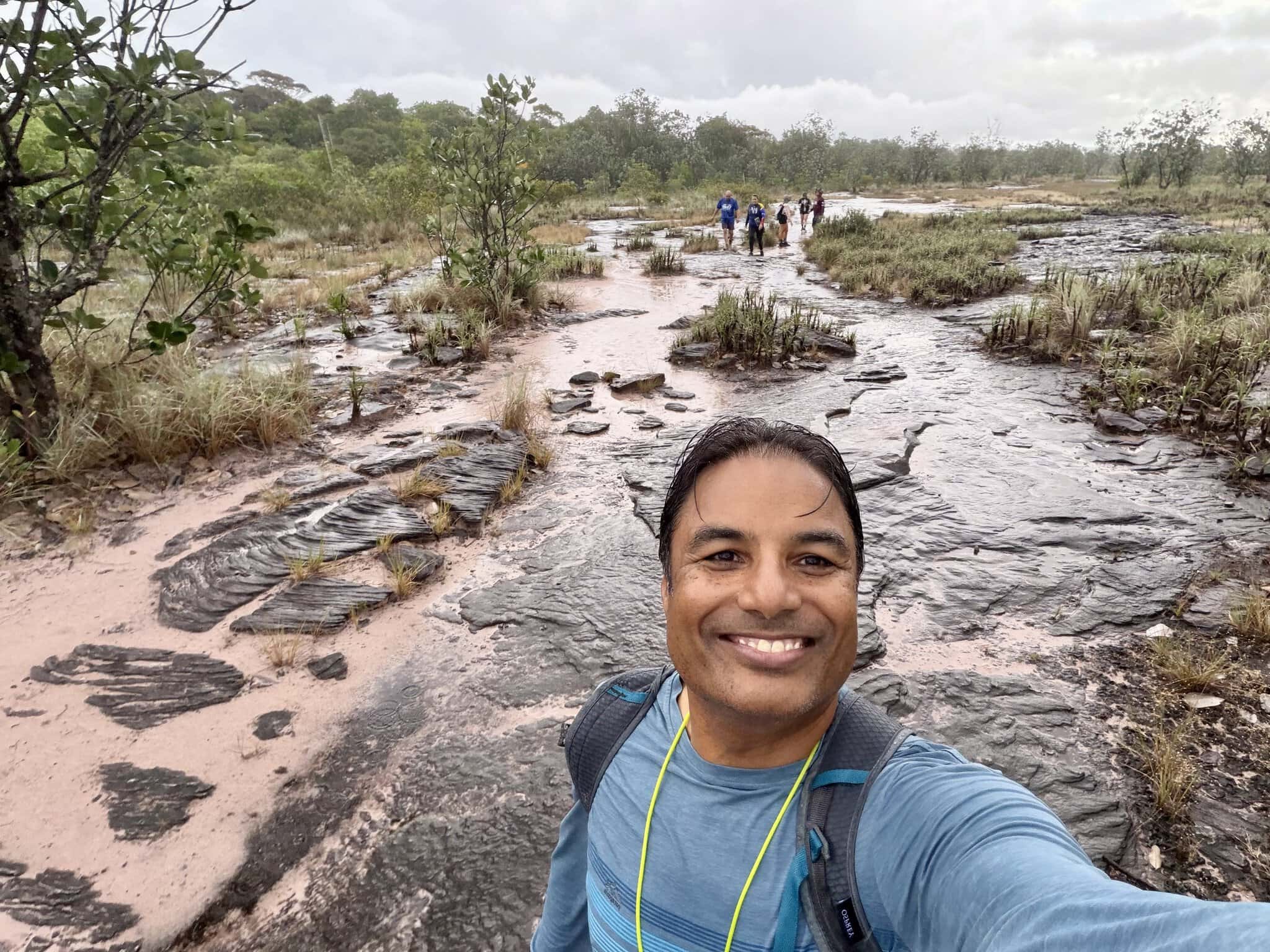
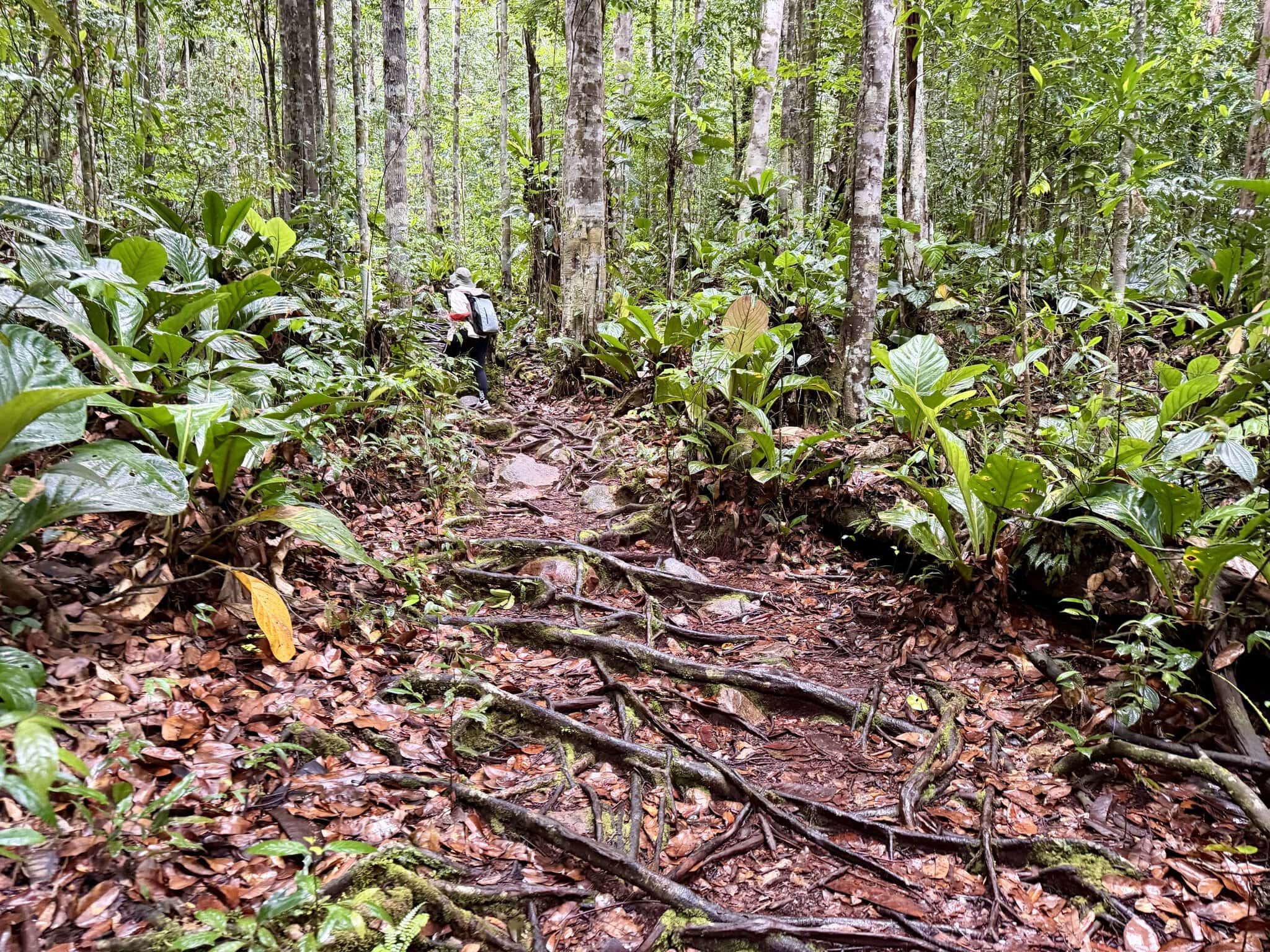
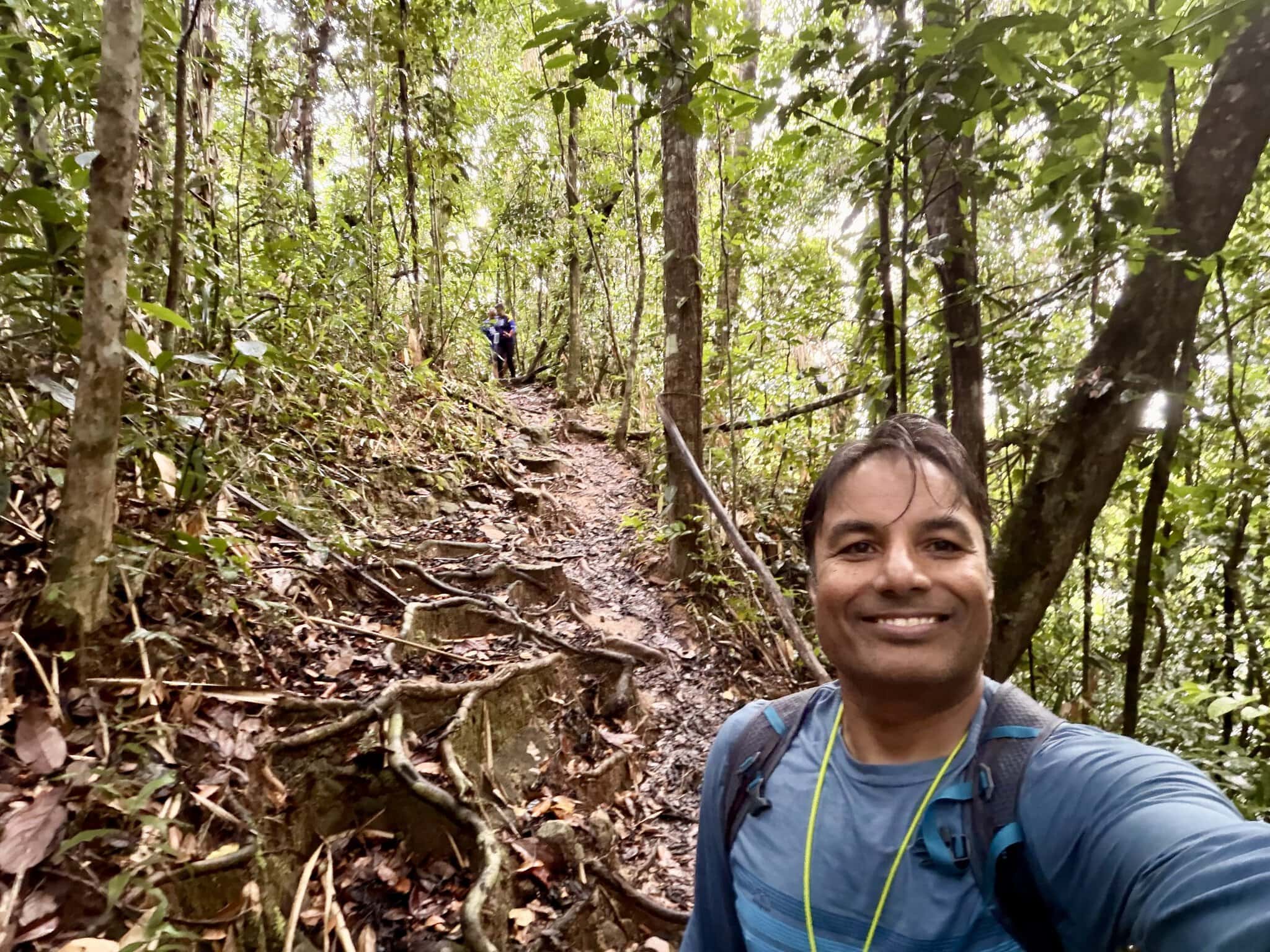
The path is a couple of hours each way: muddy, rooted, rocky, steep in places, and relentlessly green. The roots are not an obstacle course so much as the trail itself, dense enough that you are walking on a woven mat of ancient tree roots. Your shoes will not survive this dry. At the viewpoint, the falls open up in front of you. In the right season, when water levels allow, you descend further to the pool at the base.
I got to swim in that pool. The water is cold, fed directly from the tepui summit, and the mist from the falls hangs in the air so thickly that you are half-wet before you enter. The scale of the falls from the water’s edge is impossible to fully comprehend. From a distance, the water moves in that soft, almost slow-motion way. Up close, the roar fills everything.
Overnight at the Base
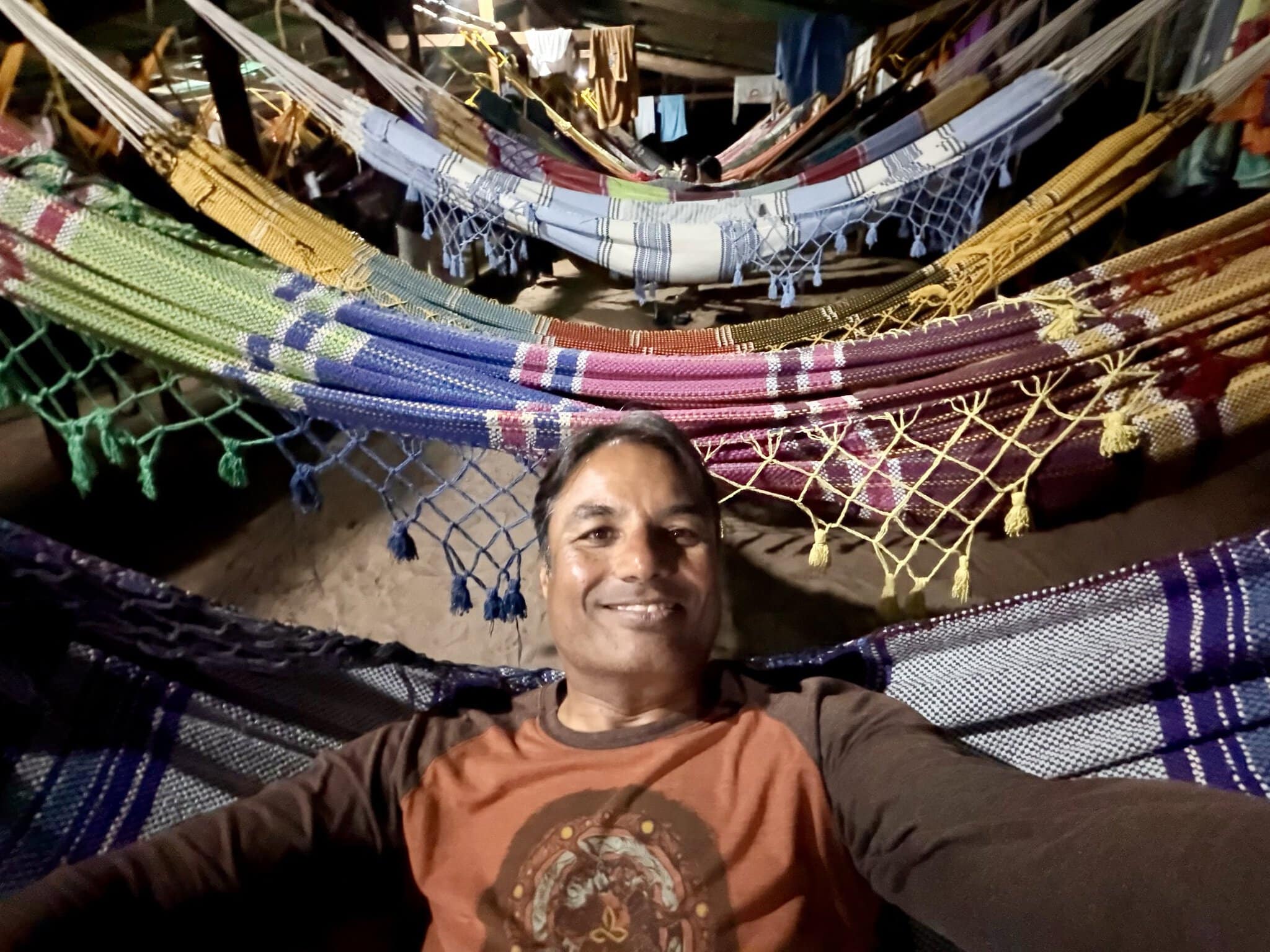
The expedition stays overnight at a hammock camp near the base of the falls. Hammocks, blankets, and towels are provided. Dinner is at the camp. Breakfast is at 7:30 a.m., and the return canoe gets you back to Campamento Canaima around midday.
Sleeping to the roar of Angel Falls is the kind of thing that sounds better as a plan than as a reality for some people, and absolutely transcendent for others. For me, it was the latter.
The Living World Between
The jungle around Angel Falls is not a backdrop. It is foreground.
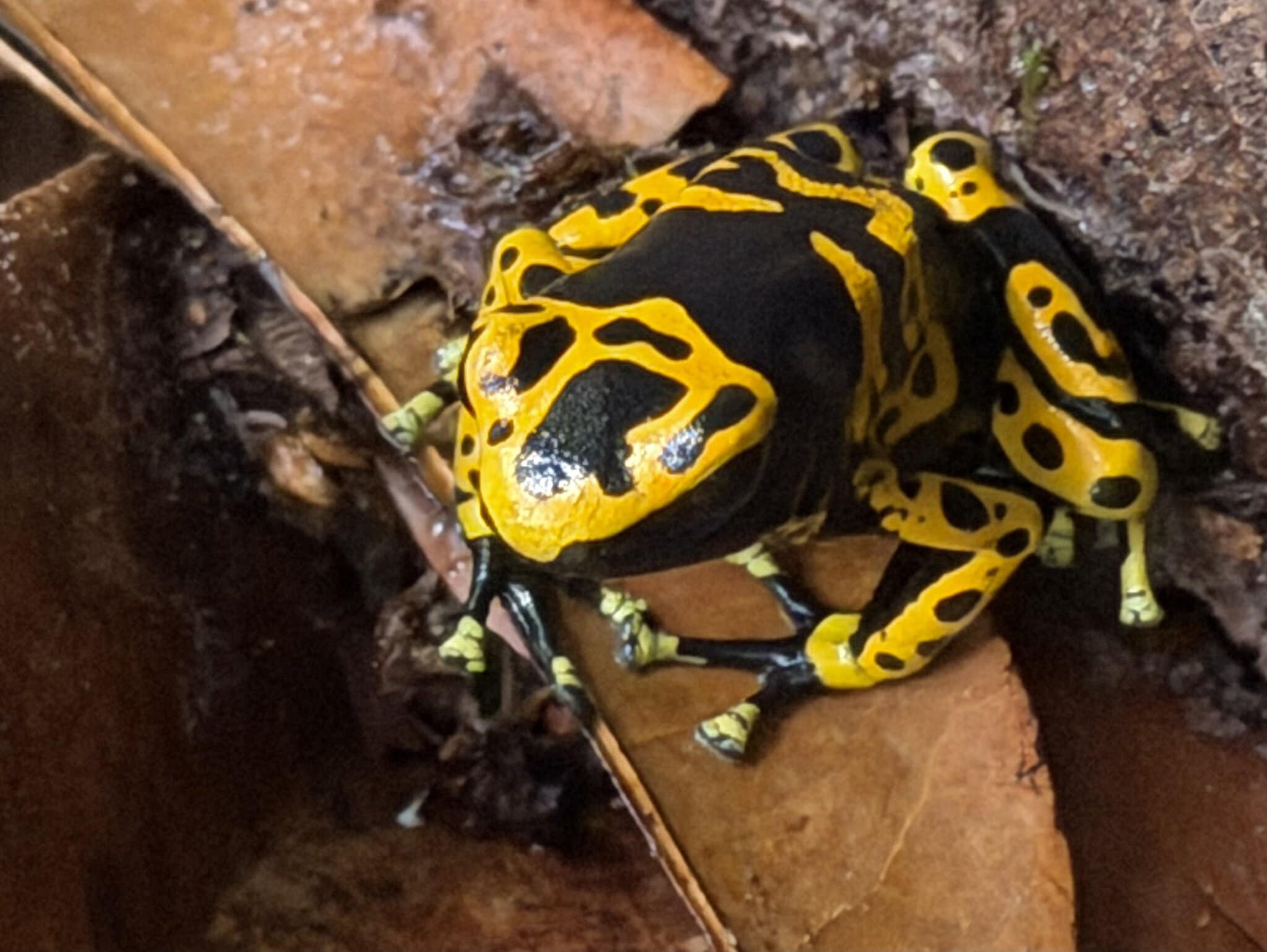
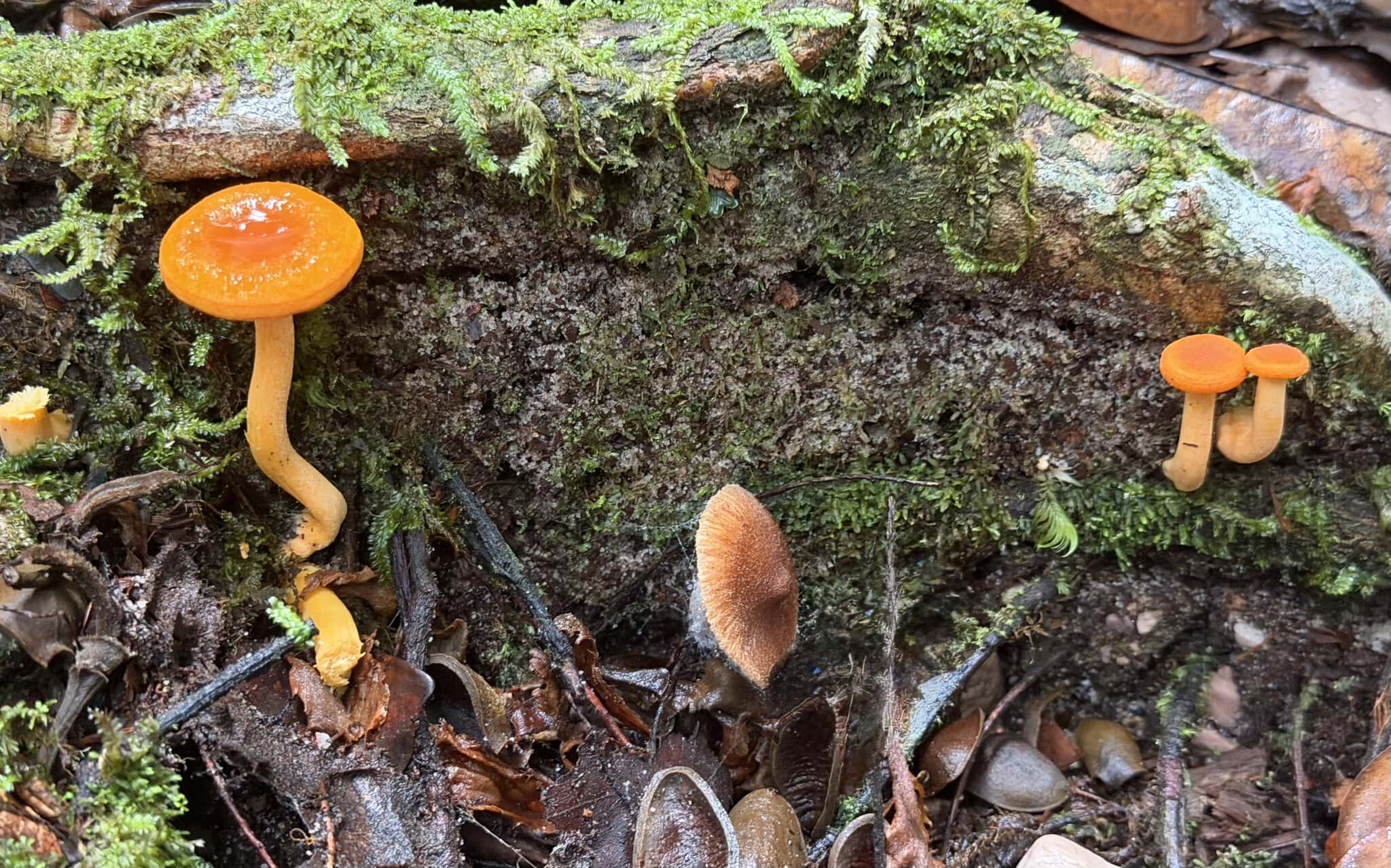
The rivers run through it like something ancient and indifferent, cutting channels that the canoe follows and loses and finds again. The moss on the rocks grows in a green so vivid it registers almost fluorescent against the dark tannic water. Poison dart frogs the size of your thumbnail announce themselves in yellow-and-black banding so bold they look designed by someone with opinions. Termites work on decomposing stumps with a quiet relentlessness that is somehow comforting — the whole system breaking down and rebuilding, the jungle eating itself and growing from the same meal.
The air is thick and green and alive in a way that cities make you forget air can be. By the second day in the jungle, you stop noticing the humidity and start noticing everything else.
The Pemon: The People the Tepuis Belong To
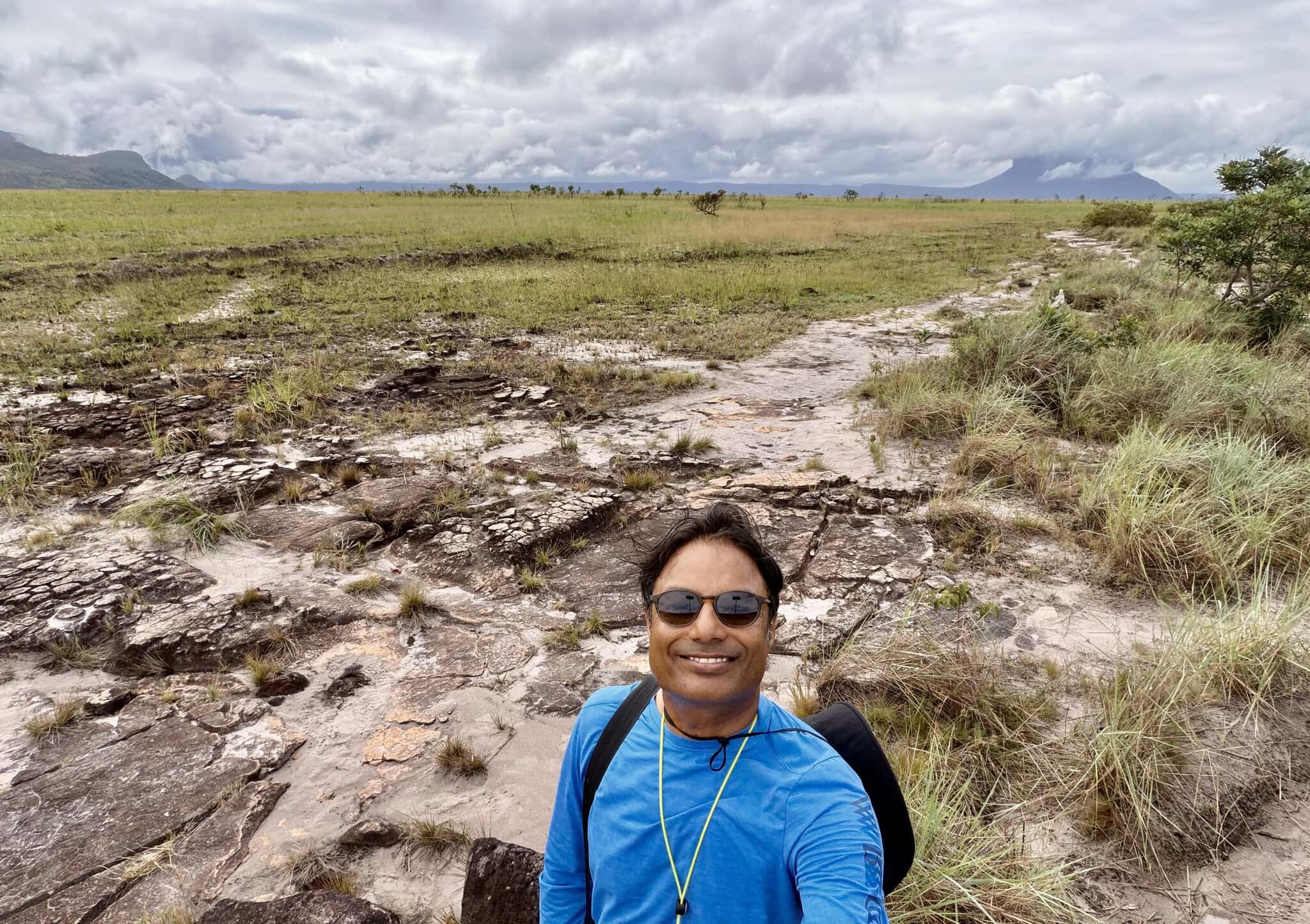
The Pemon are the indigenous people of the Gran Sabana, the vast savanna plateau that encompasses Canaima National Park and extends into Brazil and Guyana. They have lived in this landscape for thousands of years, and it is theirs in the deepest sense: not just historically, but spiritually and practically. The tepuis appear in Pemon cosmology as the homes of Mawari, powerful spirit beings. The rivers, the waterfalls, the jungle, and the plateau are all part of a living world they have named, known, and navigated across generations.
The word *tepui* is Pemon. So is *kerepakupai*, the waterfall’s true name. The Pemon guides who run the Angel Falls expeditions are not interpreting their own landscape for outsiders; they are at home in it. Our guide navigated the river rapids with the ease of someone who learned this water as a child, because he did.
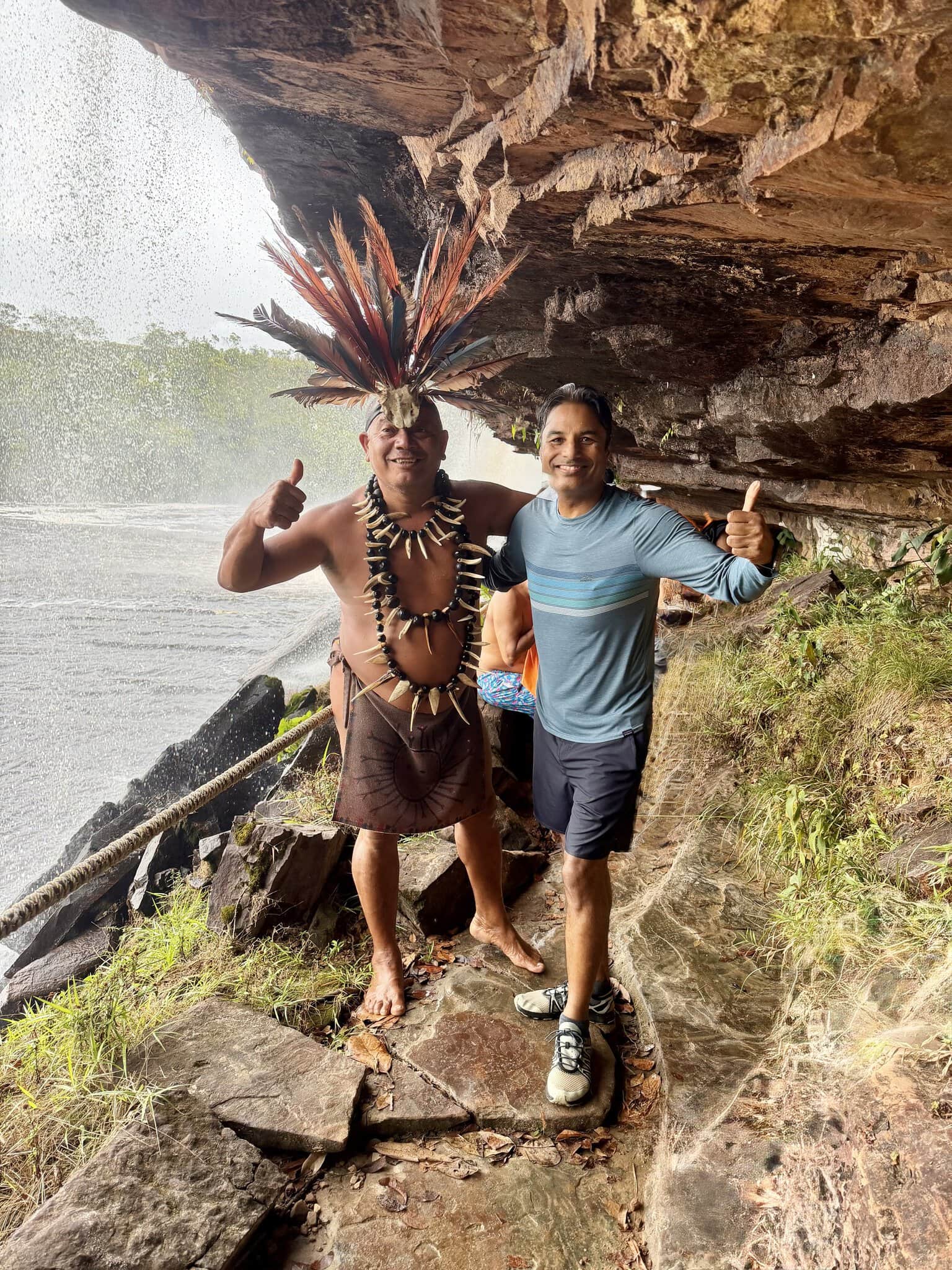
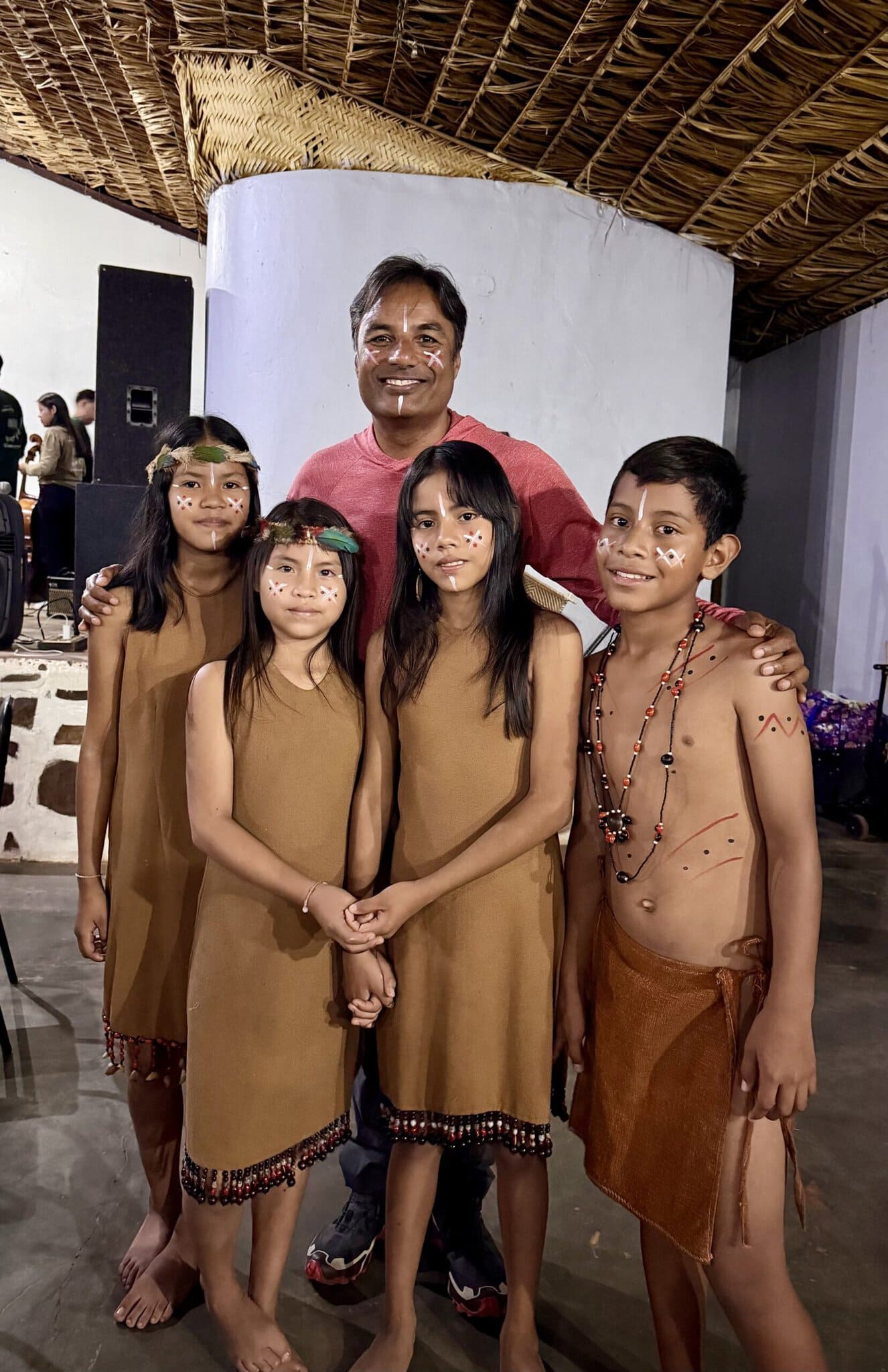
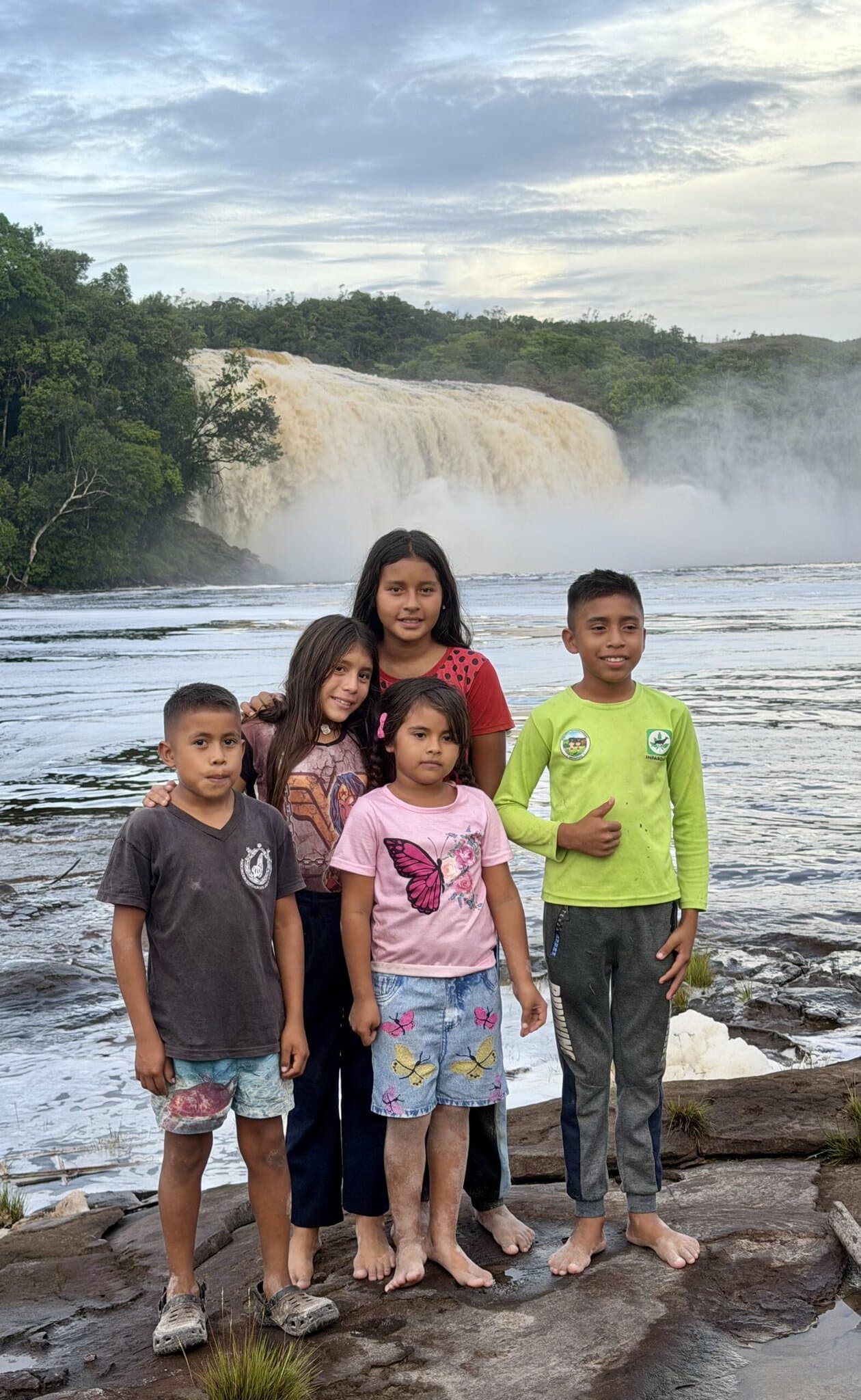
The cultural evening in the Canaima village, with traditional Pemon dance, dress, and body painting, is an experience I found genuinely moving rather than performative. The children playing beside the lagoon, with three-hundred-foot waterfalls as ordinary Tuesday afternoon scenery, said more about the Pemon relationship to this landscape than any formal presentation could.
Eating Plant-Based in Venezuela
We travel on a plant-based, whole-food diet, no meat, no fish, no dairy, no eggs, and Venezuela was better at accommodating it than expected. Not effortless, but genuinely good.
The food at Campamento Canaima was excellent. Fresh vegetables, beans, rice, arepas, empanadas, fruit, and a kitchen that responded warmly to advance notice about dietary needs. The hammock camp at the base of Angel Falls served a simple, satisfying dinner and breakfast.
Arepas, thick cornmeal rounds that are Venezuela’s default bread, are naturally plant-based and eaten at virtually every meal. They are one of those foods that seem simple and become essential within twenty-four hours.
In Caracas, finding plant-based food requires more intention. The city has a strong café and juice culture, and markets and grocery stores will get you further than most restaurants if you are self-catering.
The key phrase that helped most: “Soy vegano — sin carne, sin pollo, sin pescado, sin leche, sin huevo.” (“I am vegan, no meat, no chicken, no fish, no milk, no eggs.”) Spoken clearly and with warmth, it was received well everywhere. Venezuelans are proud cooks. They want to feed you something good.
For more on navigating plant-based eating while traveling internationally.
The Angel Falls Expedition: At a Glance
| Expedition duration | 2 days, 1 overnight |
| Transport | Motorized canoe on Carrao and Churún Rivers |
| Portage hikes | Multiple, around 45 minutes each; terrain varies from open savanna to dense jungle |
| Trek to falls | 2 hours each way; muddy, rooted, steep in sections |
| Overnight | Hammock camp near the base; hammocks, blankets, and towels provided |
| Difficulty | High. Not recommended for children under 6 or adults over 64. Requires comfort with river rapids, uneven terrain, and multi-hour physical effort. |
| What to bring | Quick-dry clothing, extra swimsuit, light sweater for the evening, closed shoes that can get completely wet, headlamp, personal medications |
| Best season for the pool | June to November (higher water flow) |
Practical Information
Getting to Canaima
Fly into Simón Bolívar International Airport (CCS) near Caracas, then connect to Canaima via Conviasa or charter. Conviasa flies to Canaima twice a week, and the lodge can help with bookings — that coordination is the preferred route. The flight itself is on a small propeller aircraft, and the aerial view of the Gran Sabana on descent is worth every minute of the journey.
Staying at Canaima
Campamento Canaima is one of the main lodges in the park, sitting directly on the lagoon with views of Salto Hacha and Salto Ucaima from the terrace. Book directly with the camp and confirm the Angel Falls expedition dates when you book — it does not run every day.
The Venezuelan Visa
The Venezuelan e-visa situation changes frequently. When Nirmal applied, the process took four days and required no fee and no supporting documents. That window has since narrowed, and requirements have become more complex. Verify current requirements at the official Venezuelan e-visa website well before making any plans, and build in processing time. This is a trip worth planning carefully.
Best Time to Visit
The falls are visible year-round, but the experience changes by season. From June through November, higher water flow means the falls are at their most powerful, and the rivers run full. The pool at the base may become inaccessible as the flow increases significantly; I visited when levels were optimal, and the pool was accessible. Cloud cover is higher in this period, and the falls may be partially obscured by mist. From December through May, visibility is clearer, and hiking is drier, but water levels are lower.
What This Trip Is Not
It is not a quick or casual add-on. Getting to Canaima and doing the Angel Falls expedition properly requires at minimum three full days in the park plus travel days on either side. The expedition is physically demanding. And Canaima is not cheap relative to the rest of Venezuela — remote logistics cost money.
It is, however, one of the most extraordinary places I have been in all my years of travel. Plan it as a destination in its own right.
A Final Thought
I came home from Venezuela with a suitcase full of damp clothes, wet shoes, a thousand photographs, and a kind of tiredness that sits differently from ordinary exhaustion. The kind that means you used yourself well.
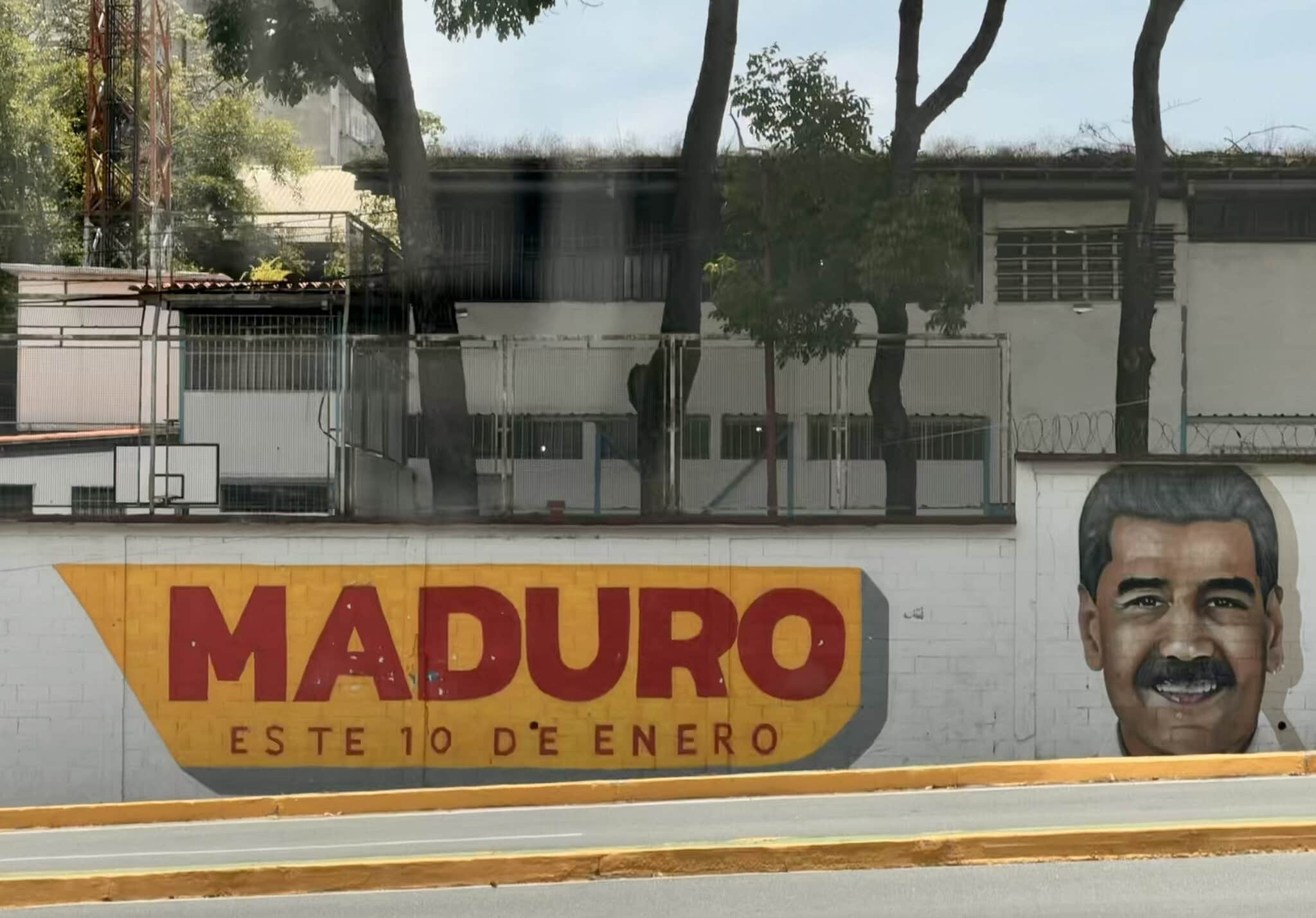
The Venezuela in my head before I went was built from headlines and warnings and friends who loved the country and were afraid for it. None of that disappeared on the trip. Caracas is complicated. The political murals are impossible to miss. The country carries visible weight. And running alongside all of that: rivers that run golden-red through ancient jungle, tepuis that rise out of the mist like something from before human time, Pemon people who have called this place home for thousands of years, and a waterfall that refuses to be described adequately in any language. And the people I met were some of the warmest. The departing thoughts of my co-travelers to me were: “I have a home in Venezuela now, come again soon.”
My Venezuelan friend asked me afterward what I thought. I told him the truth: I should have gone sooner, and I understood now why he loves it.
Some places push you, humble you, and reward you in equal measure. Salto Ángel is one of them.
Last Updated on May 8, 2026 by Jyoti Baid